Dynamic arterial elastance for predicting mean arterial pressure response to fluid administration in hypotensive critically ill surgical patients: Prospective observational study
Eadyn for predicting MAP response in critically ill surgical patients
DOI:
https://doi.org/10.54205/ccc.v34.274897Keywords:
Dynamic arterial elastance, Mean arterial pressure, Hemodynamic monitoring, Fluid responsiveness, Postoperative hypotensionAbstract
Background: Postoperative hypotension frequently occurs in high-risk surgical patients and is associated with elevated risks of adverse cardiovascular outcomes. Dynamic arterial elastance (Eadyn), calculated as the ratio of pulse pressure variation (PPV) to stroke volume variation (SVV), has been proposed as a functional parameter to guide fluid resuscitation by reflecting arterial load.
Method: This prospective observational study was conducted in a single tertiary care center and enrolled postoperative patients who developed hypotension requiring fluid resuscitation. Hemodynamic variables were measured immediately before and after fluid administration. PPV was recorded through an invasive arterial catheter, while SVV was assessed using an internally calibrated pulse contour analysis device. The primary objective was to determine Eadyn’s predictive performance in predicting mean arterial pressure (MAP) responsiveness following fluid loading. Secondary analyses compared Eadyn’s predictive performance with systemic vascular resistance (SVR) and the diastolic shock index (DSI).
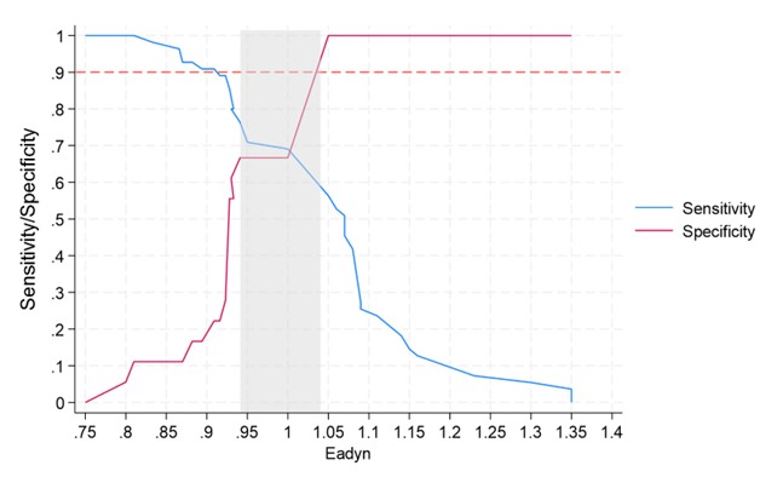
Result: Fifty-one patients were included, and 73 hypotensive interventions were analyzed, of which 55 were classified as MAP responders. An Eadyn threshold of ≥ 1.02 yielded an area under the receiver operating characteristic curve (AUC) of 0.802 (95% CI, 0.703-0.901), with a sensitivity of 56.4% and a specificity of 100%. In contrast, SVR and DSI demonstrated poor discriminatory ability, with AUCs of 0.548 and 0.565, respectively. Eadyn significantly outperformed both indices (p = 0.003).
Conclusion: Eadyn is demonstrated as a potential reliable hemodynamic index for predicting MAP responsiveness following fluid administration in mechanically ventilated postoperative patients with fluid-responsive hypotension.
Trial registration: TCTR20240330001
Downloads
References
Khanna AK, Shaw AD, Stapelfeldt WH, Boero IJ, Chen Q, Stevens M, et al. Postoperative hypotension and adverse clinical outcomes in patients without intraoperative hypotension, after noncardiac surgery. Anesth Analg. 2021;132:1410–20.
Hoppe P, Kouz K, Saugel B. Perioperative hypotension: clinical impact, diagnosis, and therapeutic approaches. Journal of Emergency and Critical Care Medicine. 2019;4.
Bain C, Myles PS, Corcoran T, Dieleman JM. Postoperative systemic inflammatory dysregulation and corticosteroids: a narrative review. Anaesthesia. 2022;78(3):356-70.
Zhou X, Pan W, Chen B, Xu Z, Pan J. Predictive performance of dynamic arterial elastance for arterial pressure response to fluid expansion in mechanically ventilated hypotensive adults: a systematic review and meta-analysis of observational studies. Annals of intensive care. 2021;11(1):119.
Monge García MI, Gil Cano A, Gracia Romero M. Dynamic arterial elastance to predict arterial pressure response to volume loading in preload-dependent patients. Crit Care. 2011;15:R15.
Monge García MI, Santos A. Understanding ventriculo-arterial coupling. Ann Transl Med. 2020;8:795.
Asleh R, Resar JR. Utilization of percutaneous mechanical circulatory support devices in cardiogenic shock complicating acute myocardial infarction and high-risk percutaneous coronary interventions. J Clin Med. 2019;8.
Monge García MI, Guijo González P, Gracia Romero M, Gil Cano A, Rhodes A, Grounds RM, et al. Effects of arterial load variations on dynamic arterial elastance: an experimental study. Br J Anaesth. 2017;118(6):938–46.
Bar S, Leviel F, Abou Arab O, Badoux L, Mahjoub Y, Dupont H, et al. Dynamic arterial elastance measured by uncalibrated pulse contour analysis predicts arterial-pressure response to a decrease in norepinephrine. Br J Anaesth. 2018;121:534-40.
Seo H, Kong YG, Jin SJ, Chin JH, Kim HY, Lee YK, et al. Dynamic arterial elastance in predicting arterial pressure increase after fluid challenge during robot-assisted laparoscopic prostatectomy: a prospective observational study. Medicine. 2015; 94(41):e1794.
Ospina-Tascón GA, Teboul J-L, Hernandez G, Alvarez I, Sánchez-Ortiz AI, Calderón-Tapia LE, et al. Diastolic shock index and clinical outcomes in patients with septic shock. Annals of Intensive Care. 2020;10:41.
Hernández G, Ospina-Tascón GA, Damiani LP, Estenssoro E, Dubin A, Hurtado J, et al. Effect of a resuscitation strategy targeting peripheral perfusion status vs serum lactate levels on 28-Day mortality among patients with septic shock: the ANDROMEDA-SHOCK randomized clinical trial. JAMA. 2019;321:654-64.
Halvorsen S, Mehilli J, Cassese S, Hall TS, Abdelhamid M, Barbato E, et al. 2022 ESC Guidelines on cardiovascular assessment and management of patients undergoing non-cardiac surgery. Eur Heart J. 2022;43:3826-924.
Monnet X, Marik PE, Teboul JL. Prediction of fluid responsiveness: an update. Annals of intensive care. 2016;6(1):111.
Shoukri MM, Asyali MH, Donner A. Sample size requirements for the design of reliability study: review and new results. Stat Methods Med Res. 2004;13:1-21.
Donner A, Eliasziw M. A goodness-of-fit approach to inference procedures for the kappa statistic: Confidence interval construction, significance-testing and sample size estimation. Stat Med. 1992;11:1511-9.
Biais M, Ehrmann S, Mari A, Conte B, Mahjoub Y, Desebbe O, et al. Clinical relevance of pulse pressure variations for predicting fluid responsiveness in mechanically ventilated intensive care unit patients: the grey zone approach. Crit Care. 2014;18:587.
García MIM, Romero MG, Cano AG, Aya HD, Rhodes A, Grounds RM, et al. Dynamic arterial elastance as a predictor of arterial pressure response to fluid administration: a validation study. Critical Care. 2014;18:626.
Cannesson M. The "grey zone" or how to avoid the binary constraint of decision-making. Can J Anaesth. 2015;62:1139-42.
Ospina-Tascón GA, Hernández G, Bakker J. Diastolic shock index (DSI) works… and it could be a quite useful tool. Annals of Intensive Care. 2020;10:109.
Fischer A, Menger J, Mouhieddine M, Seidel M, Edlinger-Stanger M, Bevilacqua M, et al. Stroke volume and arterial pressure fluid responsiveness in patients with elevated stroke volume variation undergoing major vascular surgery: a prospective intervention study. J Cardiothorac Vasc Anesth. 2023;37:407-14.
Russo A, Aceto P, Cascarano L, Menga LS, Romanò B, Carelli S, et al. A dynamic elastance-based protocol to guide intra-operative fluid management in major abdominal surgery: A randomised clinical trial. Eur J Anaesthesiol. 2025;42:727-36.
García MI, Romero MG, Cano AG, Aya HD, Rhodes A, Grounds RM, et al. Dynamic arterial elastance as a predictor of arterial pressure response to fluid administration: a validation study. Crit Care. 2014;18:626.
Abstracts of the ICARE 2023 77th SIAARTI National Congress. Journal of Anesthesia, Analgesia and Critical Care. 2023;3:43.
Downloads
Published
How to Cite
Issue
Section
License
Copyright (c) 2026 The Thai Society of Critical Care Medicine

This work is licensed under a Creative Commons Attribution-NonCommercial 4.0 International License.