Fentanyl-induced chest wall rigidity in critically ill patients: A report of two cases
Fentanyl-induced chest wall rigidity in the ICU
DOI:
https://doi.org/10.54205/ccc.v34.281424Keywords:
Fentanyl, Chest wall rigidity, Wooden chest syndrome, Intensive care unit, Mechanical ventilation, Patient-ventilator dyssynchronyAbstract
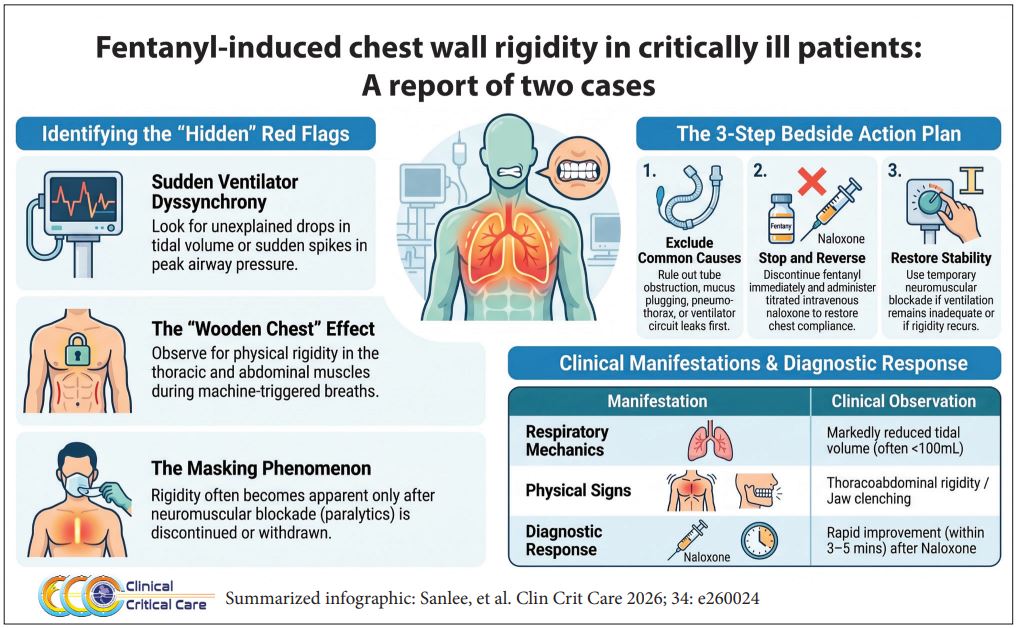
Background: Fentanyl is widely used for analgesia and sedation in critically ill patients. Fentanyl-induced chest wall rigidity, also called wooden chest syndrome, is an uncommon but potentially life-threatening adverse effect that can markedly impair ventilation. Most reports involve pediatric or peri-anesthetic settings, whereas adult intensive care unit (ICU) presentations remain underrecognized.
Case presentation: We describe two adults in whom fentanyl-induced chest wall rigidity was considered during mechanical ventilation. A 76-year-old man with severe chronic obstructive pulmonary disease and end-stage kidney disease developed abrupt patient-ventilator dyssynchrony and markedly reduced delivered tidal volumes after several days of fentanyl infusion, when neuromuscular blockade was withdrawn. No alternative mechanical or pulmonary cause was identified at the bedside. Ventilation improved after fentanyl discontinuation and naloxone administration. A 75-year-old man with myelodysplastic syndrome and cirrhosis developed similar dyssynchrony after cisatracurium discontinuation while receiving fentanyl. Respiratory mechanics improved after fentanyl was stopped and neuromuscular blockade was resumed.
Conclusion: In mechanically ventilated patients receiving fentanyl, otherwise unexplained patient-ventilator dyssynchrony, elevated airway pressure, or a sudden reduction in delivered tidal volume should prompt consideration of fentanyl-induced chest wall rigidity. Immediate bedside assessment should exclude endotracheal tube or circuit problems, mucus plugging, pneumothorax, and bronchospasm. Prompt fentanyl discontinuation, titrated naloxone, and temporary neuromuscular blockade when ventilation remains inadequate may rapidly restore effective ventilation.
Downloads
References
Scamman FL. Fentanyl-O2-N2O rigidity and pulmonary compliance. Anesth Analg. 1983;62(3):332-334.
Viscomi CM, Bailey PL. Opioid-induced rigidity after intravenous fentanyl. Obstet Gynecol. 1997;89(5 Pt 2):822-824. doi:10.1016/S0029-7844(97)81423-8.
Çoruh B, Tonelli MR, Park DR. Fentanyl-induced chest wall rigidity. Chest. 2013;143(4):1145-1146. doi:10.1378/chest.12-2131.
Dimitriou V, Zogogiannis I, Liotiri D, Wambi F, Tawfeeq N, Koumi A, et al. Impossible mask ventilation after an unusually low dose fentanyl-induced muscle rigidity in a patient with essential tremor: a case report and review of the literature. Middle East J Anaesthesiology. 2014;22(6):619-622.
Vankova ME, Weinger MB, Chen DY, Bronson JB, Motis V, Koob GF. Role of central mu, delta-1, and kappa-1 opioid receptors in opioid-induced muscle rigidity in the rat. Anesthesiology. 1996;85(3):574-583. doi:10.1097/00000542-199609000-00017.
Lui PW, Lee TY, Chan SH. Involvement of coerulospinal noradrenergic pathway in fentanyl-induced muscular rigidity in rats. Neurosci Lett. 1990;108(1-2):183-188.
Ham SY, Lee BR, Ha T, Kim J, Na S. Recurrent desaturation events due to opioid-induced chest wall rigidity after low dose fentanyl administration. Acute Crit Care. 2016; 31(2) :118-122. doi:10.4266/kjccm.2016.31.2.118.
McGreevy JL, Piraino ST, Sandhu G. Fentanyl-associated serotonin syndrome and chest wall rigidity in an intensive care unit patient. Am J Ther. 2019;26(5):e612-e614. doi:10.1097/MJT.0000000000000813.
Ming PW, Singh DL. Fentanyl-induced chest wall rigidity as a cause of acute respiratory failure in the intensive care unit. J Med Cases. 2019;10(8):249-252. doi:10.14740/jmc3351.
Rosal NR, Thelmo FL Jr, Tzarnas S, DiCalvo L, Tariq S, Grossman C. Wooden chest syndrome: a case report of fentanyl-induced chest wall rigidity. J Investig Med High Impact Case Rep. 2021;9:23247096211034036. doi:10.1177/23247096211034036.
Tammen AJ, Brescia D, Jonas D, Hodges JL, Keith P. Fentanyl-induced rigid chest syndrome in critically ill patients. J Intensive Care Med. 2023;38(2):196-201. doi:10.1177/08850666221115635.
Zoorob R, Uptegrove L, Park BL. Case report of very-low-dose fentanyl causing fentanyl-induced chest wall rigidity. Cureus. 2023;15(8):e43788. doi:10.7759/cureus.43788.
McElrath C, Chew I, Lam T. The diagnosis of fentanyl-induced chest wall rigidity: a case report. Pain Med Case Rep. 2024;8(6):209-211.
Devarashetty S, Arty F, Vangala A, Abu Shanab A, Du D. The silent threat of wooden chest syndrome: prompt management of fentanyl-induced muscle rigidity in the intensive care unit. Eur J Case Rep Intern Med. 2025;12(8):005363. doi: 10.12890/2025_005163.
Downloads
Published
How to Cite
Issue
Section
License
Copyright (c) 2026 The Thai Society of Critical Care Medicine

This work is licensed under a Creative Commons Attribution-NonCommercial 4.0 International License.