A study protocol of the additional human albumin during resuscitation in patients with surgical septic shock: A randomized controlled trial (the ALBumin Use in Surgical septic shock, ALBUS study)
Human albumin resuscitation in surgical septic shock
DOI:
https://doi.org/10.54205/ccc.v34.282660Keywords:
Surgical septic shock, Human albumin, Fluid resuscitation, Mortality, Randomized controlled trialAbstract
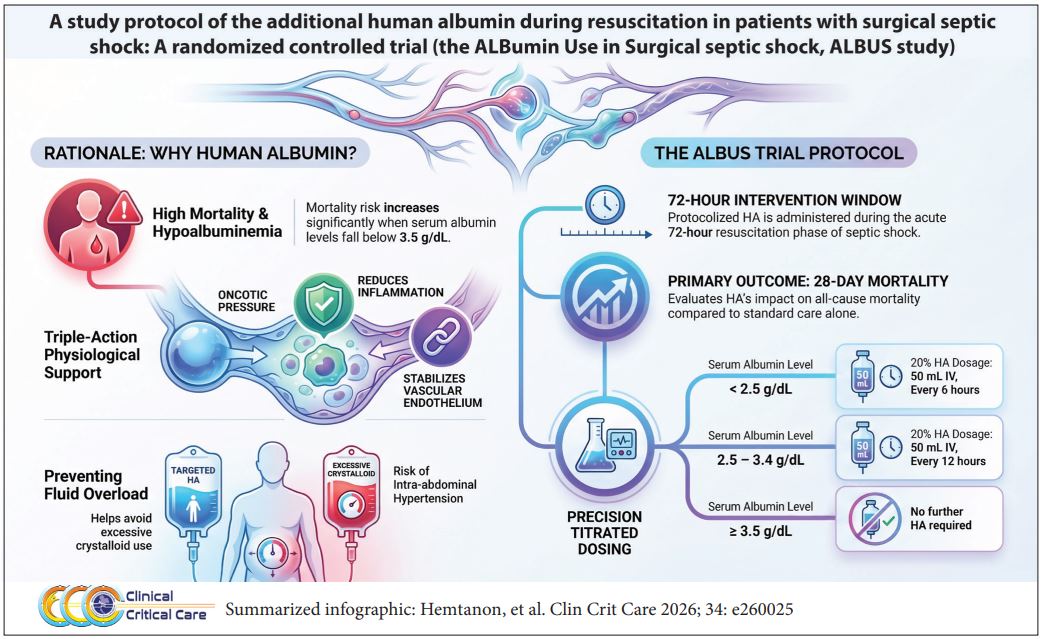
Background: Surgical septic shock has a high mortality rate, which increases further in patients with low serum albumin levels. Current guidelines recommend crystalloids for initial fluid resuscitation, but excessive fluid administration can lead to complications such as volume overload and intra-abdominal hypertension. Human albumin solution (HA) may have benefits due to its oncotic properties, anti-inflammatory effects, and stabilization of the vascular endothelium. The latter may result in reduced mortality and improve clinical outcomes compared to standard care.
Methods: This single-center, open-labeled, randomized controlled trial is conducted in surgical intensive care units (ICU) at Siriraj Hospital, Bangkok, Thailand. The patients admitted with confirmed or suspected surgical infection within 48 hours and fulfilling Sepsis-3 criteria for septic shock are enrolled. Patients are randomized at 1:1 to receive either protocolized 20% HA as an adjunct to standard care or standard care alone. The intervention is administered for 72 hours. The primary outcome is 28-day all-cause mortality. Secondary outcomes are hospital length of stay (LOS), ICU LOS, days alive and free of vasopressors and mechanical ventilation, cumulative 7-day fluid balance, rate of acute kidney injury requiring renal replacement therapy, and gastrointestinal function recovery. A total of 304 patients (152 per group), accounting for an estimated 10% dropout rate, is required. Analysis follows intention-to-treat principles.
Hypothesis: We hypothesized that adding 20% HA to standard care would improve clinical outcomes compared with standard care alone.
Conclusions: The ALBUS trial is the randomized controlled trial designed specifically to evaluate the addition of 20% HA to standard care during resuscitation in surgical septic shock. We aim to provide evidence to support the use of HA as an adjunctive resuscitation in reducing 28-day mortality and improving clinical outcomes in the surgical population.
Ethics and dissemination: This trial received approval from the Siriraj Institutional Review Board.
Trial registration: NCT07212582
Downloads
References
Alberti C, Brun-Buisson C, Burchardi H, Martin C, Goodman S, Artigas A, et al. Epidemiology of sepsis and infection in ICU patients from an international multicentre cohort study. Intensive Care Med. 2002;28:108-21. doi:10.1007/s00134-001-1143-z.
Barie PS, Hydo LJ, Eachempati SR. Longitudinal outcomes of intra-abdominal infection complicated by critical illness. Surg Infect (Larchmt). 2004;5:365-73. doi:10.1089/sur.2004.5.365.
The outcome of patients with sepsis and septic shock presenting to emergency departments in Australia and New Zealand. Crit Care Resusc. 2007;9:8-18.
Vincent JL, Rello J, Marshall J, Silva E, Anzueto A, Martin CD, et al. International study of the prevalence and outcomes of infection in intensive care units. Jama. 2009;302:2323-9. doi:10.1001/jama.2009.1754.
Cox MC, Brakenridge SC, Stortz JA, Hawkins RB, Darden DB, Ghita GL, et al. Abdominal sepsis patients have a high incidence of chronic critical illness with dismal long-term outcomes. Am J Surg. 2020;220:1467-74. doi:10.1016/j.amjsurg.2020.07.016.
Vincent JL, Jones G, David S, Olariu E, Cadwell KK. Frequency and mortality of septic shock in Europe and North America: a systematic review and meta-analysis. Crit Care. 2019;23:196. doi:10.1186/s13054-019-2478-6.
Shi Y, Tao T, Ye X, Ye B, Mi W, Lou J. Risk factors for in-hospital mortality in surgical patients with abdominal sepsis in China: a nested case-control study. BMJ Open. 2025;15:e092310. doi:10.1136/bmjopen-2024-092310.
Mohamed Younis KA-H, Abdel-Raziq GMI, Hussien ABM. Risk Factors and Outcome of Intra-abdominal Sepsis in Critically Ill Patients in Emergency Intensive Care Unit. Zagazig University Medical Journal. 2024;30:3983-91. doi:10.21608/zumj.2024.270269.3174.
Jung RG, Gupta A, Stotts C, McNeely C, Mihic A, Hanycz S, et al. Prognostic factors associated with mortality in septic shock: a systematic review and meta-analysis. Lancet Respir Med. 2026;14:225-32. doi:10.1016/s2213-2600(25)00397-2.
Evans L, Rhodes A, Alhazzani W, Antonelli M, Coopersmith CM, French C, et al. Surviving sepsis campaign: international guidelines for management of sepsis and septic shock 2021. Intensive Care Med. 2021;47:1181-247. doi:10.1007/s00134-021-06506-y.
Serpytis M, Ivaskevicius J. The influence of fluid balance on intra-abdominal pressure after major abdominal surgery. Medicina (Kaunas). 2008;44:421-7.
Sartelli M, Barie P, Agnoletti V, Al-Hasan MN, Ansaloni L, Biffl W, et al. Intra-abdominal infections survival guide: a position statement by the Global Alliance For Infections In Surgery. World J Emerg Surg. 2024;19:22. doi:10.1186/s13017-024-00552-9.
Dalfino L, Tullo L, Donadio I, Malcangi V, Brienza N. Intra-abdominal hypertension and acute renal failure in critically ill patients. Intensive Care Med. 2008;34:707-13. doi:10.1007/s00134-007-0969-4.
Reintam Blaser A, Regli A, De Keulenaer B, Kimball EJ, Starkopf L, Davis WA, et al. Incidence, Risk Factors, and Outcomes of Intra-Abdominal Hypertension in Critically Ill Patients-A Prospective Multicenter Study (IROI Study). Crit Care Med. 2019;47:535-42. doi:10.1097/ccm.0000000000003623.
Goldwasser P, Feldman J. Association of serum albumin and mortality risk. J Clin Epidemiol. 1997;50:693-703. doi:10.1016/s0895-4356(97)00015-2.
Vincent JL, Dubois MJ, Navickis RJ, Wilkes MM. Hypoalbuminemia in acute illness: is there a rationale for intervention? A meta-analysis of cohort studies and controlled trials. Ann Surg. 2003;237:319-34. doi:10.1097/01.Sla.0000055547.93484.87.
Sun JK, Sun F, Wang X, Yuan ST, Zheng SY, Mu XW. Risk factors and prognosis of hypoalbuminemia in surgical septic patients. PeerJ. 2015;3:e1267. doi:10.7717/peerj.1267.
Akirov A, Masri-Iraqi H, Atamna A, Shimon I. Low Albumin Levels Are Associated with Mortality Risk in Hospitalized Patients. Am J Med. 2017;130:1465.e11-.e19. doi:10.1016/j.amjmed.2017.07.020.
Kim SM, Ryoo SM, Shin TG, Jo YH, Kim K, Lim TH, et al. Early Mortality Stratification with Serum Albumin and the Sequential Organ Failure Assessment Score at Emergency Department Admission in Septic Shock Patients. Life (Basel). 2024;14. doi:10.3390/life14101257.
Evans TW. Review article: albumin as a drug--biological effects of albumin unrelated to oncotic pressure. Aliment Pharmacol Ther. 2002;16 Suppl 5:6-11. doi:10.1046/j.1365-2036.16.s5.2.x.
Ferrer R, Mateu X, Maseda E, Yébenes JC, Aldecoa C, De Haro C, et al. Non-oncotic properties of albumin. A multidisciplinary vision about the implications for critically ill patients. Expert Rev Clin Pharmacol. 2018;11:125-37. doi:10.1080/17512433.2018.1412827.
Moman RN, Gupta N, Varacallo MA. Physiology, Albumin. StatPearls. Treasure Island (FL): StatPearls Publishing
Copyright © 2025, StatPearls Publishing LLC.; 2025.
Annane D, Siami S, Jaber S, Martin C, Elatrous S, Declère AD, et al. Effects of fluid resuscitation with colloids vs crystalloids on mortality in critically ill patients presenting with hypovolemic shock: the CRISTAL randomized trial. Jama. 2013;310:1809-17. doi:10.1001/jama.2013.280502.
Wigmore GJ, Anstey JR, St John A, Greaney J, Morales-Codina M, Presneill JJ, et al. 20% Human Albumin Solution Fluid Bolus Administration Therapy in Patients After Cardiac Surgery (the HAS FLAIR Study). J Cardiothorac Vasc Anesth. 2019;33:2920-7. doi:10.1053/j.jvca.2019.03.049.
Gabarre P, Desnos C, Morin A, Missri L, Urbina T, Bonny V, et al. Albumin versus saline infusion for sepsis-related peripheral tissue hypoperfusion: a proof-of-concept prospective study. Critical Care. 2024;28:43. doi:10.1186/s13054-024-04827-0.
Finfer S, Bellomo R, Boyce N, French J, Myburgh J, Norton R. A comparison of albumin and saline for fluid resuscitation in the intensive care unit. N Engl J Med. 2004;350:2247-56. doi:10.1056/NEJMoa040232.
Caironi P, Tognoni G, Masson S, Fumagalli R, Pesenti A, Romero M, et al. Albumin Replacement in Patients with Severe Sepsis or Septic Shock. New England Journal of Medicine. 2014;370:1412-21. doi:doi:10.1056/NEJMoa1305727.
Guidet B, Mosqueda GJ, Priol G, Aegerter P. The COASST study: cost-effectiveness of albumin in severe sepsis and septic shock. J Crit Care. 2007;22:197-203. doi:10.1016/j.jcrc.2006.11.005.
Guidet B, Ghout I, Ropers J, Aegerter P. Economic model of albumin infusion in septic shock: The EMAISS study. Acta Anaesthesiol Scand. 2020;64:781-8. doi:10.1111/aas.13559.
Chan A-W, Boutron I, Hopewell S, Moher D, Schulz KF, Collins GS, et al. SPIRIT 2025 statement: updated guideline for protocols of randomised trials. BMJ. 2025;389:e081477. doi:10.1136/bmj-2024-081477.
Singer M, Deutschman CS, Seymour CW, Shankar-Hari M, Annane D, Bauer M, et al. The Third International Consensus Definitions for Sepsis and Septic Shock (Sepsis-3). Jama. 2016;315:801-10. doi:10.1001/jama.2016.0287.
Paul A. Harris RT, Robert Thielke, Jonathon Payne, Nathaniel Gonzalez, Jose G. Conde, , . Apr;42(2):377-81. Research electronic data capture (REDCap) - A metadata-driven methodology and workflow process for providing translational research informatics support. J Biomed Inform. 2009
Shadvar K, Nader-Djalal N, Vahed N, Sanaie S, Iranpour A, Mahmoodpoor A, et al. Comparison of lactate/albumin ratio to lactate and lactate clearance for predicting outcomes in patients with septic shock admitted to intensive care unit: an observational study. Sci Rep. 2022;12:13047. doi:10.1038/s41598-022-14764-z.
Ali MA, Raza MT, Majeed S, Tahir U, Ahmad W, Tahir MB, et al. Correlation of Serum Albumin Levels With the Severity of Sepsis Among Intensive Care Unit Patients. Cureus. 2024;16:e71411. doi:10.7759/cureus.71411.
Gibbs J, Cull W, Henderson W, Daley J, Hur K, Khuri SF. Preoperative serum albumin level as a predictor of operative mortality and morbidity: Results from the national VA surgical risk study. Archives of Surgery. 1999;134:36-42. doi:10.1001/archsurg.134.1.36.
Sakr Y, Nierhaus A, Schumacher U, Utzolino S, Jaschinski U, Petros S, et al. Albumin replacement therapy in septic shock: a randomized clinical trial. JAMA Network Open. 2026;9:e2559297-e. doi:10.1001/jamanetworkopen.2025.59297.
Malbrain MLNG, Nasa P, De laet I, De Waele J, Jacobs R, Wise R, et al. Fluid Management in Intra-abdominal Hypertension. In: Malbrain MLNG, Wong A, Nasa P, Ghosh S, editors. Rational use of intravenous fluids in critically ill patients. Cham: Springer International Publishing; 2024. p 427-57.
Malbrain M, Langer T, Annane D, Gattinoni L, Elbers P, Hahn RG, et al. Intravenous fluid therapy in the perioperative and critical care setting: Executive summary of the International Fluid Academy (IFA). Ann Intensive Care. 2020;10:64. doi:10.1186/s13613-020-00679-3.
Deslarzes P, Jurt J, Larson DW, Blanc C, Hübner M, Grass F. Perioperative fluid management in colorectal surgery: institutional approach to standardized practice. J Clin Med. 2024;13. doi:10.3390/jcm13030801.
Kannan V, Ullah N, Geddada S, Ibrahiam A, Munaf Shakir Al-Qassab Z, Ahmed O, et al. Impact of "Enhanced Recovery After Surgery" (ERAS) protocols vs. traditional perioperative care on patient outcomes after colorectal surgery: a systematic review. Patient Saf Surg. 2025;19:4. doi:10.1186/s13037-024-00425-9.
Downloads
Published
How to Cite
Issue
Section
License
Copyright (c) 2026 The Thai Society of Critical Care Medicine

This work is licensed under a Creative Commons Attribution-NonCommercial 4.0 International License.