ภาวะโภชนาการของผู้ป่วยวิกฤตอายุรกรรมที่ใช้เครื่องช่วยหายใจในโรงพยาบาลมหาราชนครเชียงใหม่
ภาวะโภชนาการของผู้ป่วยวิกฤตอายุรกรรมที่ใช้เครื่องช่วยหายใจ
DOI:
https://doi.org/10.54205/ccc.v34.279855คำสำคัญ:
ผู้ป่วยวิกฤตอายุรกรรม, ภาวะทุพโภชนาการ, เครื่องช่วยหายใจ, NT 2013, ความชุก, ปัจจัยเสี่ยงบทคัดย่อ
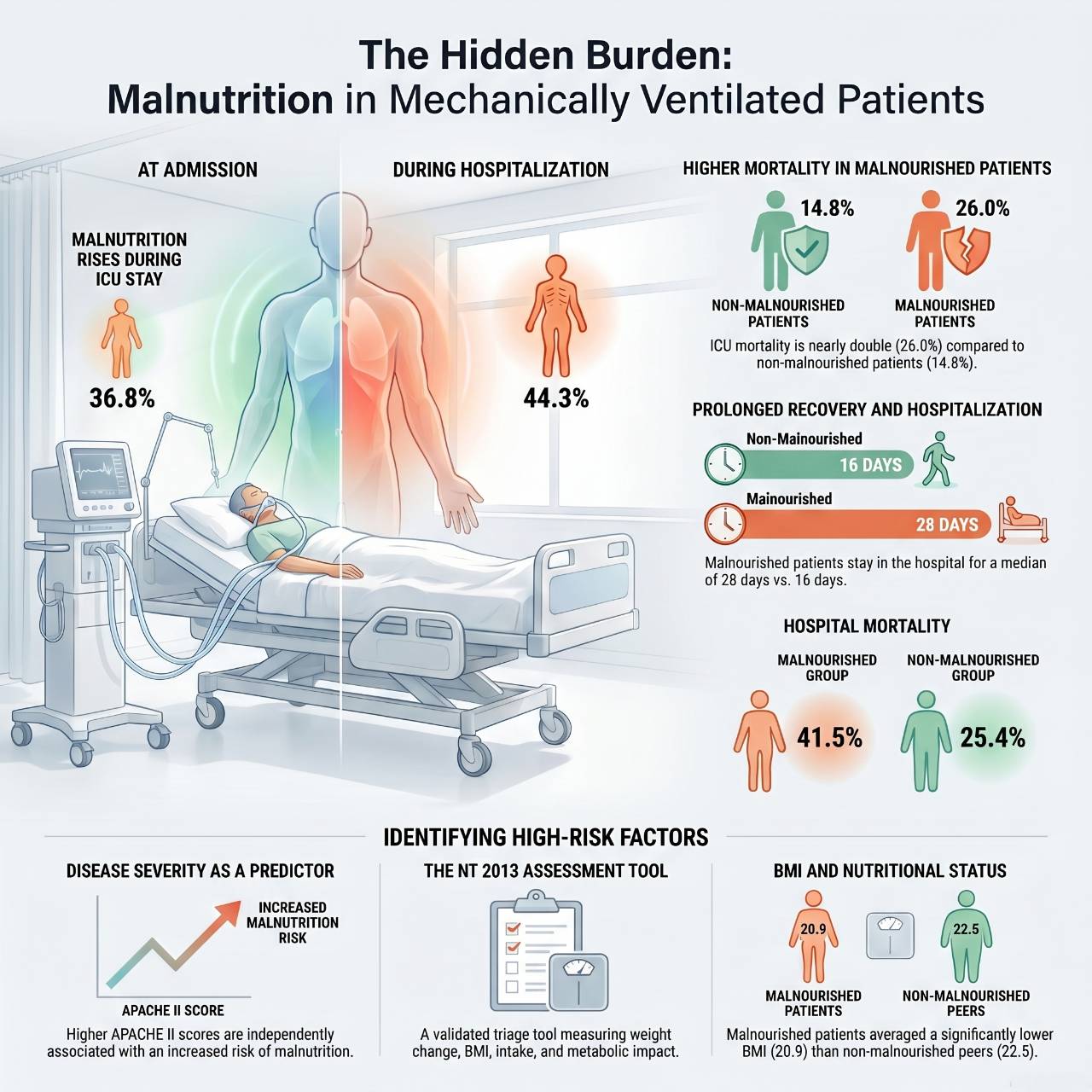
ภาวะทุพโภชนาการเป็นภาวะแทรกซ้อนที่พบบ่อยในผู้ป่วยวิกฤตโดยเฉพาะผู้ที่ใช้เครื่องช่วยหายใจ ซึ่งมีผลกระทบต่อระบบต่าง ๆ ของร่างกาย รวมถึงเพิ่มอัตราการเสียชีวิต ระยะเวลานอนโรงพยาบาล และค่าใช้จ่ายในการรักษา การประเมินภาวะโภชนาการอย่างเหมาะสมตั้งแต่แรกรับและระหว่างการรักษาในหอผู้ป่วยวิกฤตจึงมีความสำคัญอย่างยิ่ง วัตถุประสงค์ของการวิจัยครั้งนี้เพื่อศึกษาความชุกและปัจจัยที่สัมพันธ์กับการเกิดภาวะทุพโภชนาการในผู้ป่วยวิกฤตอายุรกรรมที่ใช้เครื่องช่วยหายใจ โดยรูปแบบการศึกษาเป็นการวิจัยเชิงสังเกตแบบย้อนหลัง (retrospective observational study) ดำเนินการเก็บข้อมูลจากผู้ป่วยวิกฤตอายุรกรรมที่ใช้เครื่องช่วยหายใจ จำนวน 334 ราย ทำการประเมินภาวะโภชนาการด้วยแบบประเมินแบบประเมินภาวะโภชนาการ Nutrition Triage 2013 วิเคราะห์ข้อมูลโดยใช้ สถิติเชิงพรรณนา เพื่อสรุปลักษณะทั่วไปของผู้ป่วย และเปรียบเทียบความแตกต่างระหว่างกลุ่มผู้ป่วยที่มีภาวะโภชนาการปกติและทุพโภชนาการด้วย Chi-square, Fisher’s exact test, t-test หรือ Mann–Whitney U test ตามความเหมาะสม จากนั้นใช้ ถดถอยโลจิสติกพหุตัวแปร เพื่อประเมินความสัมพันธ์ระหว่างปัจจัยเสี่ยงกับภาวะทุพโภชนาการ ผลการศึกษาพบว่าความชุกของภาวะทุพโภชนาการอยู่ที่ 36.8% (95% CI: 31.7–42.0) เมื่อแรกรับ และ 44.3% (95% CI: 35.5–53.1) ระหว่างนอนในหอผู้ป่วยวิกฤต ผู้ป่วยที่มีภาวะทุพโภชนาการมีค่า BMI ต่ำกว่าและคะแนน Acute Physiology and Chronic Health Evaluation II , Simplified Acute Physiology Score II, Sequential Organ Failure Assessment สูงกว่าอย่างมีนัยสำคัญ ภาวะทุพโภชนาการสัมพันธ์กับอัตราการเสียชีวิตในหอผู้ป่วยวิกฤตและโรงพยาบาล ระยะเวลาการใช้เครื่องช่วยหายใจ และระยะเวลานอนโรงพยาบาล ปัจจัยที่เกี่ยวข้อง ได้แก่ อายุและคะแนน APACHE II (Adjusted OR = 1.07, 95% CI: 1.01–1.14, p = 0.018) ภาวะทุพโภชนาการพบได้บ่อยและสัมพันธ์กับผลลัพธ์ไม่พึงประสงค์ จึงควรประเมินและติดตามภาวะโภชนาการอย่างต่อเนื่องเพื่อวางแผนโภชนบำบัดที่เหมาะสมกับผู้ป่วยรายบุคคล
Downloads
เอกสารอ้างอิง
Muangin W, Akarawanasakun B, Phromrin M, Uangnakhon M, Mongkhonittivech N. Development of a nursing care model for critically-ill patients based on the FAST HUG concept in a Medical and Surgical Intensive Care Unit at Chiang Rai Prachanukroh Hospital. Nursing Journal CMU. 2021;48:308–23.
Manrique S, Ruiz-Botella M, Murillo N, Canelles S, Victoria ID, Samper MA, et al. Impact of mechanical power on ICU mortality in ventilated critically ill patients: a retrospective study with continuous real-life data. Eur J Med Res. 2024;29:491.
Oami T, Yamamoto A, Ishida S, Kondo K, Hata N, Oshima T. Critical care nutrition from a metabolic point of view: A narrative review. Nutrients. 2025;17.
Lew CCH, Wong GJY, Cheung KP, Chua AP, Chong MFF, Miller M. Association between malnutrition and 28-day mortality and intensive care length-of-stay in the critically ill: A prospective cohort study. Nutrients. 2018;10:10.
Benyapad P, Kongsaman P. Nutritional support in critically ill patients: the challenges of nurses role. Vajira Medical Journal : Journal of Urban Medicine. 2019;63:219–30.
Kulnitichai W. Nursing care for continuous monitoring of the malnutrition in critical patients. Thai Journal of Cardio-Thoracic Nursing. 2019;30:2–16.
Doganay M, Halil MG, Uyar M, Kocatakan P, Dikmeer A, Kelleci Cakir B, et al. Prevalence of malnutrition risk in hospitalized patients: a large nationwide study. Journal of Health, Population and Nutrition. 2025;44:137.
Kalaiselvan MS, Arunkumar AS, Renuka MK, Sivakumar RL. Nutritional adequacy in mechanically ventilated patient: are we doing enough? Indian J Crit Care Med. 2021;25:166–71.
Wełna M, Adamik B, Kübler A, Goździk W. The NUTRIC score as a tool to predict mortality and increased resource utilization in intensive care patients with sepsis. Nutrients. 2023;15:1648.
Majumdar A, Saraf S, Sahu C, Verma K, Vishwakarma P. Current perspectives on malnutrition and immunomodulators bridging nutritional deficiencies and immune health. Future Journal of Pharmaceutical Sciences. 2025;11.
Litchford MD, Dorner B, Posthauer ME. Malnutrition as a Precursor of Pressure Ulcers. Adv Wound Care (New Rochelle). 2014;3:54–63.
Osooli F, Abbas S, Farsaei S, Adibi P. Identifying critically ill patients at risk of malnutrition and underfeeding: a prospective study at an academic hospital. Adv Pharm Bull. 2019;9:314–20.
Verheul EAH, Dijkink S, Krijnen P, Hoogendoorn JM, Arbous S, Peters R, et al. Prevalence, incidence, and complications of malnutrition in severely injured patients. Eur J Trauma Emerg Surg. 2025;51:72.
Rezaeian M, Monfared-Parizi S, Mousavi Shirazifard Z, Sayadi A, Khodadadi H, Ghaseminasab-Parizi M. Evaluation of nutritional intake and malnutrition in critically ill patients and its relationship with 28-day death. Sci Rep. 2025;15:15677.
Díaz Chavarro BC, Romero-Saldaña M, Assis Reveiz JK, Molina-Recio G. Impact of nutritional screening on mortality and intensive care unit length of stay. Front Nutr. 2025;12:1474039.
Hospital MNCM. Nutrition Assessment Tool (NT 2013). Chiang Mai, Thailand, Maharaj Nakorn Chiang Mai Hospital. 2013.
Chittawatanarat K, Chaiwat O, Morakul S, Kongsayreepong S. Outcomes of nutrition status assessment by Bhumibol Nutrition Triage/Nutrition Triage (BNT/NT) in multicenter THAI-SICU study. J Med Assoc Thai. 2016;99 Suppl 6:S184–s92.
Komindrg S, Tangsermwong T, Janepanish P. Simplified malnutrition tool for Thai patients. Asia Pac J Clin Nutr. 2013;22:516–21.
Knaus WA, Draper EA, Wagner DP, Zimmerman JE. APACHE II: a severity of disease classification system. Crit Care Med. 1985;13:818–29.
Le Gall JR, Lemeshow S, Saulnier F. A new Simplified Acute Physiology Score (SAPS II) based on a European/North American multicenter study. Jama. 1993;270:2957–63.
Vincent JL, Moreno R, Takala J, Willatts S, De Mendonça A, Bruining H, et al. The SOFA (Sepsis-related Organ Failure Assessment) score to describe organ dysfunction/failure. On behalf of the Working Group on Sepsis-Related Problems of the European Society of Intensive Care Medicine. Intensive Care Med. 1996;22:707–10.
Prammanasudh B, Trakulhoon V. NT 2013: A Recommended nutrition screening and nutrition format for practical clinical use in hospitalized patients in Thailand. The Thai Journal of Surgery. 2019;40:107–16.
Heyland DK, Dhaliwal R, Jiang X, Day AG. Identifying critically ill patients who benefit the most from nutrition therapy: the development and initial validation of a novel risk assessment tool. Crit Care. 2011;15:R268.
Detsky AS, McLaughlin JR, Baker JP, Johnston N, Whittaker S, Mendelson RA, et al. What is subjective global assessment of nutritional status? JPEN J Parenter Enteral Nutr. 1987;11:8–13.
Gongmuang L, Bannaasan B, Kitsripisarn S. The effects of an educative supportive program on the nutrition self-care behavior and nutritional status among colorectal cancer patients receiving chemotherapy. Journal of The Royal Thai Army Nurses. 2022;23:361–70.
Burns N, Grove S. The practice of nursing research: Appraisal, synthesis and generation of evidence. 6th ed. Saunders Elsevier: St. Louis.; 2009.
Cronbach, L.J. Essentials of psychological testing. 5th ed. Harper & Row: New York; 1990.
Bursac Z, Gauss CH, Williams DK, Hosmer DW. Purposeful selection of variables in logistic regression. Source Code Biol Med. 2008;3:17.
Regression methods in biostatistics: Linear, logistic, survival, and repeated measures models. In: Regression methods in biostatistics: Linear, logistic, survival, and repeated measures models.: New York, NY, US, Springer Publishing Company. 2005, pp xv, 340–xv, .
Singer P, Blaser AR, Berger MM, Calder PC, Casaer M, Hiesmayr M, et al. ESPEN practical and partially revised guideline: Clinical nutrition in the intensive care unit. Clinical Nutrition. 2023;42:1671–89.
Silva-García J, García-Grimaldo A, Rodríguez-Moguel NC, Gómez-Rodriguez AL, Rios-Ayala MA, Hernández-Cardenas CM, et al. Malnutrition is associated with clinical outcomes in mechanically ventilated patients with pneumonia and other lung manifestations: A retrospective cohort study. Nutr Clin Pract. 2025;40:870–9.
Shah S, Ullah K, Bibi A, Ullah L, Khan BA, Ullah S, et al. Prevalence and severity of malnutrition among intensive care patients in a government tertiary care hospital in Swat: malnutrition in intensive care unit patients. NURSEARCHER (Journal of Nursing & Midwifery Sciences). 2025;5:55–60.
Compher C, Higashiguchi T, Yu J, Jensen GL. Does low body mass index predict the hospital mortality of adult western or asian patients? JPEN J Parenter Enteral Nutr. 2018;42:467–72.
Wang S, He Y, Yi J, Sha L. Risk factors for enteral feeding intolerance in critically ill patients: an updated systematic review and meta-analysis. BMC Gastroenterol. 2025;25:233.
Menchamo M, Debebe Z, Abebe Z. Nutritional status and clinical outcomes of adult intensive care unit (ICU) patients -- a systematic review and Meta-analysis; 2025.
Pontzer H, Yamada Y, Sagayama H, Ainslie PN, Andersen LF, Anderson LJ, et al. Daily energy expenditure through the human life course. Science. 2021;373:808–12.
ดาวน์โหลด
เผยแพร่แล้ว
รูปแบบการอ้างอิง
ฉบับ
ประเภทบทความ
สัญญาอนุญาต
ลิขสิทธิ์ (c) 2026 สมาคมเวชบำบัดวิกฤตแห่งประเทศไทย

อนุญาตภายใต้เงื่อนไข Creative Commons Attribution-NonCommercial 4.0 International License.