
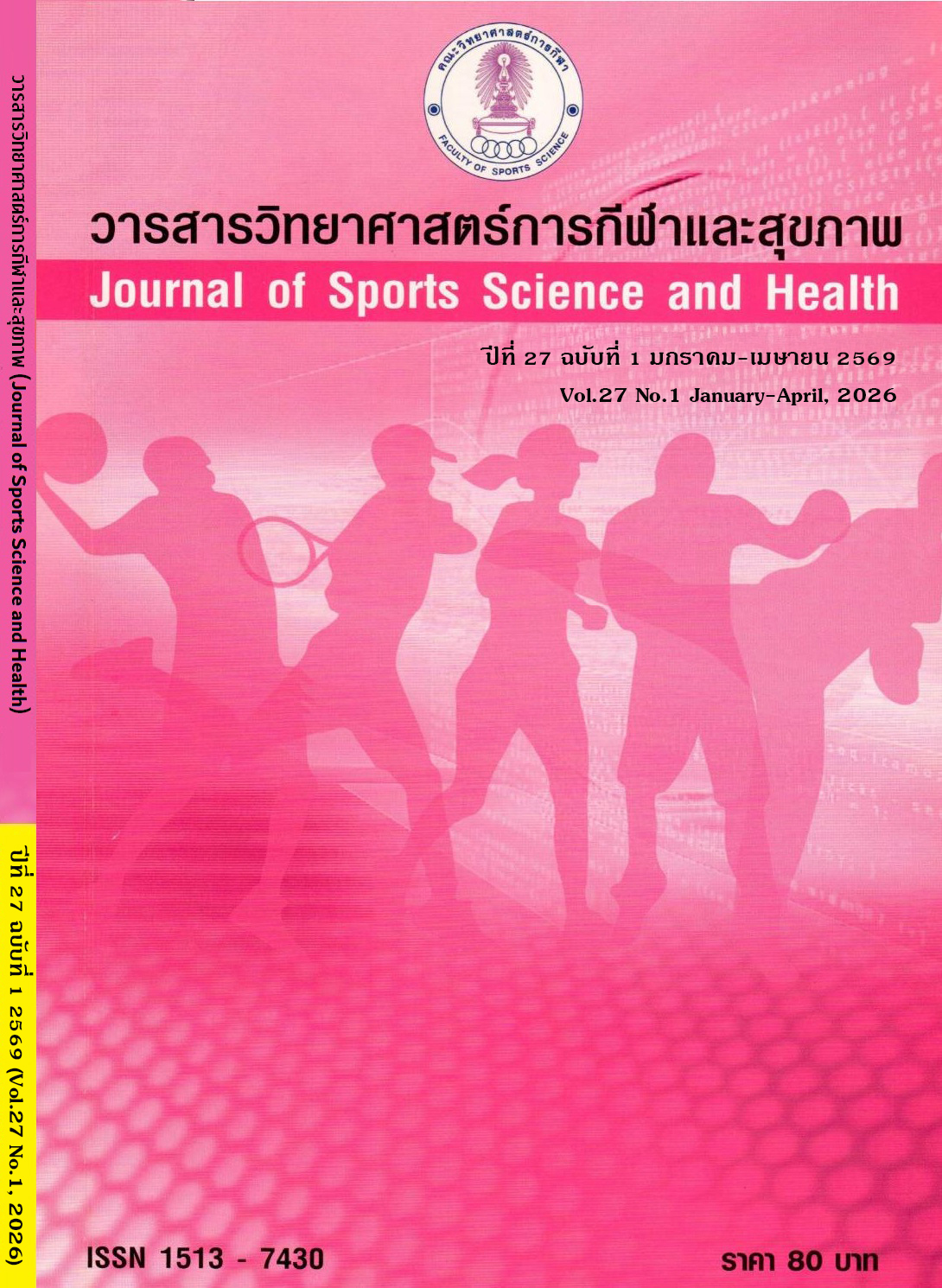
RECREATION FOR CHILDREN AND YOUTH IN THE DIGITAL ERA: TRANSITIONING FROM PHYSICAL TO VIRTUAL SPACES
Article Sidebar
Main Article Content
Abstract
In the digital era, where the real and virtual worlds no longer exist as separate entities but dynamically overlap, reinforce, and merge, Thai children and youth are experiencing a recreational transition that profoundly influences all dimensions of their holistic development. This article aims to 1) analyze the dynamic transition of recreational activities among Thai children and youth, 2) synthesize the impacts of this transition on holistic development, 3) explain and develop a Hybrid Recreation Framework that integrates the advantages of both the physical and digital worlds, and 4) propose policy and practical recommendations for developing recreation for Thai children and youth in the digital age. Drawing upon a synthesis of academic literature and emerging empirical evidence, the analysis reveals that digital-age recreation functions as a double-edged phenomenon, producing a distinct duality of impacts. On one hand, recreation promotes physical and mental well-being, strengthens life skills, digital literacy, and strategic thinking, opens new economic opportunities, preserves cultural capital, and fosters sustainable values. On the other hand, it presents potential risks stemming from sedentary lifestyles, technology addiction, erosion of deep social skills, digital inequality, and environmental pressures caused by carbon footprints and electronic waste. These findings highlight the necessity of establishing a policy-driven recreation system that harmonizes technology with human values, transforming recreation from a leisure activity into a strategic instrument for achieving balance across well-being, society, culture, and the environment, while empowering Thai youth to thrive amid the complex challenges of the twenty-first century.
Article Details

This work is licensed under a Creative Commons Attribution-NonCommercial-NoDerivatives 4.0 International License.
References
Arsapakdee, K., & Sriprom, S. (2024). The Importance of lifestyle physical activity for Thai school students. ACPES Journal of Physical Education, Sport, and Health (AJPESH), 4(2), 104-110. https://doi.org/10.15294/ajpesh.v4i2.2553
Asan, K., & Zwiegelaar, J. (2025). Digital leisure use and psychological well-being among recreation management students: The mediating role of social media engagement. Journal of Hospitality, Leisure, Sport & Tourism Education, 37(2025), 100570-100581. https://doi.org/10.1016/j.jhlste.2025.100570
Avci, H., Baams, L., & Kretschmer, T. (2025). A systematic review of social media use and adolescent identity development. Adolescent Research Review, 10(2), 219-236. https://doi.org/10.1007/s40894-024-00251-1
Balloufaud, M., Boujut, A., Marie, R., Guinaldo, A., Fourcade, L., Hamonet-Torny, J., & Perrochon, A. (2025). Augmented reality exergames for upcoming cognitive-motor rehabilitation: user-centered design approach and user experience of healthy children. JMIR Rehabilitation and Assistive Technologies, 12(1), e69205-e69220. https://doi.org/10.2196/69205
Buchan, M. C., Bhawra, J., & Katapally, T. R. (2024). Navigating the digital world: development of an evidence-based digital literacy program and assessment tool for youth. Smart Learning Environments, 11(1), 8-31. https://doi.org/10.1186/s40561-024-00293-x
Burnett, C., Dickinson, P., McDonagh, J., Merchant, G., Myers, J., & Wilkinson, J. (2003). From recreation to reflection: digital conversations in educational contexts. L1-Educational Studies in Language and Literature, 3(1), 149-167. https://doi.org/10.1023/A:1024540306179
Chen, T., Ou, J., Li, G., & Luo, H. (2024). Promoting mental health in children and adolescents through digital technology: a systematic review and meta-analysis. Frontiers in Psychology, 15, 1356554-1356566. https://doi.org/10.3389/fpsyg.2024.1356554
Clemente-Suárez, V. J., Beltrán-Velasco, A. I., Herrero-Roldán, S., Rodriguez-Besteiro, S., Martínez-Guardado, I., Martín-Rodríguez, A., & Tornero-Aguilera, J. F. (2024). Digital device usage and childhood cognitive development: Exploring effects on cognitive abilities. Children, 11(11), 1299-1325. https://doi.org/10.3390/children11111299
Craig, D., Trina, N. A., Monsur, M., Haque, U. T., Farrow, G., Hasan, M. Z., Tasnim, F., & Akinbobola, M. S. (2024). Effective nature-based outdoor play and learning environments for below-3 children: a literature-based summary. International Journal of Environmental Research and Public Health, 21(9), 1247-1268. https://doi.org/10.3390/ijerph21091247
Darmayadi, A., Ramahadi, B. T., Ariprabowo, D. R., Pandiangan, V. A., Mintiara, S. A., & Eksanti, E. (2025). Role of digital economy to economic development in Thailand. Proceeding of International Conference on Business, Economics, Social Sciences, and Humanities, 8(2025), 222-230. https://doi.org/10.34010/icobest.v8i.694
Effendi, H., Asepsujana, A., Fadlan, A. R., Batubara, R., Okilanda, A., & Syaputri, W. (2024). Improvement of physical fitness through electronic modules based on play activities. Retos, 58, 445-449. https://doi.org/10.47197/retos.v58.112522
Everri, M., & Heitmayer, M. (2024). Cyborg children: a systematic literature review on the experience of children using extended reality. Children, 11(8), 984-1000. https://doi.org/10.3390/children11080984
Hänninen, R., Korpela, V., & Pajula, L. (2025). The paradoxes and pragmatics of digital leisure in later life. Leisure Studies, 44(1), 65-78. https://doi.org/10.1080/02614367.2023.2271194
Heinrich, A. J., Heitmayer, M., Smith, E., & Zhang, Y. (2025). Experiencing hybrid spaces: a scoping literature review of empirical studies on human experiences in cyber-physical environments. Computers in Human Behavior, 164(2025), 108502-108516. https://doi.org/10.1016/j.chb.2024.108502
Howard, S. J., Hayes, N., Mallawaarachchi, S., Johnson, D., Neilsen-Hewett, C., Mackenzie, J., Bentley, L. A., & White, S. L. (2025). A meta-analysis of self-regulation and digital recreation from birth to adolescence. Computers in Human Behavior, 163(2025), 108472-108503. https://doi.org/10.1016/j.chb.2024.108472
Karaosmanoglu, S., Cmentowski, S., Nacke, L. E., & Steinicke, F. (2024). Born to run, programmed to play: mapping the extended reality exergames landscape. Proceedings of the 2024 CHI Conference on Human Factors in Computing Systems, 309, 1-28. https://doi.org/10.1145/3613904.3642124
KC, D., KC, P., Rado, I., & Vichit-Vadakan, N. (2025). Digital inequality and learning outcomes: evidence from Thailand. Education and Information Technologies, 30(2025), 19677-19702. https://doi.org/10.1007/s10639-025-13570-0
Kim, Y., Dhammasaccakarn, W., Laeheem, K., & Rinthaisong, I. (2024). The impact of family functioning factors on smartphone addiction and phubbing among Muslim adolescents in Thailand. Children, 11(5), 522-536. https://doi.org/10.3390/children11050522
Komonmarn, C. (2024). Understandings of childhood and youth and experiences of child and youth participation in Thailand's policy and programme development [Doctoral dissertation]. University of York.
Kou, R., Zhang, Z., Zhu, F., Tang, Y., & Li, Z. (2024). Effects of exergaming on executive function and motor ability in children: A systematic review and meta-analysis. Plos One, 19(9), e0309462-e0309488. https://doi.org/10.1371/journal.pone.0309462
Law, V., Jimenez, M. J., Kittinger, L., & Lopez, B. (2024). A meta-analysis of digital badges in learning environments in educational settings. Educational Technology & Society, 27(3), 29-45. https://doi.org/10.30191/ETS.202407_27(3).RP02
Mangold, M., Schwietering, A., Zink, J., Steinbauer, M. J., & Heurich, M. (2024). The digitalization of outdoor recreation: global perspectives on the opportunities and challenges for protected area management. Journal of Environmental Management, 352(2024), 120108-120116. https://doi.org/10.1016/j.jenvman.2024.120108
Martin-Barrado, A. D., & Gomez-Baya, D. (2025). The association between the use of digital technologies and positive youth development: a systematic review. Frontiers in Psychology, 16, 1552128-1552143. https://doi.org/10.3389/fpsyg.2025.1552128
McKenzie, J., Castellón, R., Willis-Grossmann, E., Landeros, C., Rooney, J., & Stewart, C. (2024). Digital divides, generational gaps, and cultural overlaps: a portrait of media use and perspectives of media in Thailand. Media Psychology, 27(1), 106-134. https://doi.org/10.1080/15213269.2023.2222533
Pöysä, V., & Ristaniemi, H. (2025). Assembling places, technologies and young people-becoming rural youth with vehicles and digital technologies in Finland. Journal of Youth Studies, 28(3), 479-495. https://doi.org/10.1080/13676261.2023.2271875
Rahman, M., Sarkar, P., Haque, S. E., Rabiul Islam, G. M., Haque, M. N., Roy, T. K., Liza, F. A., Tabashsum, A., Alam, M. R., Hasan, M., Adam, I. F., Chau Duc, N. H., Mahdee, C. M., and Asha, J. F. (2025). Technology addiction: effects of electronic games and social media use on academic performance and symptoms of psychiatric disorders among school‐age adolescents. Health Science Reports, 8(7), 71045-71056. https://doi.org/10.1002/hsr2.71045
Rainoldi, M., Ladkin, A., & Buhalis, D. (2024). Blending work and leisure: a future digital worker hybrid lifestyle perspective. Annals of Leisure Research, 27(2), 215-235. https://doi.org/10.1080/11745398.2022.2070513
Saputra, D. (2025). Hybrid religious engagement: generation’s negotiation of faith across digital and physical spaces. Ath-Thariq: Jurnal Dakwah dan Komunikasi, 9(1), 84-97. https://doi.org/10.32332/ath-thariq.v9i1/h07avp83
Showden, C. R., Barker-Clarke, E., Sligo, J., & Nairn, K. (2025). The connective is communal: Hybrid activism in online & offline spaces. Social Movement Studies, 24(2), 139-158. https://doi.org/10.1080/14742837.2023.2171387
Støckert, R., & De Caro-Barek, V. (2024). Hybrid spaces in higher education: a comprehensive guide to pedagogical, space and technology design. In M. Kurosu & A. Hashizume (Eds.), International Conference on Human-Computer Interaction (pp. 222-240). Springer Nature Switzerland.
Valenzuela, F. (2020). Technology and outdoor recreation in the dawning of the age of constant and instant digital connectivity. In S. Selin, L. K. Cerveny, D. J. Blahna, & A. B. Miller (Eds.), Igniting research for outdoor recreation: linking science, policy, and action (pp. 101-114). OR: U.S. Department of Agriculture, Forest Service, Pacific Northwest Research Station.
Walker, G., & Weidenbenner, J. V. (2019). Social and emotional learning in the age of virtual play: technology, empathy, and learning. Journal of Research in Innovative Teaching & Learning, 12(2), 116-132. https://doi.org/10.1108/JRIT-03-2019-0046
Wang, D. M., Cmentowski, S., Mogavi, R. H., Nathan, K. S., Kukshinov, E., Tu, J., & Nacke, L. E. (2025). From solo to social: exploring the dynamics of player cooperation in a co-located cooperative exergame. Proceedings of the 2025 CHI Conference on Human Factors in Computing Systems, 411, 1-16. https://doi.org/10.1145/3706598.3713937
Wattanapisit, A. (2025). Exploring and developing physical activity promotion in primary care in Thailand [Doctoral dissertation]. Keele University. https://keelerepository.worktribe.com/output/1369880
Yu, T. Y., Horng, J. S., Liu, C. H., Chou, S. F., Huang, Y. C., La, Q. P., & Ng, Y. L. (2025). The impact of digital transformation practices in the recreation sector on digital behavior decision-making post-COVID-19. Journal of Hospitality and Tourism Technology, 16(4), 746-761. https://doi.org/10.1108/JHTT-03-2024-0147
Yu, T. Y., Liu, C. H., Horng, J. S., Chou, S. F., Huang, Y. C., Fang, Y. P., Lin, J. Y., & Vu, H. T. (2025). Discovering how digital attitudes, control, self-efficacy and social norms influence the digital behavior decision-making of leisure and recreation activities participants. Current Psychology, 44(2), 1032-1054. https://doi.org/10.1007/s12144-024-07163-2
Zolotova, E. V., Byasharova, A. R., Dianova, V. Y., & Tyurina, O. A. (2025). Digital transformation of recreation economy as a direction of sustainable and innovative development of Russian regions. AIP Conference Proceedings, 3276(1), 020007. https://doi.org/10.1063/5.0267970
