การติดตามดูแลหญิงตั้งครรภ์วัยรุ่นด้วยแพลตฟอร์มดิจิทัล เพื่อเสริมสร้างสุขภาวะ หญิงตั้งครรภ์วัยรุ่น (Smart Mom)
คำสำคัญ:
แพลตฟอร์มดิจิทัล, การตั้งครรภ์วัยรุ่น, ประสิทธิภาพ, ความพึงพอใจ, พฤติกรรมการดูแลตนเองบทคัดย่อ
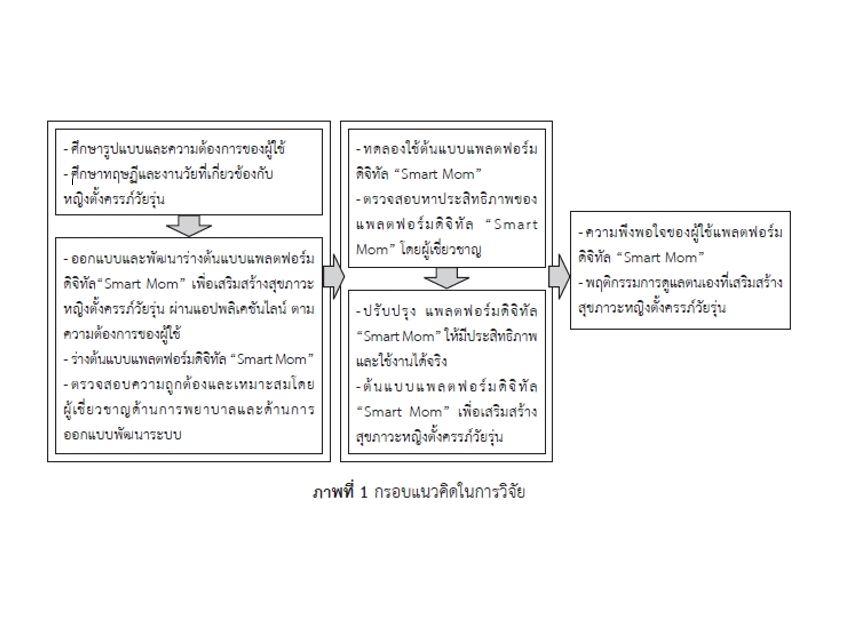
การวิจัยและพัฒนาครั้งนี้มีวัตถุประสงค์เพื่อพัฒนาและประเมินแพลตฟอร์มดิจิทัล “Smart Mom” สำหรับเสริมสร้างสุขภาวะหญิงตั้งครรภ์วัยรุ่นผ่านแอปพลิเคชันไลน์ ประเมินประสิทธิภาพและความพึงพอใจของผู้ใช้ รวมถึงประเมินพฤติกรรมการดูแลสุขภาพตนเองหลังการใช้แพลตฟอร์ม กลุ่มตัวอย่างคือหญิงตั้งครรภ์วัยรุ่นอายุ 15–19 ปี จำนวน 32 คน ที่มาฝากครรภ์ในโรงพยาบาลบุรีรัมย์ โดยใช้การสุ่มแบบเฉพาะเจาะจง เครื่องมือวิจัยประกอบด้วยแพลตฟอร์ม “Smart Mom” แบบประเมินประสิทธิภาพ แบบสอบถามความพึงพอใจ และแบบประเมินพฤติกรรมการดูแลสุขภาพตนเอง วิเคราะห์ข้อมูลด้วยสถิติเชิงพรรณนา ได้แก่ จำนวน ร้อยละ ค่าเฉลี่ย และส่วนเบี่ยงเบนมาตรฐาน
ผลการวิจัยพบว่า แพลตฟอร์ม “Smart Mom” มีประสิทธิภาพโดยรวมในระดับสูง ( = 4.47, SD = 0.57) โดยได้คะแนนสูงสุดในด้านความสะดวกในการใช้งาน ( = 4.49, SD = 0.52) ความพึงพอใจของผู้ใช้อยู่ในระดับมาก ( = 4.48, SD = 0.51) โดยพึงพอใจด้านเนื้อหาที่เป็นประโยชน์มีค่ามากที่สุด ( = 4.72, SD = 0.55) และพฤติกรรมการดูแลตนเองของหญิงตั้งครรภ์วัยรุ่น หลังการใช้งานแพลตฟอร์มดิจิทัล “Smart Mom” พบว่ามีพฤติกรรมการดูแลตนเองโดยรวมอยู่ในระดับดี (= 3.04, SD = 0.63)
จากผลการวิจัยมีข้อเสนอแนะว่า พยาบาล สามารถนำแพลตฟอร์ม "Smart Mom ไปประยุกต์ใช้ในการส่งเสริมให้หญิงตั้งครรภ์มีความรู้และสมารถดูแลตนเองในขณะตั้งครรภ์ได้
เอกสารอ้างอิง
Ameyaw, E. K., Amoah, P. A., & Ezezika, O. (2024). Effectiveness of mHealth apps for maternal health care delivery: Systematic review of systematic reviews. Journal of Medical Internet Research, 26, e49510.
Burns, N., & Grove, S. K. (2005). The practice of nursing research conduct, critique and utilization (5thed.). Philadelphia : Elsevier Saunders.
Chaisuwann, B., & Prajaknet, P. (2015). New media usage behavior of adolescents aged 10 to 19 years. Journal of Communication and Management, 1(1), 31–57.
Kanjanawetang, J., Choksuwattanasakul, M., & Sittivong, S, (2019). Development of application program on personal communication devices for promoting health of adolescent pregnant women: PREG-CAL 3.0. Retrieved from http://sutir.sut.ac.th8080/jspui/bitstream/123456789/8607/1/Abstract.pdf date 26/06/2525.
Ledford, C. J. W., Canzona, M. R., Cafferty, L. A., & Hodge, J. A. (2016). Mobile application as a prenatal education and engagement tool: A randomized controlled pilot. Patient Education and Counseling, 99(4), 578–582.
Kueasakul, K. (2021). New approaches to maternal health care during the COVID-19 pandemic. Retrieved from https://op.mahidol.ac.th/ga/posttoday-7/
Maramba, I., Chatterjee, A., & Newman, C. (2019). Methods of usability testing in the development of eHealth applications: A scoping review. International Journal of Medical Informatics, 126, 95–104.
Myors, B., & Murphy, K. R. (2023). Statistical power analysis: A simple and general model for traditional and modern hypothesis tests (5th ed.). New York, NY: Routledge.
Ngoenyinng, S., Suppasri, P., & Suppasrimanont, W. (2013). Effects of a health promotion program on nutritional health behavior and stress management in pregnant adolescents. The Journal of Faculty on Nursing Burapha, 21(4), 37–48.
Pota, T. (2018). Determinants of having first antenatal case visit among pregnant teenagers in community. Retrieved from https://buuir/buu.ac.th/xmlui/handle/1234567890/7760
Preesong, K. (2015). Factors related to self-care behaviors of pregnant Womenat Bangna 5 Hospital, Samutprakarn province. Romphruek Journal of Humanities and Social Sciences of Krirk University, 33(3), 116-136.
Royal Thai Department of Health, Bureau of Reproductive Health. (2022). Adolescent mothers' birth statistics in Thailand. Retrieved from https://rh.anamai.moph.go.th/th/adolescent-mothers-birth-statistics.
Suwanampa, T. (2023). The effect of a knowledge-providing program using a mobile application on health literacy among pregnant women. Thai Nursing Council Journal, 38(4), 98-111.
Tamrat, T., & Kachnowski, S. (2012). Special delivery: An analysis of mHealth in maternal and newborn health programs and their outcomes around the world. Maternal and Child Health Journal, 16(5), 1092-1101.
Thaneepanichskul, S. (2012). Unwanted pregnancy. In Wichaya Thitaparn and colleagues (Eds.), Perinatal crisis practice (pp. 143–149). Bangkok: P.A. Living. [In Thai]
United Nations Population Fund [UNFPA]. (2023, October 11). UNFPA collaborates with public and private partners to reduce teen pregnancies in Thailand. Retrieved from https://www.unfpa.org/updates/unfpa-collaborates-public-and-private-partners- reduce-teen-pregnancies-thailand.
Winalaiwanakul, J. (2019). Selected factors related to health responsibility behaviors among pregnant teenagers in Amnat Charoen province. Siam University Journal of Nursing, 20(39), 8–19.
Wongkhankaew, N, Puriakarathawong, T, Kantasate, P, & Hongsriti, P. (2021). Maternal age effect on pregnancy outcomes in Phrae hospital. Journal of the Phrae Hospital, 29(1), 1-15.
ดาวน์โหลด
เผยแพร่แล้ว
รูปแบบการอ้างอิง
ฉบับ
ประเภทบทความ
สัญญาอนุญาต

อนุญาตภายใต้เงื่อนไข Creative Commons Attribution-NonCommercial-NoDerivatives 4.0 International License.