Monitoring and Care of Adolescent Pregnant Women Using a Digital Platform to Promote Adolescent Pregnancy Well-being (Smart mom)
Keywords:
Digital platform, Adolescent pregnancy, Effectiveness, Satisfaction, Self-care behaviorAbstract
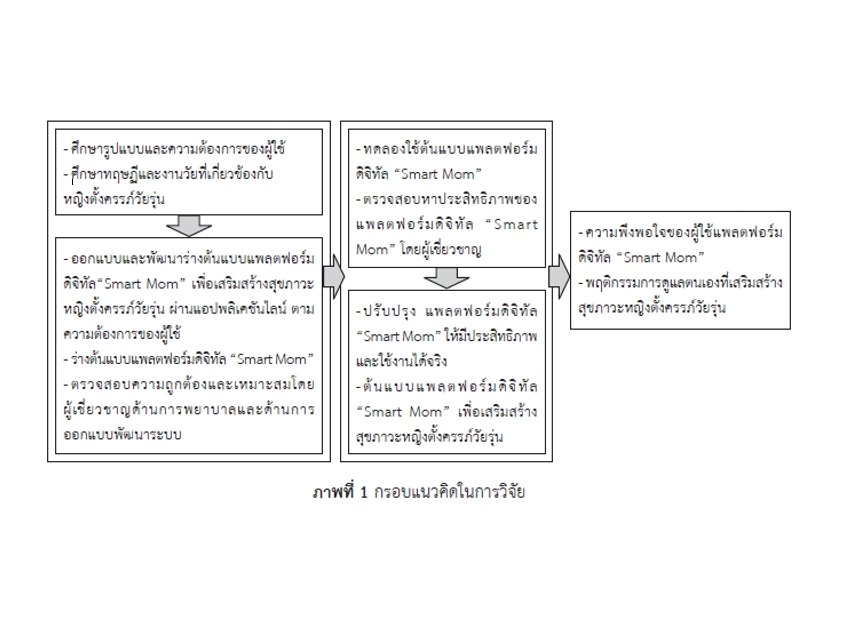
This research and development aimed to develop and evaluate the "Smart Mom" digital platform for enhancing the well-being of pregnant teenagers through a LINE application. The study assessed platform effectiveness, user satisfaction, and self-care behaviors following platform usage. The sample consisted of 32 pregnant teenagers aged 15-19 years receiving prenatal care at Buriram Hospital, selected through purposive sampling. Research instruments included the "Smart Mom" platform, effectiveness assessment forms, satisfaction questionnaires, and self-care behavior evaluation tools. Data were analyzed using descriptive statistics including frequency, percentage, mean, and standard deviation.
The results showed that the "Smart Mom" platform demonstrated high overall effectiveness ( = 4.47, S.D. = 0.57), with the highest scores in ease of use ( = 4.49, S.D. = 0.52). User satisfaction was at a high level ( = 4.48, S.D. = 0.51), with content perceived as most beneficial ( = 4.72, S.D. = 0.55). Self-care behaviors among pregnant teenagers after using the "Smart Mom" digital platform showed overall good self-care practices ( = 3.04, S.D. = 0.63).
The findings suggest that nurses should apply the "Smart Mom" platform to promote knowledge and good self-care behaviors among pregnant women.
References
Ameyaw, E. K., Amoah, P. A., & Ezezika, O. (2024). Effectiveness of mHealth apps for maternal health care delivery: Systematic review of systematic reviews. Journal of Medical Internet Research, 26, e49510.
Burns, N., & Grove, S. K. (2005). The practice of nursing research conduct, critique and utilization (5thed.). Philadelphia : Elsevier Saunders.
Chaisuwann, B., & Prajaknet, P. (2015). New media usage behavior of adolescents aged 10 to 19 years. Journal of Communication and Management, 1(1), 31–57.
Kanjanawetang, J., Choksuwattanasakul, M., & Sittivong, S, (2019). Development of application program on personal communication devices for promoting health of adolescent pregnant women: PREG-CAL 3.0. Retrieved from http://sutir.sut.ac.th8080/jspui/bitstream/123456789/8607/1/Abstract.pdf date 26/06/2525.
Ledford, C. J. W., Canzona, M. R., Cafferty, L. A., & Hodge, J. A. (2016). Mobile application as a prenatal education and engagement tool: A randomized controlled pilot. Patient Education and Counseling, 99(4), 578–582.
Kueasakul, K. (2021). New approaches to maternal health care during the COVID-19 pandemic. Retrieved from https://op.mahidol.ac.th/ga/posttoday-7/
Maramba, I., Chatterjee, A., & Newman, C. (2019). Methods of usability testing in the development of eHealth applications: A scoping review. International Journal of Medical Informatics, 126, 95–104.
Myors, B., & Murphy, K. R. (2023). Statistical power analysis: A simple and general model for traditional and modern hypothesis tests (5th ed.). New York, NY: Routledge.
Ngoenyinng, S., Suppasri, P., & Suppasrimanont, W. (2013). Effects of a health promotion program on nutritional health behavior and stress management in pregnant adolescents. The Journal of Faculty on Nursing Burapha, 21(4), 37–48.
Pota, T. (2018). Determinants of having first antenatal case visit among pregnant teenagers in community. Retrieved from https://buuir/buu.ac.th/xmlui/handle/1234567890/7760
Preesong, K. (2015). Factors related to self-care behaviors of pregnant Womenat Bangna 5 Hospital, Samutprakarn province. Romphruek Journal of Humanities and Social Sciences of Krirk University, 33(3), 116-136.
Royal Thai Department of Health, Bureau of Reproductive Health. (2022). Adolescent mothers' birth statistics in Thailand. Retrieved from https://rh.anamai.moph.go.th/th/adolescent-mothers-birth-statistics.
Suwanampa, T. (2023). The effect of a knowledge-providing program using a mobile application on health literacy among pregnant women. Thai Nursing Council Journal, 38(4), 98-111.
Tamrat, T., & Kachnowski, S. (2012). Special delivery: An analysis of mHealth in maternal and newborn health programs and their outcomes around the world. Maternal and Child Health Journal, 16(5), 1092-1101.
Thaneepanichskul, S. (2012). Unwanted pregnancy. In Wichaya Thitaparn and colleagues (Eds.), Perinatal crisis practice (pp. 143–149). Bangkok: P.A. Living. [In Thai]
United Nations Population Fund [UNFPA]. (2023, October 11). UNFPA collaborates with public and private partners to reduce teen pregnancies in Thailand. Retrieved from https://www.unfpa.org/updates/unfpa-collaborates-public-and-private-partners- reduce-teen-pregnancies-thailand.
Winalaiwanakul, J. (2019). Selected factors related to health responsibility behaviors among pregnant teenagers in Amnat Charoen province. Siam University Journal of Nursing, 20(39), 8–19.
Wongkhankaew, N, Puriakarathawong, T, Kantasate, P, & Hongsriti, P. (2021). Maternal age effect on pregnancy outcomes in Phrae hospital. Journal of the Phrae Hospital, 29(1), 1-15.
Downloads
Published
How to Cite
Issue
Section
License

This work is licensed under a Creative Commons Attribution-NonCommercial-NoDerivatives 4.0 International License.