ปัจจัยด้านจิตสังคมที่มีอิทธิพลต่อความผาสุกทางจิตวิญญาณของผู้สูงอายุในศูนย์ดูแลผู้สูงอายุเอกชน
คำสำคัญ:
ปัจจัยด้านจิตสังคม, ความผาสุกทางจิตวิญญาณ, ผู้สูงอายุ, ศูนย์ดูแลผู้สูงอายุเอกชนบทคัดย่อ
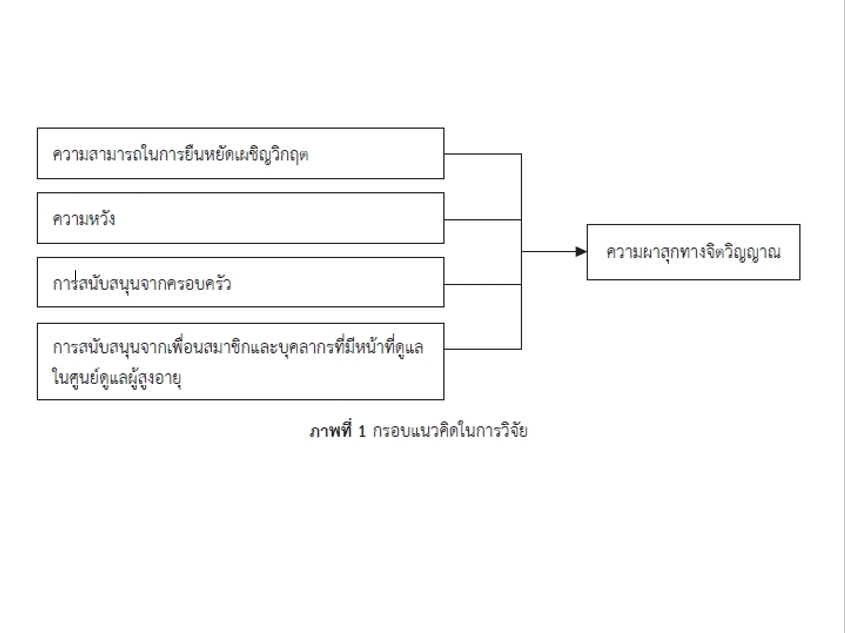
การวิจัยครั้งนี้เป็นการศึกษาเชิงพรรณนาแบบวิเคราะห์หาความสัมพันธ์เชิงทำนาย มีวัตถุประสงค์เพื่อศึกษาปัจจัยด้านจิตสังคมที่มีอิทธิพลต่อความผาสุกทางจิตวิญญาณของผู้สูงอายุในศูนย์ดูแลผู้สูงอายุ กลุ่มตัวอย่างคือผู้ที่มีอายุ 60 ปีขึ้นไป อาศัยอยู่ในศูนย์ดูแลผู้สูงอายุเอกชน จังหวัดนครปฐม จำนวน 144 คน ได้มาโดยการสุ่มตัวอย่างอย่างง่าย เครื่องมือในการเก็บรวบรวมข้อมูล ประกอบด้วย แบบสอบถามข้อมูลส่วนบุคคล แบบสอบถามความผาสุกทางจิตวิญญาณ แบบสอบถามความสามารถในการยืนหยัดเผชิญวิกฤต แบบสอบถามความหวัง แบบสอบถามการสนับสนุนจากครอบครัว และแบบสอบถามการสนับสนุนจากเพื่อนสมาชิกด้วยกันและบุคลากร ซึ่งมีค่าความเชื่อมั่นสัมประสิทธิ์แอลฟ่าครอนบาค เท่ากับ .88, .95, .74, .73 และ .73 ตามลำดับ วิเคราะห์ข้อมูลด้วยด้วยสถิติพรรณนา และสถิติการวิเคราะห์การถดถอยพหุคูณแบบขั้นตอน
ผลการวิจัยพบว่า กลุ่มตัวอย่างมีความผาสุกทางจิตวิญญาณอยู่ในระดับต่ำ คิดเป็นร้อยละ 98.61 (M = 67.92, SD = 4.17) ตัวแปรที่สามารถทำนายความผาสุกทางจิตวิญญาณได้อย่างมีนัยสำคัญทางสถิติ ได้แก่ การสนับสนุนจากเพื่อนและบุคคลากร (b = .151, p < .05) และความสามารถในการยืนหยัดเผชิญวิกฤต (b= -.562, p < .001) โดยสามารถทำนายได้ร้อยละ 33.7 (R2= .337, p < .001)
ผลวิจัยครั้งนี้มีข้อเสนอแนะว่า ศูนย์ดูแลผู้สูงอายุควรมีการพัฒนาการดูแลที่มุ่งเน้นการส่งเสริมความผาสุกทางจิตวิญญาณ โดยส่งเสริมให้ผู้สูงอายุเหล่านี้มีการทำกิจกรรมทางศาสนาหรือกิจกรรมอื่นๆที่ช่วยเพิ่มความผาสุกทางจิตวิญญาณ ตลอดจนการเพิ่มเเหล่งสนับสนุนทางสังคมทั้งจากเพื่อนผู้สูงอายุในศูนย์ฯและบุคคลากร รวมทั้งการส่งเสริมความสามารถในการยืนหยัดเผชิญวิกฤต
เอกสารอ้างอิง
Bunthai, N. (1996). Self-esteem of the elderly and its relationship with other factors. Master’s Thesis, Gerontological Nursing, Graduate School, Chiang Mai University.
Chavapattanakul, P., Wongkumsin, T., & Kongkasuwan, R. (2020). The relationship between resilience quotient, social support and spiritual well-being of caregivers of patients with hemiplegia. Siriraj Medical Journal, 72(3), 245-252.
Christraksa, W., & Chetchaowalit, T. (2018). The role of the community psychiatric nurses in the elderly living with spiritual distress: Spiritual dimension. Journal of Nursing and Health Care, 36(2), 6–14.
Cumming, E., & Henry, W. E. (1961). Growing old: The process of disengagement. Basic Books.
Department of Older Persons. (2024). The situation of Thai older persons 2023. Bangkok: Department of Older Persons, Ministry of Social Development and Human Security.
Duran, S., Avci, D., & Esim, F. (2020). Association between spiritual well-being and resilience among Turkish hemodialysis patients. Journal of Religion and Health, 59(6), 3097– 3109.
Ellison, C. W., & Smith, J. (1991). Toward an integrative measure of health and well-being. Journal of Psychology and Theology, 19(1), 35–48.
Herth, K. A. (1992). Abbreviated instrument to measure hope: Development and psychometric evaluation. Journal of Advanced Nursing, 17(2), 1251-1259.
Herth, K. (1993). Hope in Older Adults in Community and Institutional Settings. Journal Issues in Mental Health Nursing, 14(2), 139-156.
Jadidi, A., Khodaveisi, M., Sadeghian, E., & Fallahi-Khoshknab, M. (2021). Exploring the process of spiritual health of the elderly living in nursing homes: A grounded theory study. Ethiopian Journal of Health Sciences, 31(3), 589–598. https://doi.org/10.4314/ejhs.v31i3.16
Ken Thong Dee, V., Kaew Koet, A., & Chaisit, Y. (2022). Factors affecting the spiritual well-being of the elderly. Journal of Environmental Health and Community Health, 7(1), 1–8. https://he03.tci-thaijo.org/index.php/ech/article/view/493
Khemaweero, P. W., Pattanasing, T., Khankaew, T., Khumtua, K., & Lapontan, S. (2017). Enhancement of elder people’s spiritual well-being according to Buddhism doctrines. Journal of MCU Peace Studies, 5(1), 78–88.
Kleddee, J., Naksuwan, S., & Sukmaitri, J. (2017). Factors affecting the quality of life of the elderly in Nakhon Si Thammarat Province. Rajapruek Journal, 15(1), 27–32.
Kütmeç Yilmaz, C., & Kara, F. Ş. (2021). The effect of spiritual well-being on adaptation to chronic illness among people with chronic illnesses. Perspectives in Psychiatric Care, 57(1), 318–325. https://doi.org/10.1111/ppc.12566
Leelapattanaphanit, J. (1998). Hope of stroke patients. Master of Nursing Science Thesis, Graduate School, Khon Kaen University.
Mueanjan, W., Chimhad, P., & Noonklam, D. (2022). The development of life quality on Buddhist way to support society under new lifestyle of elderly in Songkhla Province. Journal of Social Science and Cultural, 8(9), 324–335. Retrieved from https://so06.tci-thaijo.org/index.php/JSC/article/view/277055
National Statistical Office. (2024). Survey of the elderly population in Thailand 2024. Bangkok: National Statistical Office.
Paloutizan, R. F., & Ellison, C. W. (1982). Loneliness, spiritual well-Being and the quality of life. New York: John Wiley & Sons.
Phutthamat, R., Jintanawat, R., & Pothiban, L. (2020). Social support and the mental well-being of the elderly in nursing homes. Journal of the Nursing and Midwifery Council, 35(1), 61-74.
Polit, D. F., & Beck, C. T. (2012). Nursing research generating and assessing evidence for nursing practice. (9th ed.). Philadelphia, Pa: Lippincott, Williams & Wilkins.
Roge, M., Gail, L., & Neal, K. (2021). Keeping hope alive: Racial-ethnic disparities in distress tolerance are mitigated by religious/spiritual hope among Black Americans. Journal of Psychosomatic Research, 144(1), 1-23.
Quintero, F. A., Garraza, M., Navazo, B., & Cesani, M. F. (2024). Teorías del envejecimiento biológico: una revisión integradora [Theories of biological aging: An integrative review]. Revista Española de Geriatría y Gerontología, 59(6), 101530. https://doi.org/10.1016/j.regg.2024.101530
Sumalrot, T., & Suksawai, H. N. (2015). Aging in the world of work: Biopsychosocial perspectives. Panyapiwat Journal, 7(1), 242–254.
Tirgari, B., Khaksari, M., Soltani, Z., Mirzaee, M., Saberi, S., & Bashiri, H. (2022). Spiritual well-being in patients with chronic diseases: A systematic review and meta-analysis. Journal of Religion and Health, 61(5), 3969–3987. https://doi.org/10.1007/s10943-022-01595-5
Toonsiri, C., Hengudomsap, P., Chaimongkol, N., & Photihung, P. (2019). Factors influencing resilience among older adults with chronic illness in the community: A causal relationship testing. Journal of Nursing Science, Burapha University, 27(1), 78–88. Retrieved from https://he02.tci-thaijo.org/index.php/Nubuu/article/view/211991
United Nations. (2023). World population prospects 2023, online edition. Bangkok: Department of Economic and Social Affairs, Population Division. Retrieved from https://population.un.org/wpp/
Vitale, E., Mea, R., & Chang, Y.-C. (2023). The nursing-home care quality perceived levels from patients and caregivers: An explanatory study. Patient Preference and Adherence, 17, 1237–1245. https://doi.org/10.2147/PPA.S409961
Wagnild, G. M., & Young, H. M. (1993). Development and psychometric evaluation of the resilience scale. Journal of Nursing Measurement, 1(2), 165-178.
Zafari, M., Sadeghipour Roudsari, M., Yarmohammadi, S., Jahangirimehr, A., & Marashi, T. (2023). Investigating the relationship between spiritual well-being, resilience, and depression: A cross-sectional study of the elderly. Psychogeriatrics, 23(3), 442–449. https://doi.org/10.1111/psyg.12952
Zhang, J., Xu, F., Zhou, Y., Wu, J., Li, Y., & Qing, W. (2024). Association between frailty and meaning in life of older adults in nursing home: the mediating effect of psychological resilience. Frontiers in Psychology, 15, 1365817.
ดาวน์โหลด
เผยแพร่แล้ว
รูปแบบการอ้างอิง
ฉบับ
ประเภทบทความ
สัญญาอนุญาต

อนุญาตภายใต้เงื่อนไข Creative Commons Attribution-NonCommercial-NoDerivatives 4.0 International License.