Psychosocial Factors Influencing Spiritual Well-Being Among Older Adults In Private Nursing Homes
Keywords:
Psychosocial Factor, Spiritual Well-Being, Older Adults, Private Nursing HomesAbstract
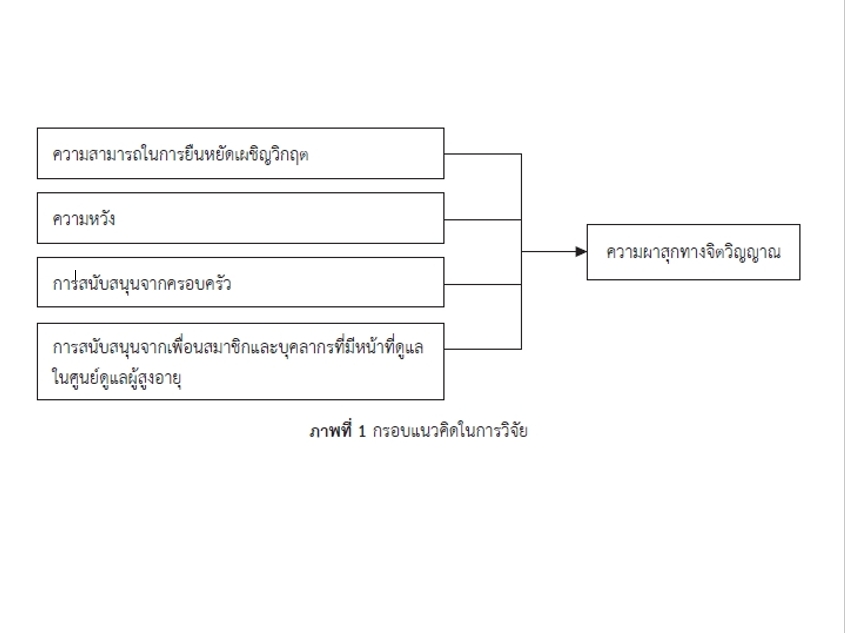
This predictive correlational study was aimed to explore spiritual well-being and examine the impact of psychosocial factors on this well- being among the nursing home residents. The study sample consists of the individuals aged 60 and above who reside in private nursing homes in Nakhon Pathom Province. The simple random sampling was used to recruit 144 older adults who met the inclusion criteria. Research instruments included questionnaires about personal information, spiritual well-being, resilience, hope, family support, and support from other nursing home residents (peers) and staff responsible for provision of care in the nursing homes. Cronbach’s alpha coefficients of questionnaires were .88, .95, .74, .73, and .73, respectively. Data were analyzed using descriptive statistics and stepwise multiple regression analysis.
The findings revealed that the spiritual well-being among older adults in these private nursing homes is generally low (M = 67.92, SD = 4.17) in which 98.61% of them reported low level of spiritual well-being. Significant predictors of spiritual well-being include support from peers and staff (b = .151, p < .05) and resilience (b = –.562, p < .001). Together, these variables account for 33.7% of the variance in spiritual well-being (R² = .337, p < .001).
The findings of this study suggest that the private nursing homes should prioritize promoting the spiritual well-being of these seniors by encouraging their engagement in religious or other meaningful activities that enhance this well-being. Additionally, fostering greater social support from peers and staff, as well as strengthening resilience are also recommended.
References
Bunthai, N. (1996). Self-esteem of the elderly and its relationship with other factors. Master’s Thesis, Gerontological Nursing, Graduate School, Chiang Mai University.
Chavapattanakul, P., Wongkumsin, T., & Kongkasuwan, R. (2020). The relationship between resilience quotient, social support and spiritual well-being of caregivers of patients with hemiplegia. Siriraj Medical Journal, 72(3), 245-252.
Christraksa, W., & Chetchaowalit, T. (2018). The role of the community psychiatric nurses in the elderly living with spiritual distress: Spiritual dimension. Journal of Nursing and Health Care, 36(2), 6–14.
Cumming, E., & Henry, W. E. (1961). Growing old: The process of disengagement. Basic Books.
Department of Older Persons. (2024). The situation of Thai older persons 2023. Bangkok: Department of Older Persons, Ministry of Social Development and Human Security.
Duran, S., Avci, D., & Esim, F. (2020). Association between spiritual well-being and resilience among Turkish hemodialysis patients. Journal of Religion and Health, 59(6), 3097– 3109.
Ellison, C. W., & Smith, J. (1991). Toward an integrative measure of health and well-being. Journal of Psychology and Theology, 19(1), 35–48.
Herth, K. A. (1992). Abbreviated instrument to measure hope: Development and psychometric evaluation. Journal of Advanced Nursing, 17(2), 1251-1259.
Herth, K. (1993). Hope in Older Adults in Community and Institutional Settings. Journal Issues in Mental Health Nursing, 14(2), 139-156.
Jadidi, A., Khodaveisi, M., Sadeghian, E., & Fallahi-Khoshknab, M. (2021). Exploring the process of spiritual health of the elderly living in nursing homes: A grounded theory study. Ethiopian Journal of Health Sciences, 31(3), 589–598. https://doi.org/10.4314/ejhs.v31i3.16
Ken Thong Dee, V., Kaew Koet, A., & Chaisit, Y. (2022). Factors affecting the spiritual well-being of the elderly. Journal of Environmental Health and Community Health, 7(1), 1–8. https://he03.tci-thaijo.org/index.php/ech/article/view/493
Khemaweero, P. W., Pattanasing, T., Khankaew, T., Khumtua, K., & Lapontan, S. (2017). Enhancement of elder people’s spiritual well-being according to Buddhism doctrines. Journal of MCU Peace Studies, 5(1), 78–88.
Kleddee, J., Naksuwan, S., & Sukmaitri, J. (2017). Factors affecting the quality of life of the elderly in Nakhon Si Thammarat Province. Rajapruek Journal, 15(1), 27–32.
Kütmeç Yilmaz, C., & Kara, F. Ş. (2021). The effect of spiritual well-being on adaptation to chronic illness among people with chronic illnesses. Perspectives in Psychiatric Care, 57(1), 318–325. https://doi.org/10.1111/ppc.12566
Leelapattanaphanit, J. (1998). Hope of stroke patients. Master of Nursing Science Thesis, Graduate School, Khon Kaen University.
Mueanjan, W., Chimhad, P., & Noonklam, D. (2022). The development of life quality on Buddhist way to support society under new lifestyle of elderly in Songkhla Province. Journal of Social Science and Cultural, 8(9), 324–335. Retrieved from https://so06.tci-thaijo.org/index.php/JSC/article/view/277055
National Statistical Office. (2024). Survey of the elderly population in Thailand 2024. Bangkok: National Statistical Office.
Paloutizan, R. F., & Ellison, C. W. (1982). Loneliness, spiritual well-Being and the quality of life. New York: John Wiley & Sons.
Phutthamat, R., Jintanawat, R., & Pothiban, L. (2020). Social support and the mental well-being of the elderly in nursing homes. Journal of the Nursing and Midwifery Council, 35(1), 61-74.
Polit, D. F., & Beck, C. T. (2012). Nursing research generating and assessing evidence for nursing practice. (9th ed.). Philadelphia, Pa: Lippincott, Williams & Wilkins.
Roge, M., Gail, L., & Neal, K. (2021). Keeping hope alive: Racial-ethnic disparities in distress tolerance are mitigated by religious/spiritual hope among Black Americans. Journal of Psychosomatic Research, 144(1), 1-23.
Quintero, F. A., Garraza, M., Navazo, B., & Cesani, M. F. (2024). Teorías del envejecimiento biológico: una revisión integradora [Theories of biological aging: An integrative review]. Revista Española de Geriatría y Gerontología, 59(6), 101530. https://doi.org/10.1016/j.regg.2024.101530
Sumalrot, T., & Suksawai, H. N. (2015). Aging in the world of work: Biopsychosocial perspectives. Panyapiwat Journal, 7(1), 242–254.
Tirgari, B., Khaksari, M., Soltani, Z., Mirzaee, M., Saberi, S., & Bashiri, H. (2022). Spiritual well-being in patients with chronic diseases: A systematic review and meta-analysis. Journal of Religion and Health, 61(5), 3969–3987. https://doi.org/10.1007/s10943-022-01595-5
Toonsiri, C., Hengudomsap, P., Chaimongkol, N., & Photihung, P. (2019). Factors influencing resilience among older adults with chronic illness in the community: A causal relationship testing. Journal of Nursing Science, Burapha University, 27(1), 78–88. Retrieved from https://he02.tci-thaijo.org/index.php/Nubuu/article/view/211991
United Nations. (2023). World population prospects 2023, online edition. Bangkok: Department of Economic and Social Affairs, Population Division. Retrieved from https://population.un.org/wpp/
Vitale, E., Mea, R., & Chang, Y.-C. (2023). The nursing-home care quality perceived levels from patients and caregivers: An explanatory study. Patient Preference and Adherence, 17, 1237–1245. https://doi.org/10.2147/PPA.S409961
Wagnild, G. M., & Young, H. M. (1993). Development and psychometric evaluation of the resilience scale. Journal of Nursing Measurement, 1(2), 165-178.
Zafari, M., Sadeghipour Roudsari, M., Yarmohammadi, S., Jahangirimehr, A., & Marashi, T. (2023). Investigating the relationship between spiritual well-being, resilience, and depression: A cross-sectional study of the elderly. Psychogeriatrics, 23(3), 442–449. https://doi.org/10.1111/psyg.12952
Zhang, J., Xu, F., Zhou, Y., Wu, J., Li, Y., & Qing, W. (2024). Association between frailty and meaning in life of older adults in nursing home: the mediating effect of psychological resilience. Frontiers in Psychology, 15, 1365817.
Downloads
Published
How to Cite
Issue
Section
License

This work is licensed under a Creative Commons Attribution-NonCommercial-NoDerivatives 4.0 International License.