Evaluation of the “Nurse Soulciety” Online Nursing Community Project for Thai Nurses: A CIPP Model Analysis
คำสำคัญ:
CIPP model, nursing community, online education, professional developmentบทคัดย่อ
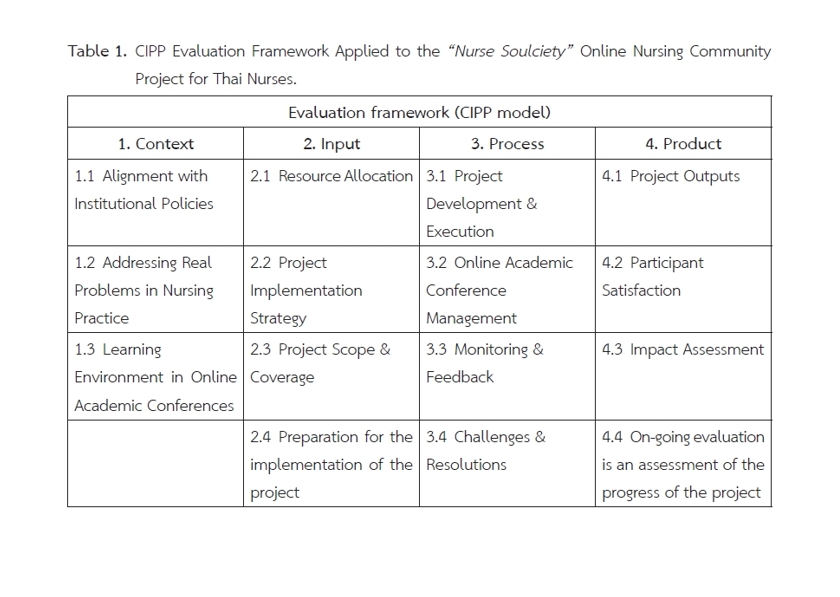
This study aimed to evaluate the implementation of the Online Nursing Community Project for Thai Nurses using the CIPP evaluation model. A descriptive research approach was employed to evaluate the project implemented between 2022 and 2024. Secondary data were collected from three sources: (1) minutes of executive meetings, (2) minutes of project management meetings, and (3) archived chat records from Zoom sessions. The data were gathered using a project evaluation form developed based on the CIPP model. Quantitative data were analyzed using descriptive statistics, including frequency and percentage, while qualitative data were analyzed using content analysis.
The results revealed that Context Evaluation: The project’s objectives and implementation plan were found to align with the hospital’s nursing quality development policy. Input Evaluation: The project was sufficiently supported with resources from the organization, including personnel, budget, technology, and equipment. Process Evaluation: The project was systematically planned and implemented. During the initial phase, it was found that some participants did not meet the required attendance hours, leading to the development of an asynchronous learning format to improve accessibility and participation. Product Evaluation: The project achieved its intended objectives. The evaluation results indicated a positive impact on professional nurses, with high levels of satisfaction among participants, despite some areas that require further development.
These findings suggest that the online nursing community project for Thai nurses is a project that promotes lifelong learning and sustainable professional development through an accessible and flexible online platform. This project has been successful in delivering quality learning experiences, meeting the needs of learners, and supporting the practical application of knowledge in nursing practice in a meaningful way.
เอกสารอ้างอิง
Burke, E., & Hennessy, M. (2021). Evaluation of an early career clinical academic training programme using the CIPP model. BMJ open, 11(11), e052965.
Joomprabutra, W., Kenbubpha, K., & Palabut, S. (2021). Development and effectiveness of an online training program based on adolescent depression guidelines for physicians in the 10th public health region. Journal of Mental Health of Thailand, 29(4), 333-344. https://he01.tci-thaijo.org/index.php/jmht/article/view/250567
Madaus, G. F., Scriven, M. S., Stufflebeam, D. L., & Stufflebeam, D. L. (1983). The CIPP model for program evaluation. Evaluation models: Viewpoints on educational and human services evaluation. Retrieved from http://dx.doi.org/10.1007/978-94-009-6669-7_1
Mokhtarzadegan, M., Amini, M., Takmil, F., Adamiat, M., & Sarveravan, P. (2015). Inservice trainings for Shiraz University of Medical Sciences employees: Effectiveness assessment by using the CIPP model. Journal of Advances in Medical Education & Professionalism, 3(2), 77-83
Patan, V. (2023). Online training system Metta Pracharak hospital (Wat Rai Khing) basic ophthalmic nursing course. Thammasat University Hospital Journal Online, 8(3), 76–85. Retrieved from https://he02.tci-thaijo.org/index.php/TUHJ/article/view/266923
Phothong, C., Voraroon, S., Phanthu, K., Ratanachai, P., & Thongkomol. L. (2020).The study of human resource development for nurse anesthetists under the jurisdiction of the Ministry of Public Health. Journal of Health and Nursing Research, 36(3), 259–272. https://he01.tci-thaijo.org/index.php/bcnbangkok/article/view/247024
Pibanwong, P., Teeyapan, W., Nadoon, W., Apichutboonchock, S., Phuarsa, B., Chopsiang, L., Harasan, P., Jantasen, O., & Palachai, T. (2019). The evaluation of training program of nursing specialty in family nursing practitioner: A study in Boromarajonani College of Nursing Sanpasithiprasong. Vajira Medical Journal: Journal of Urban Medicine, 63(3), 175–184. Retrieved from https://he02.tci-thaijo.org/index.php/VMED/article/view/211667
Stufflebeam, D. L. (2000). The CIPP model for evaluation. In Evaluation models: Viewpoints on educational and human services evaluation. Dordrecht: Springer Netherlands.
Supaworawong, C., Ruckbumrung, T., & Lalognum, N. (2021). The development of online training package on fire prevention and suppression for the operation unit Phrapokklao Hospital. Journal of Interdisciplinary Social Sciences and Communication, 4(2), 13–22. https://so02.tci-thaijo.org/index.php/ISSC/article/view/249927
Thanaboonpuang, P., & Intana, J. (2021). The evaluation of training program of care managers in 2021: Using Stufflebeam’s CIPP model. Journal of Social Sciences in Measurement Evaluation Statistics and Research, 2(1), 36–46. https://so03.tci-thaijo.org/index.php/mesr/article/view/253445
ดาวน์โหลด
เผยแพร่แล้ว
รูปแบบการอ้างอิง
ฉบับ
ประเภทบทความ
สัญญาอนุญาต

อนุญาตภายใต้เงื่อนไข Creative Commons Attribution-NonCommercial-NoDerivatives 4.0 International License.