ปัจจัยทำนายคุณภาพชีวิตของผู้ป่วยโรคปอดอุดกั้นเรื้อรังภายหลังสถานการณ์ การแพร่ระบาดของโรคติดเชื้อไวรัสโคโรนา 2019
คำสำคัญ:
โรคปอดอุดกั้นเรื้อรัง, คุณภาพชีวิต, การรับรู้ความรุนแรงของโรคไวรัสโคโรนา 2019, ความวิตกกังวล, พฤติกรรมการจัดการตนเองบทคัดย่อ
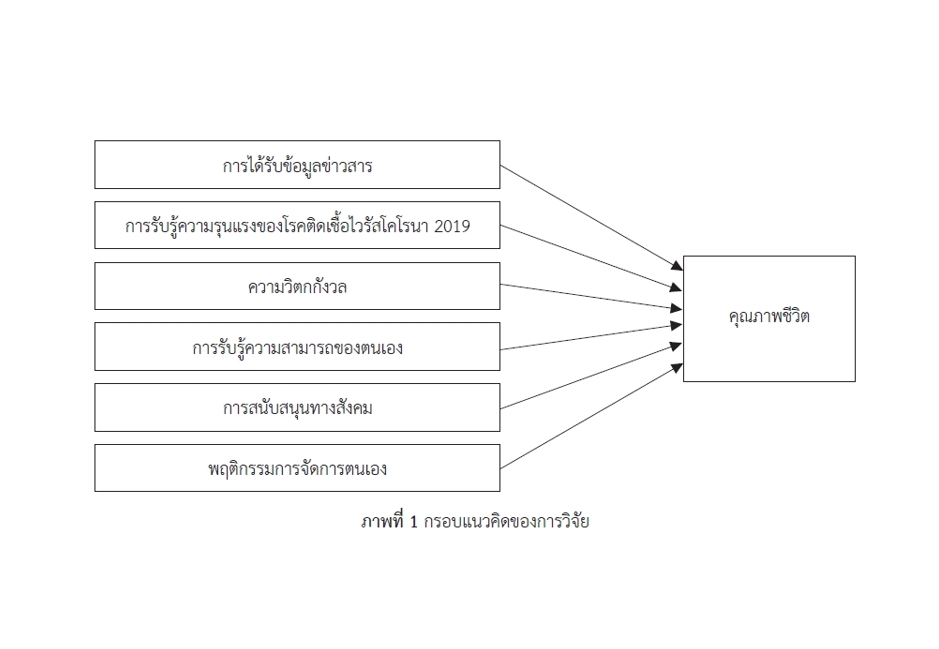
คุณภาพชีวิตเป็นเป้าหมายสำคัญในการรักษาและการจัดการโรคปอดอุดกั้นเรื้อรัง จากภายหลังสถานการณ์การแพร่ระบาดของโรคติดเชื้อไวรัสโคโรนา 2019 ผู้ป่วยโรคปอดอุดกั้นเรื้อรังจัดว่าเป็นกลุ่มเสี่ยงสูงการวิจัยครั้งนี้มีวัตถุประสงค์เพื่อศึกษาปัจจัยทำนายคุณภาพชีวิตของผู้ป่วยโรคปอดอุดกั้นเรื้อรังภายหลังสถานการณ์การแพร่ระบาดของโรคติดเชื้อไวรัสโคโรนา 2019 กลุ่มตัวอย่างเป็น ผู้ป่วยโรคปอดอุดกั้นเรื้อรัง จำนวน 125 ราย ที่มาติดตามอาการที่แผนกผู้ป่วยนอก คลินิกโรคปอดอุดกั้นเรื้อรัง โรงพยาบาลในจังหวัดชลบุรี ระดับปฐมภูมิ และระดับทุติยภูมิ เครื่องมือวิจัย ประกอบด้วย แบบประเมินข้อมูลส่วนบุคคลและภาวะสุขภาพ การได้รับข้อมูลข่าวสาร การรับรู้ความรุนแรงของโรคติดเชื้อไวรัสโคโรนา 2019 ต่อผู้ป่วยโรคปอดอุดกั้นเรื้อรัง ความวิตกกังวล การรับรู้ความสามารถของตนเอง การสนับสนุนทางสังคม พฤติกรรมการจัดการตนเอง และแบบสอบถามการรับรู้ภาวะสุขภาพ ค่าสัมประสิทธิ์แอลฟ่าของครอนบาค ดังนี้ การได้รับข้อมูลข่าวสาร = .84 การรับรู้ความรุนแรงของโรคติดเชื้อไวรัสโคโรนา 2019 ต่อผู้ป่วยโรคปอดอุดกั้นเรื้อรัง = .80 ความวิตกกังวล = .84 การรับรู้ความสามารถของตนเอง = .84 การสนับสนุนทางสังคม = .91 พฤติกรรมการจัดการตนเอง = .80 คุณภาพชีวิต = .81 วิเคราะห์ข้อมูลด้วยสถิติพรรณนา และสถิติการวิเคราะห์ถดถอยพหุคูณแบบ Enter
ผลการการศึกษาพบว่า คุณภาพชีวิตของผู้ป่วยโรคปอดอุดกั้นเรื้อรังภายหลังสถานการณ์การแพร่ระบาดของโรคติดเชื้อไวรัสโคโรนา 2019 โดยรวมอยู่ในระดับดี (M = 65.47, SD = 13.01) การได้รับข้อมูลข่าวสาร การรับรู้ความรุนแรงของโรคติดเชื้อไวรัสโคโรนา 2019 ความวิตกกังวล การรับรู้ความสามารถของตนเอง การสนับสนุนทางสังคม พฤติกรรมการจัดการตนเอง สามารถร่วมกันทำนายคุณภาพชีวิตของผู้ป่วยโรคปอดอุดกั้นเรื้อรังภายหลังสถานการณ์การแพร่ระบาดของโรคติดเชื้อไวรัสโคโรนา 2019 ร้อยละ 53.9 (R2 = .539, p< .001) โดยการรับรู้ความรุนแรงของโรคติดเชื้อไวรัสโคโรนา 2019 เป็นตัวแปรที่ทำนายได้มากที่สุด (β = .618, p < .001) รองลงมาได้แก่ พฤติกรรมการจัดการตนเอง (β = .293, p< .001) ความวิตกกังวล (β = .249, p <.01) แรงสนับสนุนทางสังคม (β = .163, p <.05) การรับรู้ความสามารถของตนเอง (β = .143, p <.05) และการได้รับข้อมูลข่าวสาร (β = .126, p >.05) ตามลำดับ
ผลการศึกษาครั้งนี้สามารถใช้เป็นแนวทางในการส่งเสริมคุณภาพชีวิต โดยเฉพาะภายหลังสถานการณ์การแพร่ระบาดของโรคติดเชื้อไวรัสโคโรนา 2019 ที่เป็นบริบทจำเพาะของโรคติดเชื้ออุบัติใหม่ สามารถนำไปประยุกต์ใช้ในการส่งเสริมคุณภาพชีวิต และป้องกันโรคอื่นๆได้ ทั้งโรคติดต่อทั่วไป โรคอุบัติใหม่และโรคอุบัติซ้ำตามบริบทของแต่ละพื้นที่ให้มีประสิทธิภาพประสิทธิผลยิ่งขึ้น
เอกสารอ้างอิง
Albishi, W. K., Ramadan, I. K., Abulkalam, S. M. M., Alsaab, H. A., Hayd, M. Y. B., AL-Ghamdi, M. A., & Al-Raddadi, R. (2024). Factors associated with the severity of COVID-19 in Jeddah, Saudi Arabia: A retrospective cohort study. Australasian Medical Journal, 16(11), 822–841.
Algahtani, F. D., Hassan, S. U., Alsaif, B., & Zrieq, R. (2021). Assessment of the quality of life during COVID-19 pandemic: A cross-sectional survey from the Kingdom of Saudi Arabia. International Journal of Environmental Research and Public Health, 18(3), 847. https://doi.org/10.3390/ijerph18030847
Aree-ue, S., & Yangcharoen., P. O. (2020). Thai version of the 6-item cognitive performance assessment: a test of psychometric properties. Rama Nurse Journal, 26(2), 188-202
Camacho-Rivera, M., Islam, J. Y., & Vidot, D. C. (2020). Associations Between Chronic Health Conditions and COVID-19 Preventive Behaviors Among a Nationally Representative Sample of U.S. Adults: An Analysis of the COVID Impact Survey. Health Equity, 4(1), 336-344. https://doi.org/10.1089/heq.2020.0031
Chonburi Provincial Office of Public Health Strategy and Planning. (2024). Morbidity and mortality rates from 4 chronic non-communicable diseases per 100,000 population, 2023-2024. Retrieved from https://spd.moph.go.th [In Thai]
Fongwanich, K. (2022). Media exposure and quality of life of Thai population aged 50 years and over (Unpublished doctoral dissertation). Chulalongkorn University, Bangkok, Thailand. [In Thai]
Gao, M., Lu, Y., Zhang, L., Shi, M., Zhou, H., Zhou, H., Kuang, X., & Li, Y. (2024). Social anxiety, self‐esteem and quality of life among hypertensive patients during COVID‐19 local epidemic in China: A mediation analysis. Nursing open, 11(1), e2014.
Goodman-Casanova, J. M., Dura-Perez, E., Guzman-Parra, J., Cuesta-Vargas, A., & Mayoral-Cleries, F. (2020). Telehealth home support during COVID-19 confinement for community-dwelling older adults with mild cognitive impairment or mild dementia: survey study. Journal of medical Internet research, 22(5), e19434.
Gvozdanovic, Z., Farcic, N., Simic, H., Buljanovic, V., Gvozdanovic, L., Katalinic, S., ... Prlic, N. (2021). The impact of education, COVID-19 and risk factors on the quality of life in patients with type 2 diabetes. International Journal of Environmental Research and Public Health, 18(5), 2332. https://doi.org/10.3390/ijerph18052332
Global Initiative for Chronic Obstructive Lung Disease. (2024). Global strategy for the diagnosis, management, and prevention of chronic obstructive pulmonary disease: 2024 report. Fontana, WI: Author. Retrieved from https://goldcopd.org/2024-gold-report/
Pipatwet, K. (2009). The results of treatment using a comprehensive treatment program for patients with chronic obstructive pulmonary disease. Journal of Tuberculosis, Thoracic Diseases and Critical Care Medicine, 30(2), 100–111. [In Thai]
Khorani, H., Mohammadi, F., Hosseinkhani, Z., & Motalebi, S. A. (2022). Predictive factors of quality of life in older adults during the COVID-19 pandemic. BMC Psychology, 10(1), 176. doi:10.1186/s40359-022-00885-3
Kobayashi, S., Chiba, F., Ishida, M., Satoh, H., Ono, M., Hanagama, M., & Yanai, M. (2024). Physical activity and outcomes in Japanese patients with chronic obstructive pulmonary disease: From the Ishinomaki COPD network registry. Respiratory Investigation, 62(1), 107–112.
Korth, C. X., Gibson, G. C., Vander Horst, A., Cleveland, K., & Hughes, J. W. (2024). The protective roles of coping self-efficacy and social support for posttraumatic stress during the COVID-19 pandemic. Psychological Trauma: Theory, Research, Practice, and Policy.
Limsringam, P., Sasithanakornkaew, S., & Apisupachok, W. (2021). Information perception about Coronavirus 2019 (COVID-19) through social media with attitudes and disease prevention behaviors in Bangkok. Journal of MCU Nakhondhat, 8(9), 18-33.
Malik, P., Patel, K., Pinto, C., Jaiswal, R., Tirupathi, R., Pillai, S., & Patel, U. (2022). Post-acute COVID-19 syndrome (PCS) and health-related quality of life (HRQoL): A systematic review and meta-analysis. Journal of Medical Virology, 94(1), 253–262. doi:10.1002/jmv.27309
Ministry of Public Health. (2024). Number and mortality rate of chronic obstructive pulmonary disease 2023-2024. Retrieved from https://spd.moph.go.th [In Thai]
Moore, R. C., & Hancock, J. T. (2020). Older Adults, Social Technologies, and the Coronavirus Pandemic: Challenges, Strengths, and Strategies for Support. Social Media + Society, 6(3), 1-5. doi/10.1177/2056305120948162
Napalai, P., Seangpraw, K., Boonyathee, S., & Ong-Artborirak, P. (2022). COVID-19-related knowledge influences mental health, self-care behaviors, and quality of life among elderly with non-communicable diseases in Northern Thailand. Front Public Health, 10, 993531. https://doi.org/10.3389/fpubh.2022.993531 [In Thai]
Nikoloski, Z., Alqunaibet, A. M., Alfawaz, R. A., Almudarra, S. S., Herbst, C. H., El-Saharty, S., Alsukait, R., . . . Algwizani, A. (2021). COVID-19 and non-communicable diseases: Evidence from a systematic literature review. BMC Public Health, 21(1), 1068. doi:10.1186/s12889-021-11116-w
Phuthong, S. (2003). Development of experiential learning models to promote quality of life. For adults in rural communities in the northern region. Journal of Education Studies, 33(1), 49-59. [In Thai]
Rogers, R. W. (1983). Cognitive and physiological processes in fear appeals and attitude change: A revised theory of protection motivation. In J. T. Cacioppo & R. E. Petty (Eds.), Social psychophysiology: A sourcebook (pp. 153-177). New York, NY: Guilford Press.
Songkhao, S., Masingboon, K., Chanthamita-opas, C., & Phonphinij, P. (2022). Factors affecting the prevention of acute exacerbations in patients with chronic obstructive pulmonary disease. Thai Journal of Pharmacy and Health Science, 17(4), 335–343. [In Thai]
Tantinantrakun, S., Khrobsorn, C., & Wichairam, N. (2021). Factors related to quality of life of the elderlyin a community in Bang Pho Nuea subdistrict, Sam Khok district, Pathum Thani provice. Journal of Social Science and Buddhistic Anthropology, 7(11), 352-373.
Photjaroen, T. (2023). Health behaviors management that affect the quality of life of the elderly in Maepum Sub-district, Muang District, Phayao Province. Science and Technology to Community, 1(3), 12-24
World Health Organization. (2020). Coronavirus disease (COVID-19). Retrieved from https://www.who.int/news-room/fact-sheets/detail/coronavirus-disease-(covid-19)
Ware, J., Kosinski, M., Turner-Bowker, D., & Gandek, B. (2002). SF-12v2: how to score version 2 of the SF-12 health survey quality metric incorporated. Massachusetts: Health Assessment Lab Boston.
World Health Organization. (2024). Chronic obstructive pulmonary disease (COPD). Retrieved from https://www.who.int/news-room/fact-sheets/detail/chronic-obstructive-pulmonary-disease-(copd)
Ying, Y., Khunthason, S., Apidechkul, T., & Nilvarangkul, K. (2024). Influencing factors of good quality of life among chronic obstructive pulmonary disease patients living in Zhejiang province, China. Scientific Reports, 14(1), 8687.
Zigmond, A. S., & Snaith, R. P. (1983). The hospital anxiety and depression scale. Acta psychiatrica scandinavica, 67(6), 361-370.
ดาวน์โหลด
เผยแพร่แล้ว
รูปแบบการอ้างอิง
ฉบับ
ประเภทบทความ
สัญญาอนุญาต

อนุญาตภายใต้เงื่อนไข Creative Commons Attribution-NonCommercial-NoDerivatives 4.0 International License.