Factors Predicting the Quality of Life among Chronic Obstructive Pulmonary Disease Patients after Covid-19 Pandemic
Keywords:
Chronic obstructive pulmonary disease, Quality of life, Perceived severity of COVID-19, Anxiety, Self-management behaviorAbstract
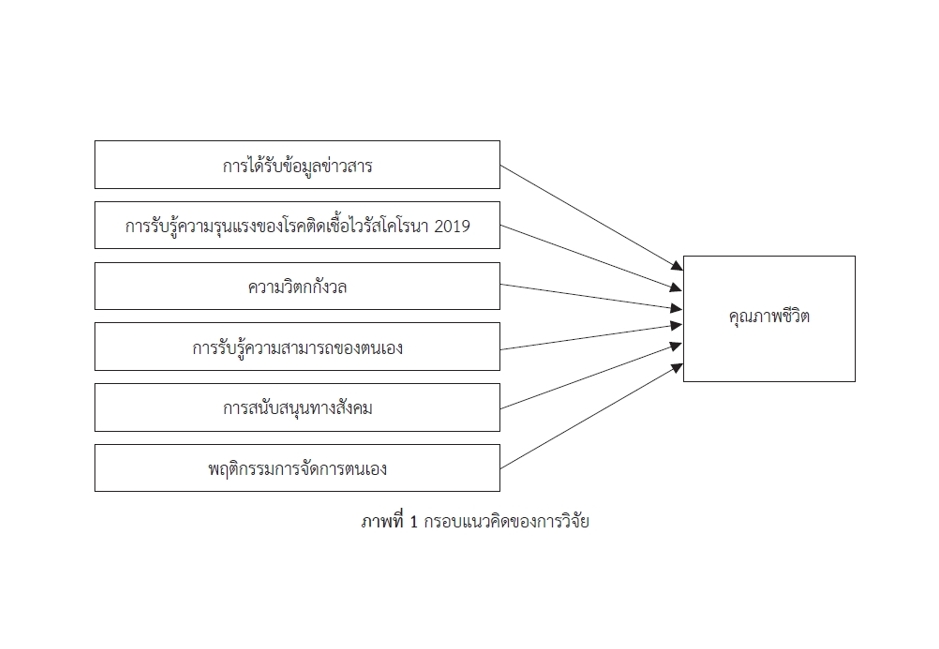
Quality of life is an important goal of the treatment and management of Chronic Obstructive Pulmonary Disease. After the outbreak of COVID-19, COPD patients are considered a high-risk group. This research aimed to study the predictors of quality of life of COPD patients after the outbreak of COVID-19. The sample consisted of 125 COPD patients who visited the outpatient department, COPD clinic, Primary and secondary hospitals. The research instruments included a personal data and health status assessment form, information exposure, perception of severity of COVID-19 in COPD patients, anxiety, self-efficacy perception, social support, self-management behaviors, and a health perception questionnaire. Data were analyzed using descriptive statistics and Enter multiple regression analysis.
The results of the study found that the overall quality of life of COPD patients after the outbreak of COVID-19 was good (M = 65.47, SD = 13.01). Information exposure, perceived severity of coronavirus disease, anxiety, self-efficacy, social support, and self-management behaviors can jointly predict the quality of life of patients with chronic obstructive pulmonary disease after the outbreak of COVID-19 by 53.9 percent (R2 = .539, p< .001). Perceived severity of coronavirus disease 2019 was the most predictive variable (β = .618, p< .001), followed by self-management behavior (β = .293, p< .001), anxiety (β = .249, p<.01), social support (β = .163, p<.05), self-efficacy (β = .143, p<.05), and information exposure (β = .126, p<.05), respectively.
The results of this study can be used as a guideline to promote quality of life by recognizing that the severity of COVID-19 especially after the outbreak of COVID-19, which is a specific context of emerging infectious diseases. It can be applied to promote quality of life and prevent other diseases, including common infectious diseases, emerging diseases, and re-emerging diseases, according to the context of each area, to be more effective and efficient.
References
Albishi, W. K., Ramadan, I. K., Abulkalam, S. M. M., Alsaab, H. A., Hayd, M. Y. B., AL-Ghamdi, M. A., & Al-Raddadi, R. (2024). Factors associated with the severity of COVID-19 in Jeddah, Saudi Arabia: A retrospective cohort study. Australasian Medical Journal, 16(11), 822–841.
Algahtani, F. D., Hassan, S. U., Alsaif, B., & Zrieq, R. (2021). Assessment of the quality of life during COVID-19 pandemic: A cross-sectional survey from the Kingdom of Saudi Arabia. International Journal of Environmental Research and Public Health, 18(3), 847. https://doi.org/10.3390/ijerph18030847
Aree-ue, S., & Yangcharoen., P. O. (2020). Thai version of the 6-item cognitive performance assessment: a test of psychometric properties. Rama Nurse Journal, 26(2), 188-202
Camacho-Rivera, M., Islam, J. Y., & Vidot, D. C. (2020). Associations Between Chronic Health Conditions and COVID-19 Preventive Behaviors Among a Nationally Representative Sample of U.S. Adults: An Analysis of the COVID Impact Survey. Health Equity, 4(1), 336-344. https://doi.org/10.1089/heq.2020.0031
Chonburi Provincial Office of Public Health Strategy and Planning. (2024). Morbidity and mortality rates from 4 chronic non-communicable diseases per 100,000 population, 2023-2024. Retrieved from https://spd.moph.go.th [In Thai]
Fongwanich, K. (2022). Media exposure and quality of life of Thai population aged 50 years and over (Unpublished doctoral dissertation). Chulalongkorn University, Bangkok, Thailand. [In Thai]
Gao, M., Lu, Y., Zhang, L., Shi, M., Zhou, H., Zhou, H., Kuang, X., & Li, Y. (2024). Social anxiety, self‐esteem and quality of life among hypertensive patients during COVID‐19 local epidemic in China: A mediation analysis. Nursing open, 11(1), e2014.
Goodman-Casanova, J. M., Dura-Perez, E., Guzman-Parra, J., Cuesta-Vargas, A., & Mayoral-Cleries, F. (2020). Telehealth home support during COVID-19 confinement for community-dwelling older adults with mild cognitive impairment or mild dementia: survey study. Journal of medical Internet research, 22(5), e19434.
Gvozdanovic, Z., Farcic, N., Simic, H., Buljanovic, V., Gvozdanovic, L., Katalinic, S., ... Prlic, N. (2021). The impact of education, COVID-19 and risk factors on the quality of life in patients with type 2 diabetes. International Journal of Environmental Research and Public Health, 18(5), 2332. https://doi.org/10.3390/ijerph18052332
Global Initiative for Chronic Obstructive Lung Disease. (2024). Global strategy for the diagnosis, management, and prevention of chronic obstructive pulmonary disease: 2024 report. Fontana, WI: Author. Retrieved from https://goldcopd.org/2024-gold-report/
Pipatwet, K. (2009). The results of treatment using a comprehensive treatment program for patients with chronic obstructive pulmonary disease. Journal of Tuberculosis, Thoracic Diseases and Critical Care Medicine, 30(2), 100–111. [In Thai]
Khorani, H., Mohammadi, F., Hosseinkhani, Z., & Motalebi, S. A. (2022). Predictive factors of quality of life in older adults during the COVID-19 pandemic. BMC Psychology, 10(1), 176. doi:10.1186/s40359-022-00885-3
Kobayashi, S., Chiba, F., Ishida, M., Satoh, H., Ono, M., Hanagama, M., & Yanai, M. (2024). Physical activity and outcomes in Japanese patients with chronic obstructive pulmonary disease: From the Ishinomaki COPD network registry. Respiratory Investigation, 62(1), 107–112.
Korth, C. X., Gibson, G. C., Vander Horst, A., Cleveland, K., & Hughes, J. W. (2024). The protective roles of coping self-efficacy and social support for posttraumatic stress during the COVID-19 pandemic. Psychological Trauma: Theory, Research, Practice, and Policy.
Limsringam, P., Sasithanakornkaew, S., & Apisupachok, W. (2021). Information perception about Coronavirus 2019 (COVID-19) through social media with attitudes and disease prevention behaviors in Bangkok. Journal of MCU Nakhondhat, 8(9), 18-33.
Malik, P., Patel, K., Pinto, C., Jaiswal, R., Tirupathi, R., Pillai, S., & Patel, U. (2022). Post-acute COVID-19 syndrome (PCS) and health-related quality of life (HRQoL): A systematic review and meta-analysis. Journal of Medical Virology, 94(1), 253–262. doi:10.1002/jmv.27309
Ministry of Public Health. (2024). Number and mortality rate of chronic obstructive pulmonary disease 2023-2024. Retrieved from https://spd.moph.go.th [In Thai]
Moore, R. C., & Hancock, J. T. (2020). Older Adults, Social Technologies, and the Coronavirus Pandemic: Challenges, Strengths, and Strategies for Support. Social Media + Society, 6(3), 1-5. doi/10.1177/2056305120948162
Napalai, P., Seangpraw, K., Boonyathee, S., & Ong-Artborirak, P. (2022). COVID-19-related knowledge influences mental health, self-care behaviors, and quality of life among elderly with non-communicable diseases in Northern Thailand. Front Public Health, 10, 993531. https://doi.org/10.3389/fpubh.2022.993531 [In Thai]
Nikoloski, Z., Alqunaibet, A. M., Alfawaz, R. A., Almudarra, S. S., Herbst, C. H., El-Saharty, S., Alsukait, R., . . . Algwizani, A. (2021). COVID-19 and non-communicable diseases: Evidence from a systematic literature review. BMC Public Health, 21(1), 1068. doi:10.1186/s12889-021-11116-w
Phuthong, S. (2003). Development of experiential learning models to promote quality of life. For adults in rural communities in the northern region. Journal of Education Studies, 33(1), 49-59. [In Thai]
Rogers, R. W. (1983). Cognitive and physiological processes in fear appeals and attitude change: A revised theory of protection motivation. In J. T. Cacioppo & R. E. Petty (Eds.), Social psychophysiology: A sourcebook (pp. 153-177). New York, NY: Guilford Press.
Songkhao, S., Masingboon, K., Chanthamita-opas, C., & Phonphinij, P. (2022). Factors affecting the prevention of acute exacerbations in patients with chronic obstructive pulmonary disease. Thai Journal of Pharmacy and Health Science, 17(4), 335–343. [In Thai]
Tantinantrakun, S., Khrobsorn, C., & Wichairam, N. (2021). Factors related to quality of life of the elderlyin a community in Bang Pho Nuea subdistrict, Sam Khok district, Pathum Thani provice. Journal of Social Science and Buddhistic Anthropology, 7(11), 352-373.
Photjaroen, T. (2023). Health behaviors management that affect the quality of life of the elderly in Maepum Sub-district, Muang District, Phayao Province. Science and Technology to Community, 1(3), 12-24
World Health Organization. (2020). Coronavirus disease (COVID-19). Retrieved from https://www.who.int/news-room/fact-sheets/detail/coronavirus-disease-(covid-19)
Ware, J., Kosinski, M., Turner-Bowker, D., & Gandek, B. (2002). SF-12v2: how to score version 2 of the SF-12 health survey quality metric incorporated. Massachusetts: Health Assessment Lab Boston.
World Health Organization. (2024). Chronic obstructive pulmonary disease (COPD). Retrieved from https://www.who.int/news-room/fact-sheets/detail/chronic-obstructive-pulmonary-disease-(copd)
Ying, Y., Khunthason, S., Apidechkul, T., & Nilvarangkul, K. (2024). Influencing factors of good quality of life among chronic obstructive pulmonary disease patients living in Zhejiang province, China. Scientific Reports, 14(1), 8687.
Zigmond, A. S., & Snaith, R. P. (1983). The hospital anxiety and depression scale. Acta psychiatrica scandinavica, 67(6), 361-370.
Downloads
Published
How to Cite
Issue
Section
License

This work is licensed under a Creative Commons Attribution-NonCommercial-NoDerivatives 4.0 International License.