ผลของโปรแกรมการจัดการตนเองต่อพฤติกรรมป้องกันภาวะน้ำเกินและน้ำหนักตัวที่เพิ่มขึ้นระหว่างการฟอกเลือดในผู้ป่วยที่ได้รับการฟอกเลือดด้วยเครื่องไตเทียม
คำสำคัญ:
การจัดการตนเอง, ฟอกเลือดด้วยเครื่องไตเทียม, พฤติกรรมการป้องกันภาวะน้ำเกิน, น้ำหนักตัวที่เพิ่มขึ้นระหว่างการฟอกเลือดบทคัดย่อ
การศึกษาครั้งนี้มีวัตถุประสงค์เพื่อศึกษาผลของโปรแกรมการจัดการตนเองต่อพฤติกรรมป้องกันภาวะน้ำเกินและน้ำหนักตัวระหว่างการฟอกเลือดในผู้ป่วยที่ได้รับการฟอกเลือดด้วยเครื่องไตเทียม กลุ่มตัวอย่าง คือ ผู้ป่วยที่ได้รับการฟอกเลือดด้วยเครื่องไตเทียม 3 ครั้งต่อสัปดาห์ จำนวน 50 ราย สุ่มเข้ากลุ่มทดลองและกลุ่มเปรียบเทียบกลุ่มละ 25 ราย กลุ่มทดลองได้รับโปรแกรมการจัดการตนเองเป็นระยะเวลา 8 สัปดาห์ ส่วนกลุ่มเปรียบเทียบได้รับการพยาบาลตามปกติ ดำเนินการวิจัยระหว่างเดือนธันวาคม 2566 ถึงเดือนมีนาคม 2567 เครื่องมือที่ใช้ในการเก็บรวบรวมข้อมูล ได้แก่ แบบบันทึกข้อมูลส่วนบุคคล แบบสอบถามพฤติกรรมป้องกันภาวะน้ำเกิน และแบบบันทึกน้ำหนักตัว วิเคราะห์ข้อมูลด้วยสถิติเชิงพรรณนา สถิติไคสแควร์ สถิติฟิชเชอร์ สถิติ Wilcoxon Signed Rank Test และ Mann-Whitney U test
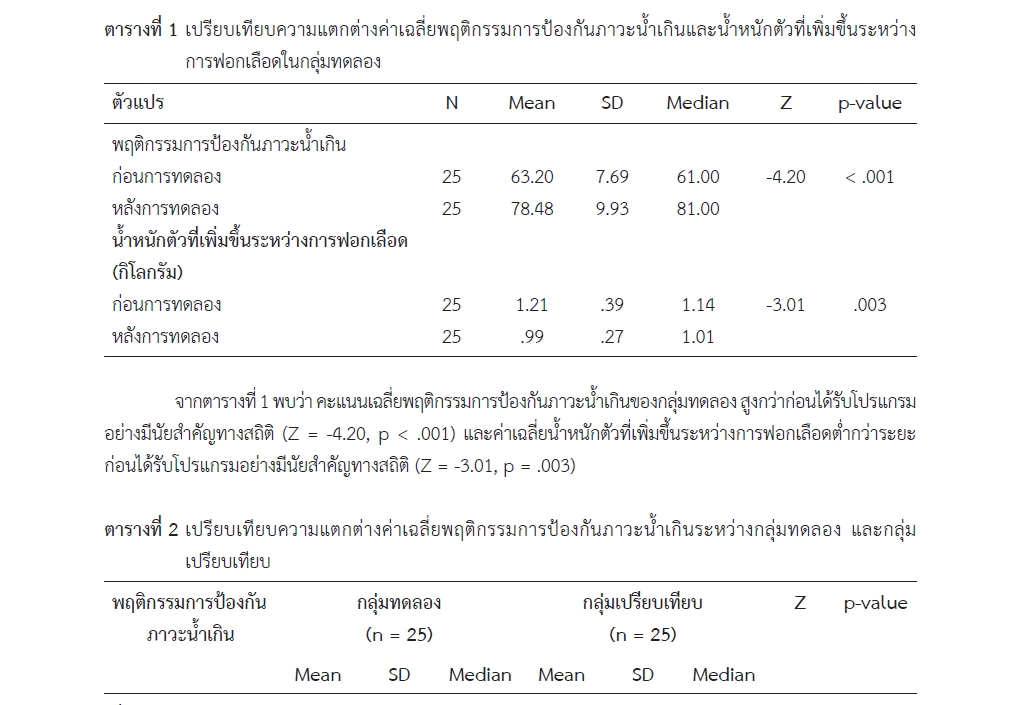
ผลการวิจัยพบว่า กลุ่มทดลองมีคะแนนเฉลี่ยพฤติกรรมป้องกันภาวะน้ำเกินหลังได้รับโปรแกรมสูงขึ้นอย่างมีนัยสำคัญทางสถิติ (Z = -4.20, p < .001) และสูงกว่ากลุ่มเปรียบเทียบอย่างมีนัยสำคัญทางสถิติ (Z = -4.97, p < .001) น้ำหนักตัวเฉลี่ยที่เพิ่มขึ้นระหว่างการฟอกเลือดของกลุ่มทดลองหลังได้รับโปรแกรมลดลงอย่างมีนัยสำคัญทางสถิติ (Z = -3.01, p = .003) แต่ไม่แตกต่างจากกลุ่มเปรียบเทียบ (Z = -1.57, p = .116) ผลการศึกษานี้สนับสนุนว่าโปรแกรมการจัดการตนเองช่วยให้ผู้ป่วยที่ได้รับการฟอกเลือดสามารถปรับเปลี่ยนพฤติกรรมป้องกันภาวะน้ำเกินได้
เอกสารอ้างอิง
Chatchawan, W., & Jariya, K. (2017). An intensive educational program on therapeutic volume overload for end stage renal disease patients receiving hemodialysis: Hemodialysis nurses, roles. Journal of Health Sciences and Wellness, 21(41), 137–150. [In Thai]
Chutamat, T., & Nilobol, K. (2016). Motivational interviewing: Concept and application in persons with chronic kidney disease. Ramathibodi Nursing Journal, 22(3), 223–232. [In Thai]
Duzalan, Ö. B., Cosar, A. A., & Sarikaya, S. (2021). Hemodialysis patients’ experiences of diet and fluid restriction: A qualitative study. Progress in Nutrition, 23(2), 1-11. https://doi.org/10.23751/pn.v23iS2.11985
Grey, M., Schulman-Green, D., Knafl, K., & Reynolds, N. R. (2015). A revised self- and family management framework. Nursing outlook, 63(2), 162-170. https://doi.org/10.1016/j.outlook.2014.10.003
Lambert, K., Mullan, J., & Mansfield, K. (2017). An integrative review of the methodology and findings regarding dietary adherence in end stage kidney disease. BMC Nephrology, 18(1), 318. https://doi.org/10.1186/s12882-017-0734-z
Loutradis, C., Sarafidis, P. A., Ferro, C. J., & Zoccali, C. (2021). Volume overload in hemodialysis: Diagnosis, cardiovascular consequences, and management. Nephrology Dialysis Transplantation, 36(12), 2182-2193. https://doi.org/10.1093/ndt/gfaa182
Maimani, Y. A., Elias, F., Salmi, I. A., Aboshakra, A., Alla, M. A., & Hannawi, S. (2021). Interdialytic weight gain in hemodialysis patients: Worse hospital admissions and intradialytic hypotension. Open Journal of Nephrology, 11(02), 156-170. https://doi.org/10.4236/ojneph.2021.112013
Mananawan, S. P., & Rosa, E. M. (2022). Association between attitudes to self management on adherence in restriction fluid and dietary among patient hemodialysis related to hypervolemia. Journal of Nursing and Health, 3(1), 42-53. https://doi.org/10.31539/josing.v3i1.4093
Nephrology Society of Thailand. (2020). Thailand renal replacement therapy: Year 2020. Retrieved from: https://www.nephrothai.org/wp-content/uploads/2022/06/Final-TRT-report-2020.pdf
Nisakorn, W., & Rungtiwa, S. (2020). Development of a program to enhance the motivation for self-management in delaying the diadetic nephropathy progression of type 2 diabetic patients with hypertension. Royal Thai Naval Medical Journal, 47(2), 373–393. [In Thai]
Opiyo, R. O., Nyasulu, P. S., Olenja, J., Zunza, M., Nguyen, K. A., Bukania, Z., Nabakwe, E., Mbogo, A., & Were, A. O. (2019). Factors associated with adherence to dietary prescription among adult patients with chronic kidney disease on hemodialysis in national referral hospitals in kenya: A mixed-methods survey. Renal Replacement Therapy, 5(1). https://doi.org/10.1186/s41100-019-0237-4
Purba, A. K., Emaliyawati, E., & Sriati, A. (2018). Self-management and self-efficacy in hemodialysis patients. Journal of Nursing Care, 1(2), 129-139.
Roni, A. S., & Awaludin, S. (2023). Intervention compliance of diet and fluids to interdialytic weight gain in patients with chronic kidney disease undergoing hemodialysis: A systematic review. Babali Nursing Research, 4(2), 209-227. https://doi.org/10.37363/bnr.2023.42209
Supap, A., & Pitchapraorn, Y. (2020). The 6 item cognitive function test-thai version: Psychometric property testing. Ramathibodi Nursing Journal, 26(2), 188–202. [In Thai]
Thanairath, R., & Tadsana, C. (2018). The effect of an individual and family self-management program on volume overload in older persons with chronic kidney disease undergoing hemodialysis. Journal of Nursing Science Chulalongkorn University, 30(1), 96–107. [In Thai]
Thidarat, P., Srisuda, M., Yaowalak, N., Walaiporn, K., Porntipa, H., Anchalee, P., Jaruek, S., & Thanaporn, Y. (2018). The effectiveness of self management on fluid overload management for chronic kidney disease patients with hemodialysis at somdej phranangchaoririkit hospital. Royal Thai Naval Medical Journal, 45(1), 106–120. [In Thai]
Vr, V., & Kaur Kang, H. (2021). The worldwide prevalence of nonadherence to diet and fluid restrictions among hemodialysis patients: A systematic review and meta-analysis. Journal of Renal Nutrition. https://doi.org/10.1053/j.jrn.2021.11.007
Wanvisa, S., Nittaya, K., & Petchlada, C. (2020). Self-management on volume overload in end-stage renal disease undergoing hemodialysis patients. Journal of Health Research and Development, 6(2), 5–20. [In Thai]
Wichunee, S., & Nonglak, M. (2021). Effects of self-management program with reminder system via line application to prevent volume overload among patients receiving hemodialysis. Journal of Nursing Science and Health, 44(4), 1–16. [In Thai]
Wileman, V., Chilcot, J., Armitage, C. J., Farrington, K., Wellsted, D. M., Norton, S., Davenport, A., Franklin, G., Da Silva Gane, M., Horne, R., & Almond, M. (2016). Evidence of improved fluid management in patients receiving haemodialysis following a self-affirmation theory-based intervention: A randomised controlled trial. Psychology Health, 31(1), 100-114. https://doi.org/10.1080/08870446.2015.1073729
ดาวน์โหลด
เผยแพร่แล้ว
รูปแบบการอ้างอิง
ฉบับ
ประเภทบทความ
สัญญาอนุญาต

อนุญาตภายใต้เงื่อนไข Creative Commons Attribution-NonCommercial-NoDerivatives 4.0 International License.