The Effects of Self-Management Program on Volume Overload Prevention Behavior and Interdialytic Weight Gain in Patients Undergoing Hemodialysis
Keywords:
Self-management, Hemodialysis, Volume overload prevention behavior, Interdialytic weight gainAbstract
This study aimed to examine the effects of a self-management program on volume overload prevention behavior and interdialytic weight gain in patients undergoing hemodialysis. The sample consisted of patients receiving hemodialysis three times per week. Participants were recruited based on inclusion criteria and randomly assigned to either an experimental group (n = 25) or a comparison group (n = 25). The experimental group participated in an eight-week self-management program, the comparison group received usual care. The study was conducted between December 2023 and March 2024. Research instruments included a demographic data form, a volume overload prevention behavior questionnaire, and a record of interdialytic weight gain. Data were analyzed using descriptive statistics, Chi-square test, Fisher’s exact probability test, Wilcoxon Signed-Rank Test, and Mann-Whitney U test.
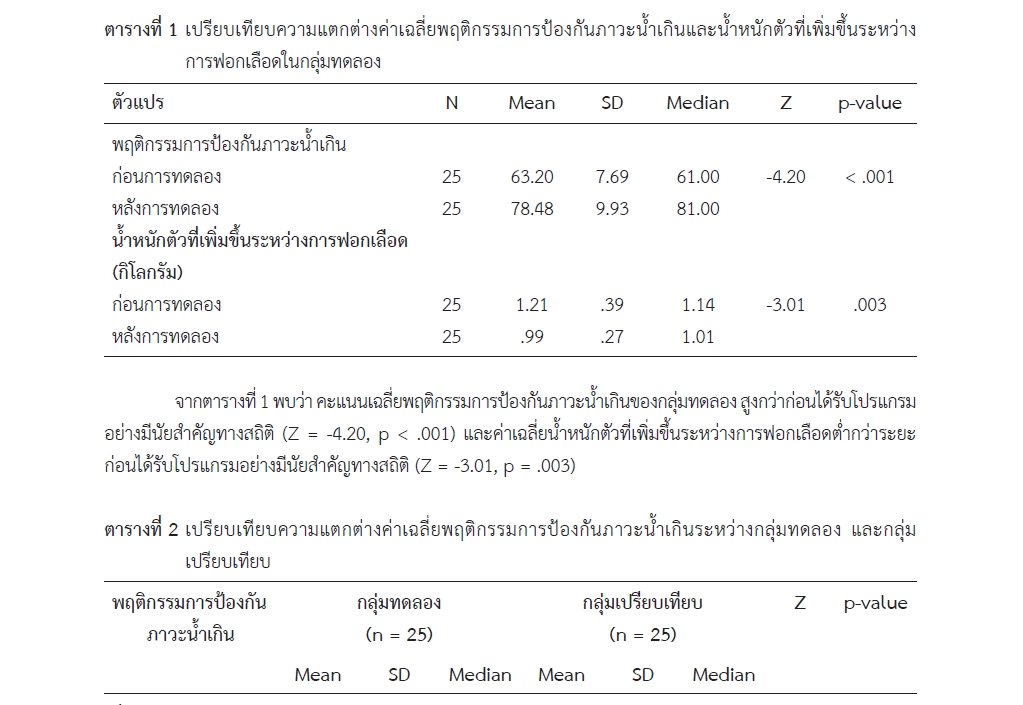
The results showed that the experimental group had a significantly higher mean score of volume overload prevention behavior after the program (Z = -4.20, p < .001) and significantly higher than the comparison group (Z = -4.97, p < .001). Additionally, the experimental group demonstrated a significant decrease in interdialytic weight gain after the program (Z = -3.01, p = .003), although there was no significant difference between the two groups (Z = -1.57, p = .116). These findings support that the self-management program effectively promote preventive behavior and reduce intradialytic volume overload among hemodialysis patients.
References
Chatchawan, W., & Jariya, K. (2017). An intensive educational program on therapeutic volume overload for end stage renal disease patients receiving hemodialysis: Hemodialysis nurses, roles. Journal of Health Sciences and Wellness, 21(41), 137–150. [In Thai]
Chutamat, T., & Nilobol, K. (2016). Motivational interviewing: Concept and application in persons with chronic kidney disease. Ramathibodi Nursing Journal, 22(3), 223–232. [In Thai]
Duzalan, Ö. B., Cosar, A. A., & Sarikaya, S. (2021). Hemodialysis patients’ experiences of diet and fluid restriction: A qualitative study. Progress in Nutrition, 23(2), 1-11. https://doi.org/10.23751/pn.v23iS2.11985
Grey, M., Schulman-Green, D., Knafl, K., & Reynolds, N. R. (2015). A revised self- and family management framework. Nursing outlook, 63(2), 162-170. https://doi.org/10.1016/j.outlook.2014.10.003
Lambert, K., Mullan, J., & Mansfield, K. (2017). An integrative review of the methodology and findings regarding dietary adherence in end stage kidney disease. BMC Nephrology, 18(1), 318. https://doi.org/10.1186/s12882-017-0734-z
Loutradis, C., Sarafidis, P. A., Ferro, C. J., & Zoccali, C. (2021). Volume overload in hemodialysis: Diagnosis, cardiovascular consequences, and management. Nephrology Dialysis Transplantation, 36(12), 2182-2193. https://doi.org/10.1093/ndt/gfaa182
Maimani, Y. A., Elias, F., Salmi, I. A., Aboshakra, A., Alla, M. A., & Hannawi, S. (2021). Interdialytic weight gain in hemodialysis patients: Worse hospital admissions and intradialytic hypotension. Open Journal of Nephrology, 11(02), 156-170. https://doi.org/10.4236/ojneph.2021.112013
Mananawan, S. P., & Rosa, E. M. (2022). Association between attitudes to self management on adherence in restriction fluid and dietary among patient hemodialysis related to hypervolemia. Journal of Nursing and Health, 3(1), 42-53. https://doi.org/10.31539/josing.v3i1.4093
Nephrology Society of Thailand. (2020). Thailand renal replacement therapy: Year 2020. Retrieved from: https://www.nephrothai.org/wp-content/uploads/2022/06/Final-TRT-report-2020.pdf
Nisakorn, W., & Rungtiwa, S. (2020). Development of a program to enhance the motivation for self-management in delaying the diadetic nephropathy progression of type 2 diabetic patients with hypertension. Royal Thai Naval Medical Journal, 47(2), 373–393. [In Thai]
Opiyo, R. O., Nyasulu, P. S., Olenja, J., Zunza, M., Nguyen, K. A., Bukania, Z., Nabakwe, E., Mbogo, A., & Were, A. O. (2019). Factors associated with adherence to dietary prescription among adult patients with chronic kidney disease on hemodialysis in national referral hospitals in kenya: A mixed-methods survey. Renal Replacement Therapy, 5(1). https://doi.org/10.1186/s41100-019-0237-4
Purba, A. K., Emaliyawati, E., & Sriati, A. (2018). Self-management and self-efficacy in hemodialysis patients. Journal of Nursing Care, 1(2), 129-139.
Roni, A. S., & Awaludin, S. (2023). Intervention compliance of diet and fluids to interdialytic weight gain in patients with chronic kidney disease undergoing hemodialysis: A systematic review. Babali Nursing Research, 4(2), 209-227. https://doi.org/10.37363/bnr.2023.42209
Supap, A., & Pitchapraorn, Y. (2020). The 6 item cognitive function test-thai version: Psychometric property testing. Ramathibodi Nursing Journal, 26(2), 188–202. [In Thai]
Thanairath, R., & Tadsana, C. (2018). The effect of an individual and family self-management program on volume overload in older persons with chronic kidney disease undergoing hemodialysis. Journal of Nursing Science Chulalongkorn University, 30(1), 96–107. [In Thai]
Thidarat, P., Srisuda, M., Yaowalak, N., Walaiporn, K., Porntipa, H., Anchalee, P., Jaruek, S., & Thanaporn, Y. (2018). The effectiveness of self management on fluid overload management for chronic kidney disease patients with hemodialysis at somdej phranangchaoririkit hospital. Royal Thai Naval Medical Journal, 45(1), 106–120. [In Thai]
Vr, V., & Kaur Kang, H. (2021). The worldwide prevalence of nonadherence to diet and fluid restrictions among hemodialysis patients: A systematic review and meta-analysis. Journal of Renal Nutrition. https://doi.org/10.1053/j.jrn.2021.11.007
Wanvisa, S., Nittaya, K., & Petchlada, C. (2020). Self-management on volume overload in end-stage renal disease undergoing hemodialysis patients. Journal of Health Research and Development, 6(2), 5–20. [In Thai]
Wichunee, S., & Nonglak, M. (2021). Effects of self-management program with reminder system via line application to prevent volume overload among patients receiving hemodialysis. Journal of Nursing Science and Health, 44(4), 1–16. [In Thai]
Wileman, V., Chilcot, J., Armitage, C. J., Farrington, K., Wellsted, D. M., Norton, S., Davenport, A., Franklin, G., Da Silva Gane, M., Horne, R., & Almond, M. (2016). Evidence of improved fluid management in patients receiving haemodialysis following a self-affirmation theory-based intervention: A randomised controlled trial. Psychology Health, 31(1), 100-114. https://doi.org/10.1080/08870446.2015.1073729
Downloads
Published
How to Cite
Issue
Section
License

This work is licensed under a Creative Commons Attribution-NonCommercial-NoDerivatives 4.0 International License.