Factors Influencing Preventive Health Behaviors for Cannabis Use among Vocational Students
คำสำคัญ:
Family connectedness, Mental health literacy, Optimism, Preventive health behaviors, Psychological flexibilityบทคัดย่อ
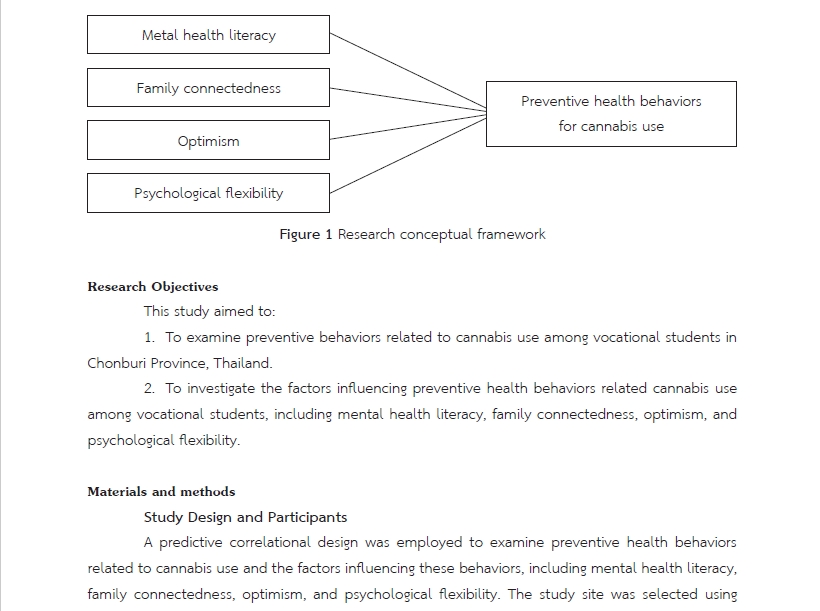
Cannabis use among adolescents is an increasing public health concern, particularly among vocational students who may be vulnerable to substance-related risk behaviors. This predictive correlational cross-sectional study examined preventive health behaviors related to cannabis use among vocational students and investigated the predictive roles of mental health literacy, family connectedness, optimism, and psychological flexibility. The study was conducted between April to June 2024 among 299 vocational students in Chonburi Province, Thailand. Data were collected using six self-report questionnaires assessing demographic characteristics, mental health literacy, family connectedness, optimism, psychological flexibility, and preventive health behaviors for cannabis use. Descriptive statistics and multiple linear regression analyses were used to analyze the data.
The findings showed that the mean score for preventive health behaviors related to cannabis use among participants was 59.47 (SD = 21.89). Mental health literacy, family connectedness, optimism, and psychological flexibility significantly predicted preventive health behaviors related to cannabis use, jointly accounting for 34.5% of the variance (R² = .345, F(4, 294) = 38.64, p < .001). Mental health literacy was the strongest (β = .32, p < .001), whereas psychological flexibility was the weakest (β = .12, p < .05).
The findings highlight the importance of mental health literacy, family connectedness, optimism, and psychological flexibility in influencing preventive health behaviors related to cannabis use among vocational students. These results may inform the development of nursing and mental health interventions designed to strengthen preventive health behaviors and reduce cannabis use risk among adolescents.
เอกสารอ้างอิง
Ansari, H., Khammarnia, M., Okati, H., Fakhrrahimi, S., Mahdavifar, N., Mohammadian, M., . . . Tirgarfakheri, K. (2019). The role of optimism in predicting tobacco smoking and illicit drug use among high school students in southeast of Iran, 2018. Health Scope, 8(2).
Arslan, G., Uzun, K., Güven, A. Z., & Gürsu, O. (2024). Psychological flexibility, self-compassion, subjective well-being, and substance misuse in college students: a serial mediation model. Journal of Ethnicity in Substance Abuse, 1-22. Retrieved from https://www.tandfonline.com/doi/full/10.1080/15332640.2024.2366981
Bronfenbrenner, U. (2000). Ecological systems theory: American Psychological Association.
Campos, L., Dias, P., Palha, F., Duarte, A., & Veiga, E. (2016). Development and psychometric properties of a new questionnaire for assessing mental health literacy in young people.
Carvajal, S. C., Clair, S. D., Nash, S. G., & Evans, R. I. (2011). Relating optimism, hope, and self-esteem to social influences in deterring substance use in adolescents. Journal of Social and Clinical Psychology, 17(4), 443-465. Retrieved from https://guilfordjournals.com/doi/10.1521/jscp.1998.17.4.443
Carver, H., Elliott, L., Kennedy, C., & Hanley, J. (2016). Parent–child connectedness and communication in relation to alcohol, tobacco and drug use in adolescence: An integrative review of the literature. Drugs: Education, Prevention and Policy, 24(2), 119-133. Retrieved from https://doi.org/10.1080/09687637.2016.1221060
Chomsri, P., Aramratana, A., Siviroj, P., & Kuntawee, S. (2017). Prevalence of substance used, and association between substances used with sensation seeking among vocational students. Nursing Journal, 44(2), 172-181. Retrieved from https://he02.tci-thaijo.org/index.php/cmunursing/article/view/97858
Detchaiyot, P., Vatanasin, D., & Dallas, J. C. (2021). Factors predicting intention to quit substance abuse among youth receiving substance abuse treatment. Journal of Health Science Research, 15 No.2, 37-49. Retrieved from https://he01.tci-thaijo.org/index.php/JHR/article/view/247389
González-Cano-Caballero, M., Torrejón-Guirado, M.-C., Cano-Caballero, M. D., Mac Fadden, I., Barrera-Villalba, M.-D.-C., & Lima-Serrano, M. (2023). Adolescents and youths’ opinions about the factors associated with cannabis use: a qualitative study based on the I-Change model. BMC Nursing, 22(1), 114. Retrieved from https://bmcnurs.biomedcentral.com/articles/10.1186/s12912-023-01283-z
Guillemin, F., Bombardier, C., & Beaton, D. (1993). Cross-cultural adaptation of health-related quality of life measures: literature review and proposed guidelines. Journal of clinical epidemiology, 46(12), 1417-1432.
Hoover, D. S., Wetter, D. W., Vidrine, D. J., Nguyen, N., Frank, S. G., Li, Y., . . . Vidrine, J. I. (2018). Enhancing smoking risk communications: the influence of health literacy and message content. Annals of Behavioral Medicine, 52(3), 204-215.
Jorm, A. F. (2000). Mental health literacy: Public knowledge and beliefs about mental disorders. The British Journal of Psychiatry, 177(5), 396-401. Retrieved from https://pubmed.ncbi.nlm.nih.gov/11059991/
Kashdan, T. B., & Rottenberg, J. (2010). Psychological flexibility as a fundamental aspect of health. Clinical Psychology Review, 30(7), 865-878. doi:10.1016/j.cpr.2010.03.001
Krasaesat, W., Deoisres, W., & Wacharasin, C. (2011). Relationships between family rituals, family connectedness and adolescents’ resilience in Ayutthaya Province. The Public Health Journal of Burapha University, 6(2), 59-68.
Kutcher, S., Wei, Y., & Coniglio, C. (2016). Mental health literacy: Past, present, and future. The Canadian Journal of Psychiatry, 61(3), 154-158. Retrieved from https://pubmed.ncbi.nlm.nih.gov/27254090/
Laodarun, S., Hengudomsub, P., & Dallas, J. C. (2018). Factors Influencing Drug Preventive Behaviors among Students of Opportunity Expansion Schools. Journal of Nursing and Healthcare, 36 No.4. Retrieved from https://he01.tci-thaijo.org/index.php/jnat-ned/article/view/165235
Lonhlam, S., Sutiwan, P., & Pornprasertmanit, S. (2008). Relationships among trait anxiety, optimism, and self-esteem of university students. Journal of Health Research, 22(2), 91-96. Retrieved from https://sunthud.com/media/Publication/traitanxiety08.pdf
Nopparat, P. (2000). Factors Related to Sexual risk Behaviors Among High school and Vocational Students. (Master Degree). Chiang Mai University, Retrieved from http://cmuir.cmu.ac.th/jspui/handle/6653943832/29944
ONCB. (2021). Fiscal Report Year 2021. Retrieved from https://www.oncb.go.th/EBookLibrary/annual%20report%202564.pdf
Polit, D. F., & Beck, C. T. (2008). Nursing research: Generating and assessing evidence for nursing practice: Lippincott Williams & Wilkins.
Resnick, M. D., Harris, L. J., & Blum, R. W. (1993). The impact of caring and connectedness on adolescent health and well‐being. Journal of paediatrics and child health, 29, S3-S9.
RTGS. (2022). Controlled Narcotic Drugs list According to Narcotic Drugs Act, B.E.2522. Retrieved from https://ratchakitcha.soc.go.th/pdfdownload/?id=139D307S0000000001000
Sannarin, T., Sakulsriprasert, C., & Thongpibul, K. (2019). Development and psychometric evaluation of the psychological flexibility scale for adolescents. Journal of the Psychiatric Association of Thailand, 65, 25-36.
Scheier, M. F., Carver, C. S., & Bridges, M. W. (1994). Distinguishing optimism from neuroticism (and trait anxiety, self-mastery, and self-esteem): a reevaluation of the Life Orientation Test. Journal of personality and social psychology, 67(6), 1063.
Sequeira, C., Sampaio, F., Pinho, L. G. d., Araújo, O., Lluch Canut, T., & Sousa, L. (2022). Mental health literacy: How to obtain and maintain positive mental health. In (Vol. 13, pp. 1036983): Frontiers Media SA.
Thapinta, D., Dallas, J. C., Sophonsuwapap, P., Vatanasin, D., Tabootwong, W., Kwansumran, W., . . . Inchai, P. (2024). The Development of Cultivating of Psychological Flexibility, Purpose of Life for Preventing Drug Use by Integrated Acceptance and Commitment Therapy and Performing Art among Youths in Eastern region, Thailand: Mixed Method Study. Retrieved from https://kb.hsri.or.th/dspace/handle/11228/6091?locale-attribute=th
UNODC. (2024). Online World Drug Report 2024 - Drug market patterns and trends. Retrieved from https://www.unodc.org/unodc/en/data-and-analysis/wdr2024-drug-market-trends.html
Vipa, D., Anukul, R., Samroui, V., Supaporn, S., & Sarochinee, C. (2022). Context, affecting Factors and substance abuse situation among vocational students in high risk Provinces. Thai Journal of Addiction, 4, 33-50. Retrieved from https://he01.tci-thaijo.org/index.php/pmnidat/article/view/248655
Yangyuen, S., Mahaweerawat, C., Thitisutthi, S., & Mahaweerawat, U. (2021). Relationship between health literacy in substance use and alcohol consumption and tobacco use among adolescents, Northeast Thailand. Journal of Education and Health Promotion, 10. doi:10.4103/jehp.jehp_603_20
Zare, S., Kaveh, M. H., Ghanizadeh, A., Nazari, M., Asadollahi, A., & Zare, R. (2022). Adolescent Mental Health Literacy Questionnaire: Investigating Psychometric Properties in Iranian Female Students. BioMed Research International, 2022.
ดาวน์โหลด
เผยแพร่แล้ว
รูปแบบการอ้างอิง
ฉบับ
ประเภทบทความ
สัญญาอนุญาต

อนุญาตภายใต้เงื่อนไข Creative Commons Attribution-NonCommercial-NoDerivatives 4.0 International License.