การพัฒนาสื่อการเรียนรู้แบบเกมมิฟิเคชันเพื่อการให้คำปรึกษาทางสุขภาพจิต สำหรับนักศึกษาพยาบาล
คำสำคัญ:
เกมมิฟิเคชัน, การให้คำปรึกษา, ผู้สูงอายุ, นักศึกษาพยาบาลชั้นปีที่ 2บทคัดย่อ
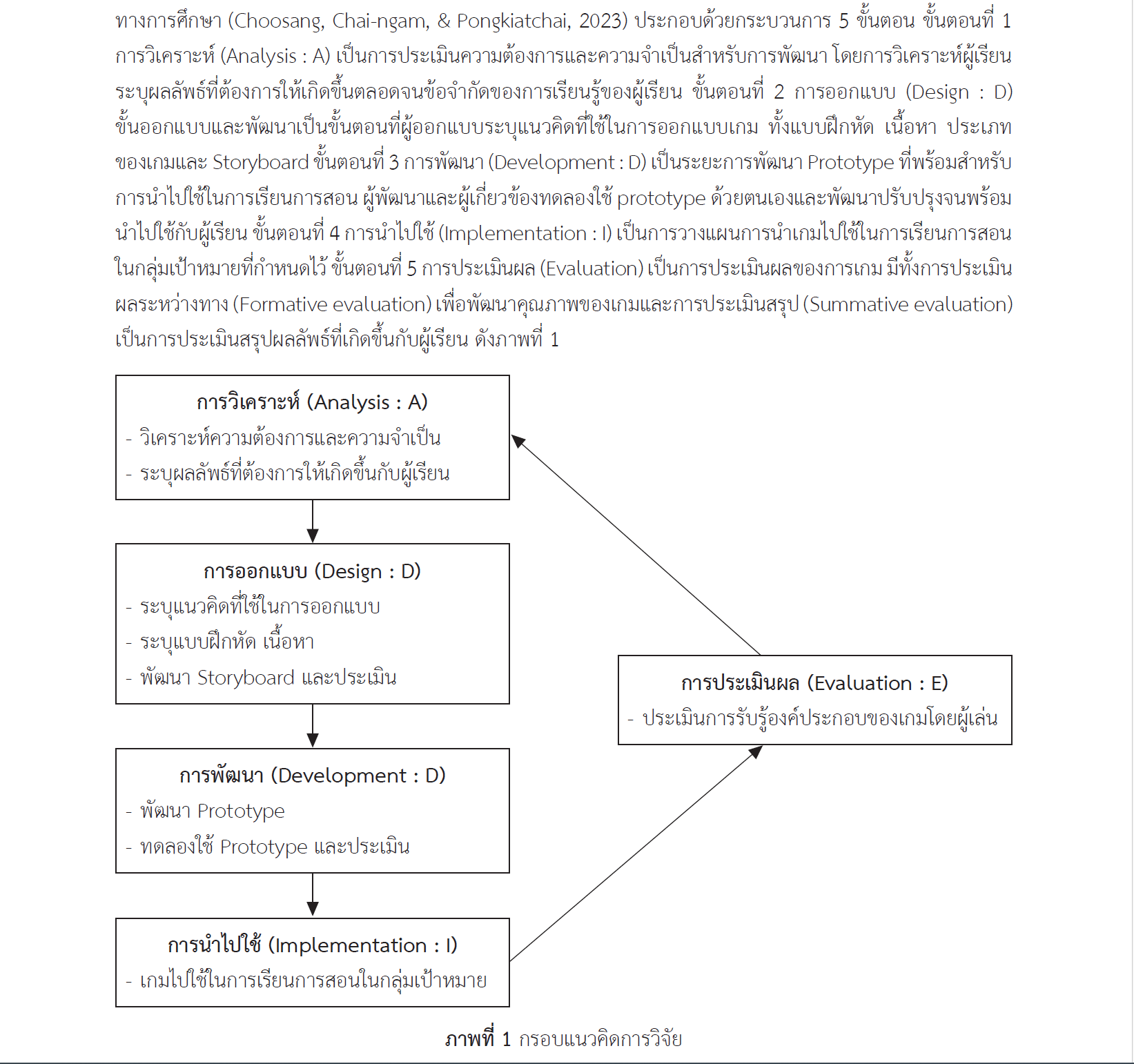
การวิจัยนี้มีวัตถุประสงค์เพื่อพัฒนาสื่อเกมมิฟิเคชันเรื่องการให้คำปรึกษาทางสุขภาพจิตสำหรับนักศึกษาพยาบาลและศึกษาการรับรู้ของนักศึกษาต่อองค์ประกอบของสื่อเกมมิฟิเคชันเรื่องการให้คำปรึกษาทางสุขภาพจิต กระบวนการพัฒนาสื่อ 5 ระยะ คือ 1) การวิเคราะห์ปัญหาและความต้องการ (Analysis) 2) การออกแบบสื่อ (Design) โดยประยุกต์แนวคิดกระบวนการเกม 3) การพัฒนาและสร้างต้นแบบสื่อ (Development) 4) การนำไปใช้ในสถานการณ์จริง (Implementation) และ 5) การประเมินผล (Evaluation) โดยประเมินการรับรู้ของนักศึกษาพยาบาลชั้นปีที่ 3 ต่อองค์ประกอบของการออกแบบเกมคอมพิวเตอร์ คัดเลือกกลุ่มตัวอย่างแบบเจาะจง ได้กลุ่มตัวอย่างนักศึกษาพยาบาลจำนวน 50 คน เครื่องมือที่ใช้วิจัยประกอบด้วย สื่อเกมมิฟิเคชันเรื่องการให้คำปรึกษาทางสุขภาพจิตในผู้สูงอายุ และแบบประเมินการรับรู้ของผู้เล่นต่อองค์ประกอบการออกแบบเกมคอมพิวเตอร์ ค่าความเชื่อมั่น เท่ากับ 0.959 วิเคราะห์ข้อมูลด้วยสถิติเชิงพรรณนา
ผลการวิจัยพบว่า สื่อเกมมิฟิเคชันที่พัฒนาขึ้นประกอบด้วย 3 ส่วนหลัก คือ ส่วนแนะนำกติกาและการเล่นเกม ส่วนเกมเทคนิคการให้คำปรึกษาทางสุขภาพจิต และส่วนเกมฝึกปฏิบัติการให้คำปรึกษาในสถานการณ์สมมติ ผลการประเมินการรับรู้ของนักศึกษาต่อองค์ประกอบของสื่อเกมมิฟิเคชันเรื่องการให้คำปรึกษาทางสุขภาพจิต พบว่า นักศึกษามีการรับรู้ต่อองค์ประกอบของเกมในระดับสูง (Mean = 4.23, SD = 0.38) โดยองค์ประกอบที่มีค่าเฉลี่ยสูงสุดคือ ด้านเนื้อหาและการเล่าเรื่องของเกม (Mean = 4.35, SD = 0.66) รองลงมาคือ องค์ประกอบด้านกฎและกติกาของเกม (Mean = 4.42, SD = 0.61) ผลการศึกษาแสดงให้เห็นว่าสื่อที่พัฒนาขึ้นมีองค์ประกอบในการออกแบบที่สามารถส่งเสริมการเรียนรู้ของนักศึกษาพยาบาลได้อย่างมีประสิทธิภาพ ผลการวิจัยเป็นข้อมูลที่สำคัญในการปรับปรุงสื่อการเรียนรู้เรื่องการให้คำปรึกษาทางสุขภาพจิตเพื่อส่งเสริมให้เกิดผลลัพธ์การเรียนรู้ที่คาดหวัง
เอกสารอ้างอิง
Bakke, J., & Lewis, B. E. (2025). Escaping the ordinary: Mechanics, dynamics, and aesthetic-guided design and evaluation of an escape room for high-yield review in basic medical sciences. Anatomical Sciences Education. Advance online publication. https://doi.org/10.1002/ase.70100
Chaiyachet, M. (2020). The development of counseling skills for counselors using the reflection process in communication teaching and counseling in health course. Journal of Prachomklao College of Nursing, Phetchaburi Province, 3(2), 190–206. [In Thai]
Choosang, S., Chai-ngam, N., & Pongkiatchai, R. (2023). Instructional design under the concept of game-based learning for nursing education. Journal of Food Health and Bioenvironmental Science, 16(1), 60–70.
Groening, C., & Binnewies, C. (2019). “Achievement unlocked!”: The impact of digital achievements as a gamification element on motivation and performance. Computers in Human Behavior, 97, 151–166. https://doi.org/10.1016/j.chb.2019.02.026
Hasna, S. S., & Suwarjo, S. (2023). Effectiveness of basic counseling skills videos on student skills of opening and closing in micro counseling learning. In Proceedings of the International Seminar on Delivering Transpersonal Guidance and Counselling Services in School (ISDTGCSS 2022) (pp. 54–63). Atlantis Press. https://doi.org/10.2991/978-2-38476-034-3_9
Hunicke, R., LeBlanc, M., & Zubek, R. (2004). MDA: A formal approach to game design and game research. AAAI Workshop Technical Report.
Jinruang, S., Nithitantiwat, P., & Naraphong, W. (2018). Outcome-based education in nursing science. Journal of Phrapokklao Nursing College, 29(2), 207–216.
Karcı, H., Akpınar, N., & Ozcan Yuce, U. (2024). Role-play-based gamification for communication skills and nursing competence in internal medicine nursing. Journal of Nursology, 27, 88–100. https://doi.org/10.17049/jnursology.1507481
Kuruca Ozdemir, E., & Dinc, L. (2022). Game-based learning in undergraduate nursing education: A systematic review of mixed-method studies. Nurse Education in Practice, 62, 103375. https://doi.org/10.1016/j.nepr.2022.103375
Kozub, H., Sipii, V., Kozub, Y., Bratytsya, G., & Bondarenko, L. (2025). Effectiveness of gamification in mobile and interactive learning: Analysis of approaches and outcome. International Journal of Interactive Mobile Technologies, 19(8), 27–41. https://doi.org/10.3991/ijim.v19i08.50917
Lai, Y., Saab, N., & Admiraal, W. (2022). University students’ use of mobile technology in self-directed language learning: Using the integrative model of behavior prediction. Computers & Education, 179, 104413. https://doi.org/10.1016/j.compedu.2021.104413
Li, M., Ma, S., & Shi, Y. (2023). Examining the effectiveness of gamification as a tool promoting teaching and learning in educational settings: A meta-analysis. Frontiers in Psychology, 14, 1253549. https://doi.org/10.3389/fpsyg.2023.1253549
McGriff, S. J. (2000). Instructional systems. College of Education, Penn State University. Nylén-Eriksen, M., Stojiljkovic, M., Lillekroken, D., Lindeflaten, K., Hessevaagbakke, E., Flølo, T. N., Hovland, O. J., Solberg, A. M. S., Hansen, S., Bjørnnes, A. K., & Tørris, C. (2025). Game-thinking: Utilizing serious games and gamification in nursing education – A systematic review and meta-analysis. BMC Medical Education, 25(1), 140. https://doi.org/10.1186/s12909-024-06531-7
Phattsajatham, P. (2015). Instructional system design by ADDIE model: The development of metacognition of nursing students. Journal of Education, Silpakorn University, 13(2), 6–17.
Potiratsombut, C., Srichannil, C., & Wongteeratorn, D. (2022). Counseling older adults: Counselors’ perspectives. Thai Journal of Clinical Psychology, 53(3), 47–63. [In Thai]
Ruangpermpoon, K., Rongmuang Yagi, S., & Samarksavee, N. (2020). The effects of computer-assisted instruction of counseling on knowledge and anxiety in nursing students. Journal of Psychiatric and Mental Health Nursing, 34(3), 152–166. [In Thai]
Tavares, N. (2022). The use and impact of game-based learning on the learning experience and knowledge retention of nursing undergraduate students: A systematic literature review. Nurse Education Today, 117, 105484. https://doi.org/10.1016/j.nedt.2022.105484
Thomas, N. J., & Baral, R. (2023). Mechanism of gamification: Role of flow in the behavioral and emotional pathways of engagement in management education. The International Journal of Management Education, 21(1), 100718. https://doi.org/10.1016/j.ijme.2022.100718
Tirakoat, S. (2020). The perception of players toward computer game design. Journal of Innovative Technology Management, 7(1), 88–101. [In Thai]
Yanawongsa, T., Intasingh, S., Nguenyuang, S., & Intanet, N. (2021). Outcome-based curriculum: New approach for higher education curriculum. Humanities and Social Sciences Journal of Pibulsongkram Rajabhat University, 15(2), 279–291. [In Thai]
ดาวน์โหลด
เผยแพร่แล้ว
รูปแบบการอ้างอิง
ฉบับ
ประเภทบทความ
สัญญาอนุญาต

อนุญาตภายใต้เงื่อนไข Creative Commons Attribution-NonCommercial-NoDerivatives 4.0 International License.