Development of a Gamification-Based Media for Mental Health Counseling in the Elderly among Nursing Students
Keywords:
Gamification, Mental health counseling, elderly with hip fractures, Nursing studentsAbstract
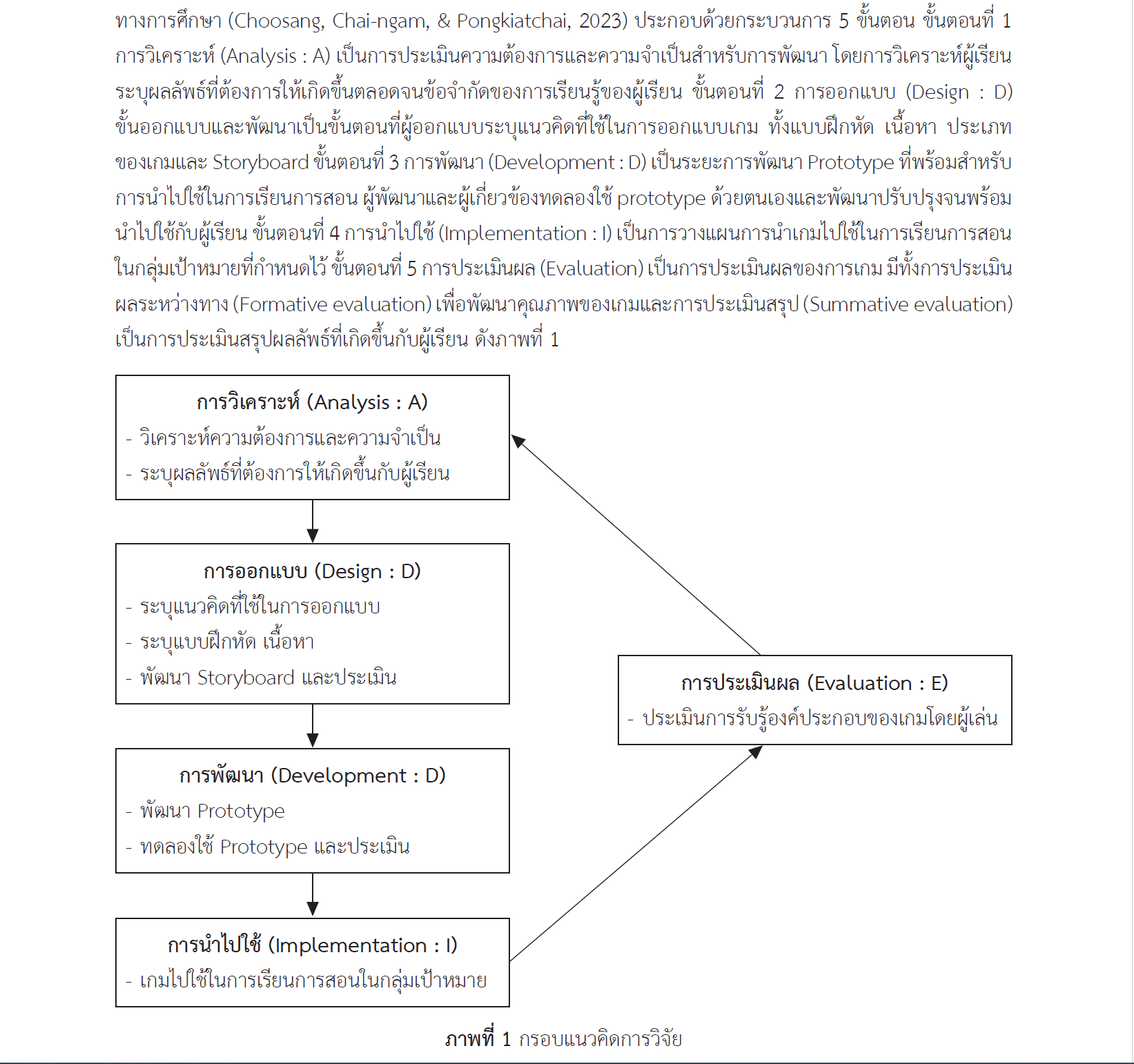
This study aimed to develop Gamification-Based Media for Mental Health Counseling and to examine students’ perceptions toward the components of the gamified mental health counseling media. The development process consisted of five phases: 1) problem and needs analysis 2) Game design 3) prototype development 4) Implementation and 5) Evaluation. The evaluation phases focused on assessing third-year nursing students’ perceptions of computer game design components. A purposive sampling method was used, yielding a sample of 50 third-year nursing students. The research instruments included the gamified mental health counseling and a questionnaire to assess players’ perceptions of game components. The reliability coefficient of the questionnaire was 0.959. Data were analyzed using descriptive statistics.
The results revealed that the developed gamified media comprised three main components: the game rules and gameplay tutorial section, the mental health counseling techniques game section, and the simulated scenario-based counseling practice game section. The evaluation results indicated that students demonstrated a high level of perception toward the gamified media components (Mean = 4.23, SD = 0.38). The highest mean score was found in the content and game narrative domain (Mean = 4.35, SD = 0.66), followed by the game rules and regulation domain (Mean = 4.42, SD = 0.61). The findings suggest that the developed media design components effectively supported nursing students’ learning. The results provide essential evidence for improving mental health counseling learning media to promote expected learning outcomes.
References
Bakke, J., & Lewis, B. E. (2025). Escaping the ordinary: Mechanics, dynamics, and aesthetic-guided design and evaluation of an escape room for high-yield review in basic medical sciences. Anatomical Sciences Education. Advance online publication. https://doi.org/10.1002/ase.70100
Chaiyachet, M. (2020). The development of counseling skills for counselors using the reflection process in communication teaching and counseling in health course. Journal of Prachomklao College of Nursing, Phetchaburi Province, 3(2), 190–206. [In Thai]
Choosang, S., Chai-ngam, N., & Pongkiatchai, R. (2023). Instructional design under the concept of game-based learning for nursing education. Journal of Food Health and Bioenvironmental Science, 16(1), 60–70.
Groening, C., & Binnewies, C. (2019). “Achievement unlocked!”: The impact of digital achievements as a gamification element on motivation and performance. Computers in Human Behavior, 97, 151–166. https://doi.org/10.1016/j.chb.2019.02.026
Hasna, S. S., & Suwarjo, S. (2023). Effectiveness of basic counseling skills videos on student skills of opening and closing in micro counseling learning. In Proceedings of the International Seminar on Delivering Transpersonal Guidance and Counselling Services in School (ISDTGCSS 2022) (pp. 54–63). Atlantis Press. https://doi.org/10.2991/978-2-38476-034-3_9
Hunicke, R., LeBlanc, M., & Zubek, R. (2004). MDA: A formal approach to game design and game research. AAAI Workshop Technical Report.
Jinruang, S., Nithitantiwat, P., & Naraphong, W. (2018). Outcome-based education in nursing science. Journal of Phrapokklao Nursing College, 29(2), 207–216.
Karcı, H., Akpınar, N., & Ozcan Yuce, U. (2024). Role-play-based gamification for communication skills and nursing competence in internal medicine nursing. Journal of Nursology, 27, 88–100. https://doi.org/10.17049/jnursology.1507481
Kuruca Ozdemir, E., & Dinc, L. (2022). Game-based learning in undergraduate nursing education: A systematic review of mixed-method studies. Nurse Education in Practice, 62, 103375. https://doi.org/10.1016/j.nepr.2022.103375
Kozub, H., Sipii, V., Kozub, Y., Bratytsya, G., & Bondarenko, L. (2025). Effectiveness of gamification in mobile and interactive learning: Analysis of approaches and outcome. International Journal of Interactive Mobile Technologies, 19(8), 27–41. https://doi.org/10.3991/ijim.v19i08.50917
Lai, Y., Saab, N., & Admiraal, W. (2022). University students’ use of mobile technology in self-directed language learning: Using the integrative model of behavior prediction. Computers & Education, 179, 104413. https://doi.org/10.1016/j.compedu.2021.104413
Li, M., Ma, S., & Shi, Y. (2023). Examining the effectiveness of gamification as a tool promoting teaching and learning in educational settings: A meta-analysis. Frontiers in Psychology, 14, 1253549. https://doi.org/10.3389/fpsyg.2023.1253549
McGriff, S. J. (2000). Instructional systems. College of Education, Penn State University. Nylén-Eriksen, M., Stojiljkovic, M., Lillekroken, D., Lindeflaten, K., Hessevaagbakke, E., Flølo, T. N., Hovland, O. J., Solberg, A. M. S., Hansen, S., Bjørnnes, A. K., & Tørris, C. (2025). Game-thinking: Utilizing serious games and gamification in nursing education – A systematic review and meta-analysis. BMC Medical Education, 25(1), 140. https://doi.org/10.1186/s12909-024-06531-7
Phattsajatham, P. (2015). Instructional system design by ADDIE model: The development of metacognition of nursing students. Journal of Education, Silpakorn University, 13(2), 6–17.
Potiratsombut, C., Srichannil, C., & Wongteeratorn, D. (2022). Counseling older adults: Counselors’ perspectives. Thai Journal of Clinical Psychology, 53(3), 47–63. [In Thai]
Ruangpermpoon, K., Rongmuang Yagi, S., & Samarksavee, N. (2020). The effects of computer-assisted instruction of counseling on knowledge and anxiety in nursing students. Journal of Psychiatric and Mental Health Nursing, 34(3), 152–166. [In Thai]
Tavares, N. (2022). The use and impact of game-based learning on the learning experience and knowledge retention of nursing undergraduate students: A systematic literature review. Nurse Education Today, 117, 105484. https://doi.org/10.1016/j.nedt.2022.105484
Thomas, N. J., & Baral, R. (2023). Mechanism of gamification: Role of flow in the behavioral and emotional pathways of engagement in management education. The International Journal of Management Education, 21(1), 100718. https://doi.org/10.1016/j.ijme.2022.100718
Tirakoat, S. (2020). The perception of players toward computer game design. Journal of Innovative Technology Management, 7(1), 88–101. [In Thai]
Yanawongsa, T., Intasingh, S., Nguenyuang, S., & Intanet, N. (2021). Outcome-based curriculum: New approach for higher education curriculum. Humanities and Social Sciences Journal of Pibulsongkram Rajabhat University, 15(2), 279–291. [In Thai]
Downloads
Published
How to Cite
Issue
Section
License

This work is licensed under a Creative Commons Attribution-NonCommercial-NoDerivatives 4.0 International License.