Factors Associated With Breastfeeding Behavior Among Migrant Postpartum Mothers In Chonburi Province
คำสำคัญ:
Breastfeeding behaviors, Postpartum mothers, Migrant, Factors associatedบทคัดย่อ
This correlational study aimed to examine the level of breastfeeding behavior among migrant postpartum mothers and the factors associated with breastfeeding behavior in Chonburi Province. The sample consisted of 125 migrant postpartum mothers selected through convenience sampling. Data were collected between December 2024 and May 2025. Data were collected using 7 structured questionnaires: 1) A Personal and obstetric information, 2) the breastfeeding Behavior Assessment form, 3) The Infant Feeding Intentions Questionnaire, 4) the Iowa Infant Feeding Attitude Scale, 5) the Group reference norm for breastfeeding, 6) the Breastfeeding Attrition Prediction Tool, and 7) the Breastfeeding Support from Nurses. The (Cronbach’s alpha) of the instruments were 0.71, 0.85, 0.74, 0.72, 0.75, and 0.87, respectively. Data were analyzed using descriptive statistics, Pearson’s correlation coefficient, and the point-biserial correlation coefficient
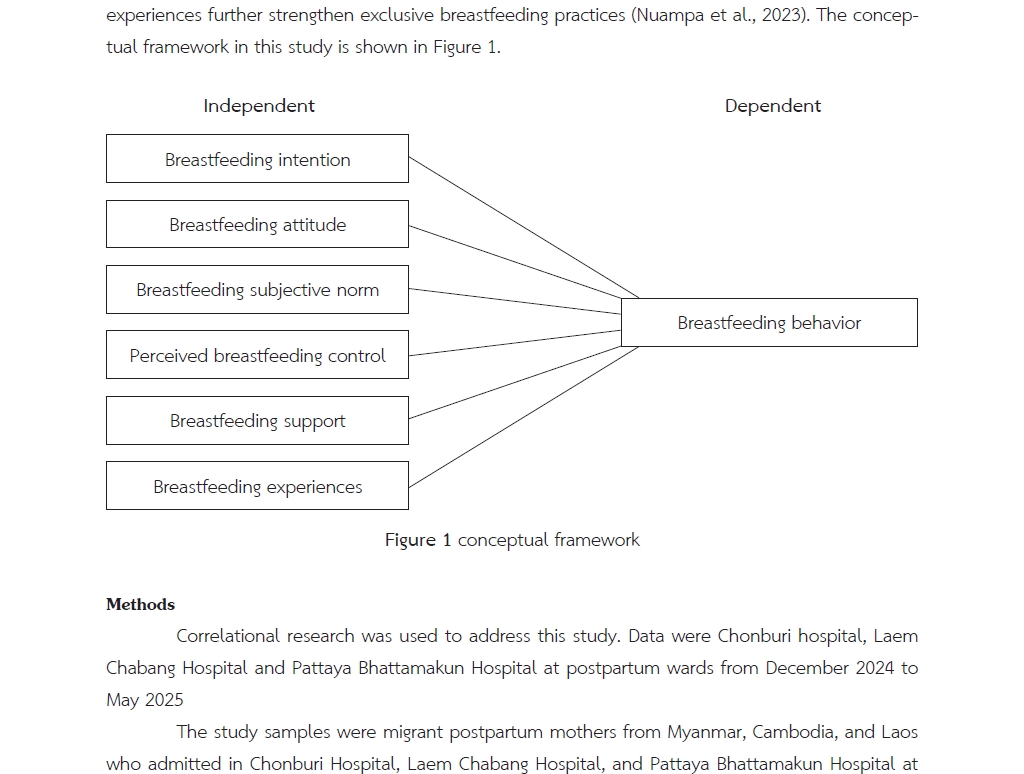
The findings showed that breastfeeding behavior was at good level. Breastfeeding behavior was significantly positively correlated with perceived breastfeeding control (r = .263, p =.003), breastfeeding support (r = .220, p =.015), breastfeeding experience (r = .219, p =.015), breastfeeding subjective norm (r = .203, p = .025), and breastfeeding intention (r = .197, p =.029). However, no significant relationship was found between breastfeeding attitude and breastfeeding behavior (r = .072, p = .429).
Findings suggested that enhancing perceived control, providing adequate support, and reinforcing positive social norms and intentions may improve breastfeeding behavior among migrant mothers. Culturally sensitive counseling and care are recommended to promote successful breastfeeding practices.
เอกสารอ้างอิง
Ajzen, I. (1991). The theory of planned behavior. Organizational Behavior and Human Decision Processes, 50(2), 179–211. https://doi.org/10.1016/0749-5978(91)90020-T
Chisuwan, C., Prasopkittikun, T., Sangperm, P., & Payakkaraung, S. (2012). Predictive power of support from husbands, grandmothers, and nurses on duration of exclusive breastfeeding. Nursing Science Journal of Thailand, 30(1), 70–80.
Chansiri, S., Phahuwatanakorn, W., & Yusamran, C. (2018). Influences of breastfeeding attitude, subjective norm, and self-efficacy on intention to exclusive breastfeeding among teenage pregnant women. Nursing Science Journal of Thailand, 35(4), 49–60. https://he02.tci-thaijo.org/index.php/ns/article/view/116181
Gu, Y., Xiang, Y., Chen, X., Wang, L., Shan, C., & Ji, M. (2025). Evaluating and predicting exclusive breastfeeding behavior based on an energy vitality model during women's lactation: A longitudinal study. BMC Pregnancy and Childbirth, 25(1), 768. https://doi.org/10.1186/s12884-025-07851-2
Lertsakornsiri & Saibae, (2018). The relationship between self-efficacy, self-esteem, attitude toward breastfeeding and breastfeeding behaviors in the first-time teenage postpartum mothers. Journal of Nursing and Education. https://he01.tci-thaijo.org/index.php/JNAE/article/view/152482
Mora, A. D. L., Russell, D. W., Dungy, C. I., Losch, M., & Dusdieker, L. (1999). The Iowa infant feeding attitude scale: Analysis of reliability and validity 1. Journal of Applied Social Psychology, 29(11), 2362-2380.
Wannasen, S., Sangin, S. & Suppasri, P. (2022). Factors predicting intention to exclusive breastfeeding among mothers with elective cesarean section at a private hospital, bangkok metropolis. Nursing Science Journal of Thailand, 41(1), 12–26. https://he02.tci-thaijo.org/index.php/ns/article/view/255871
Wen, J., Yu, G., Kong, Y., Wei, H., Zhao, S., & Liu, F. (2021). Effects of a theory of planned behavior-based intervention on breastfeeding behaviors after cesarean section: A randomized controlled trial. International journal of nursing sciences, 8(2), 152–160. https://doi.org/10.1016/j.ijnss.2021.03.012
Klomyong, S., Sripum, J., Karabutr, T., & Kulanuwat, A. (2024). A comparitive study of pregnancy outcomes between pregnant teenagers and adults at Uthai Thani Hospital. Nursing Journal of The Ministry of Public Health, 34(2), 149–159. retrieved from https://he02.tci-thaijo.org/index.php/tnaph/article/view/270895
Nuampa, S., Kuesakul, K., Prasong, S., & Sudphet, M. (2023). Social support for breastfeeding practice during the COVID-19 second wave in Thailand: A cross-sectional study. Journal of Human Lactation, 39(2), 206–216.
Sangin, S., Chuenarrom, N., & Cheidchim, R. (2022). Factors predicting six-month exclusive breastfeeding in eastern region of thailand. Nursing Science Journal of Thailand, 38(3), 22–34. https://he02.tci-thaijo.org/index.php/ns/article/view/241138
Sayed, S. H., & Bugis, B. A. (2023). Predicting perceived exclusive breastfeeding behavior among higher education female students in Saudi Arabia: Application of the theory of planned behavior using structural equation modeling. African journal of reproductive health, 27(5), 58–71. https://doi.org/10.29063/ajrh2023/v27i5.6
Tariqujjaman, M., Hasan, M. M., Mahfuz, M., Hossain, M., & Ahmed, T. (2022). Association between mother's education and infant and young child feeding practices in South Asia. Nutrients, 14(7), 1514. https://doi.org/10.3390/nu14071514
World Health Organization. (2021). Infant and young child feeding. https://www.who.int/news-room/fact-sheets/detail/infant-and-young-child-feeding
Zhang, Y., Qian, X., & Xiao, Y. (2021). Social support, subjective norms, and exclusive breastfeeding in Chinese mothers of preterm infants: A longitudinal study. BMC Pregnancy and Childbirth, 21, Article 89.
ดาวน์โหลด
เผยแพร่แล้ว
รูปแบบการอ้างอิง
ฉบับ
ประเภทบทความ
สัญญาอนุญาต

อนุญาตภายใต้เงื่อนไข Creative Commons Attribution-NonCommercial-NoDerivatives 4.0 International License.