การพัฒนารูปแบบการดูแลผู้ป่วยเบาหวานชนิดที่ 2 ที่ควบคุมระดับน้ำตาลในเลือดไม่ได้ ศูนย์สุขภาพชุมชนเมืองย่านยาว โรงพยาบาลตะกั่วป่า
คำสำคัญ:
รูปแบบการดูแล, โรคเบาหวานชนิดที่ 2, ผู้ป่วยเบาหวานที่ควบคุมระดับน้ำตาลในเลือดไม่ได้บทคัดย่อ
การวิจัยและพัฒนานี้มีวัตถุประสงค์เพื่อศึกษาสภาพปัญหา พัฒนารูปแบบการดูแลผู้ป่วย และศึกษาประสิทธิผลของรูปแบบ โดยดำเนินการ 3 ขั้นตอน ได้แก่ 1) ศึกษาเอกสารและการวิจัยเชิงคุณภาพ 2) พัฒนารูปแบบการดูแล GMSC Model และ 3) ศึกษาประสิทธิผลโดยใช้การวิจัยแบบกึ่งทดลองสองกลุ่มวัดก่อนและหลัง กลุ่มตัวอย่างเป็นผู้ป่วยเบาหวานชนิดที่ 2 ที่ควบคุมระดับน้ำตาลในเลือดไม่ได้ จำนวน 70 คน สุ่มเข้ากลุ่มทดลองและกลุ่มควบคุม กลุ่มละ 35 คน ระยะเวลา 12 สัปดาห์ เครื่องมือวิจัยประกอบด้วย GMSC Model แบบสอบถามพฤติกรรมสุขภาพ และการตรวจค่าน้ำตาลสะสมในเลือด (HbA1C) แบบสอบถามมีค่าความตรงตามเนื้อหา 0.67–1.00 และค่าความเชื่อมั่น Cronbach’s alpha = 0.827 วิเคราะห์ข้อมูลด้วยสถิติเชิงพรรณนา paired t-test และ independent t-test
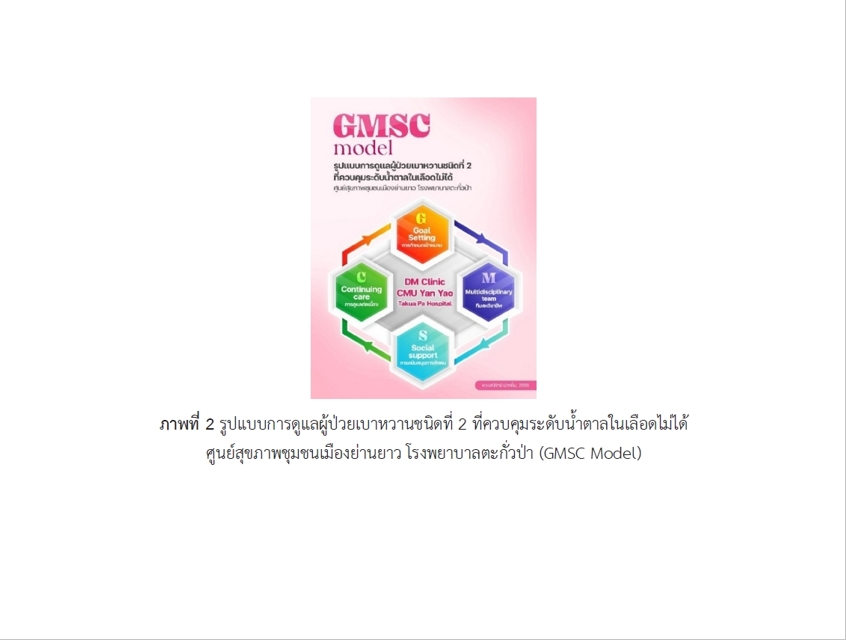
ผลการวิจัยพบว่า 1) ปีงบประมาณ 2566 จำนวนผู้ป่วยเบาหวานที่ HbA1C ≥7% เพิ่มขึ้นร้อยละจากปีงบประมาณ 2565 เป็น 56.17 ปัญหาที่พบคือ รับประทานอาหารหวาน ขาดความรู้ในการเลือกรับประทานอาหาร รับประทานยาไม่ต่อเนื่อง วิตกกังวลเรื่องโรค มีความต้องการความช่วยเหลือจากทีมสหวิชาชีพ ต้องการความรู้และช่องทางในปรึกษา 2) รูปแบบที่พัฒนาขึ้นคือ GMSC Model ประกอบด้วย Goal Setting (การกำหนดเป้าหมาย Multidisciplinary team (ทีมสหวิชาชีพ) Social support (การสนับสนุนทางสังคม) และ Continuing Care (การติดตามดูแลต่อเนื่อง) 3) หลังใช้รูปแบบ กลุ่มทดลองมีคะแนนพฤติกรรมสุขภาพเพิ่มขึ้นและระดับน้ำตาลสะสมในเลือดลดลง และดีกว่ากลุ่มควบคุมอย่างมีนัยสำคัญ (p<.001, .036)
สรุปได้ว่า GMSC Model มีประสิทธิภาพในการส่งเสริมพฤติกรรมสุขภาพและลดระดับ HbA1C สามารถประยุกต์ใช้ในการดูแลผู้ป่วยเบาหวานที่มีทีมสหวิชาชีพ
เอกสารอ้างอิง
Alliston, P., Jovkovic, M., Khalid, S., Fitzpatrick-Lewis, D., Ali, M. U., & Sherifali, D. (2024). The effects of diabetes self-management programs on clinical and patient-reported outcomes in older adults: A systematic review and meta-analysis. Frontiers in Clinical Diabetes and Healthcare, 17(5), 1348104. doi:10.3389/fcdhc.2024.1348104
American Diabetes Association. (2023). Standards of care in diabetes—2023. Diabetes Care, 46(Suppl. 1), S1–S291.
Boonkruachoo, A., & Kanjanapangka, P. (2023). Effectiveness of an innovative health promotion model for patients with diabetes at Laplae Hospital. Journal of Disease Prevention and Control: Phitsanulok, 10(1), 73–91.
Boonmee, P., Jaiboon, S., Wisitjaroen, K., & Kaweenantachai, D. (2024). Effects of a Self-Management Behaviors for Slowing the Progression of Diabetic Nephropathy among Diabetic Patients at Fang Hospital, Chiang Mai Province. Journal of Health Sciences Boromarajonani College of Nursing, Sunpasitthiprasong, 8(2), 1–15.
Crabtree, B. F., & Miller, W. L. (1992). A template approach to text analysis: Developing and using codebooks. In B. F. Crabtree & W. L. Miller (Eds.), Doing qualitative research in primary care: Multiple strategies (pp. 93–109). Sage Publications.
Department of Disease Control. (2021). Report on the situation of diabetes and its complications. Ministry of Public Health.
Faul, F., Erdfelder, E., Lang, A. G., & Buchner, A. (2007). G*Power 3: A flexible statistical power analysis program for the social, behavioral, and biomedical sciences. Behavior Research Methods, 39(2), 175–191.
Fraenkel, R. J., Wallen, E. N., & Hyun, H. H. (2012). How to design and evaluate research in education (8th ed.). New York: McGraw-Hill.
International Diabetes Federation. (2025). IDF diabetes atlas (11th ed.). Brussels, Belgium: Author.
Isarapanit, A., & Nawsuwan, K. (2022). Development of care model in Diabetic and Hypertention with stage 4 renal complications in Khuan Niang District Health Network, Songkhla Province. Boromarajonani College of Nursing, Uttaradit Journal, 14(1), 157–175.
Jivaramonaikul, T., & Sirimanassakul, K. (2025). Factors affecting exercise behaviour among Thai people. Weekly Epidemiological Surveillance Report, 56(10), 1–12.
Kanfer, F. H., & Gaelick-Buys, L. (1991). Self-management methods. In F. H. Kanfer & A. P. Goldstein (Eds.), Helping people change: A textbook of methods (4th ed., pp. 305–360). Oxford: Pergamon Press.
Locke, E. A., & Latham, G. P. (1990). A theory of goal setting and task performance. Englewood Cliffs, NJ: Prentice-Hall.
Nawsuwan, S., & Thongnuannual, P. (2023). Development of a social support model to promote health care behaviors among diabetic patients with uncontrolled blood sugar levels. Journal of Public Health and Innovation, 3(3), 18–31.
Ruamsuk, T. (2024). Nursing care for elderly patients with chronic obstructive pulmonary disease and bladder cancer after bladder surgery with fatigue and dizziness in the community using Orem’s nursing theory: A case study. Journal of Research for Health Promotion and Quality of Life, 4(1), 107–118.
Rupsom, M., Worawittayasrangkul, R., Rungrueng, W., & Kaewwanna, C. (2024). Effectiveness of discharge planning program for diabetic patients with hyperglycemic patients for decrease readmission rate at Nonghan Hospital, Udon Thani Province. Journal of Environmental Education Medical and Health, 9(4), 349–360.
Sari, C. W. M., Haroen, H., Juniarti, N., Amalia, L., & Pardosi, J. F. (2025). A systematic review of continuity of care strategies for enhancing diabetes self-management in older adults in Asian countries. Journal of Multidisciplinary Healthcare, 18, 5441–5459. doi:10.2147/JMDH.S536258
The Diabetes Association of Thailand. (2023). Clinical practice guidelines for diabetes, 2023. Bangkok: Srimuang Printing Co., Ltd.
The Nephrology Society of Thailand. (2022). Recommendations for the care of patients with chronic kidney disease before renal replacement therapy, 2022 (Revised edition). Bangkok: Srimuang Printing.
Traisaeng, A. (2024). Effects of a self-management support program on self-management behaviors and glycated hemoglobin levels among patients with uncontrolled type 2 diabetes mellitus. Thailand Journal of Health Promotion and Environmental Health, 47(2), 98–112.
Wachirarommaneeyakul, T. (2024). Effective of social support program among uncontrolled diabetic patients at Thungsaliam Hospital, Sukhothai Province. Nursing, Health, and Public Health Journal, 3(3), 1–13.
Wichian, K. (1995). Statistics for research (5th ed.). Srinakharinwirot University Press.
Wongsreesha, W., Saensupa, W., & Niamdaeng, P. (2024). Development of a health behavior modification model to reduce glycated hemoglobin (HbA1C) levels among diabetic patients through self-management awareness during the COVID-19 situation at Nakae Hospital, Nakhon Phanom Province. Journal of Environmental Health and Community Health, 9(5), 220–228.
World Health Organization. (2022). Package of essential noncommunicable (PEN) disease interventions for primary health care. Geneva: World Health Organization.
Yan Yao Health Center. (2024). Diabetes clinic patient record files, 2022–2024. Duplicated document, Department of Social Medicine, Takuapa Hospital, Phangnga Province.
ดาวน์โหลด
เผยแพร่แล้ว
รูปแบบการอ้างอิง
ฉบับ
ประเภทบทความ
สัญญาอนุญาต

อนุญาตภายใต้เงื่อนไข Creative Commons Attribution-NonCommercial-NoDerivatives 4.0 International License.