Development of Care Model for Type 2 Diabetes Patients with Uncontrolled Blood Glucose at Yan Yao Health Center, Takua Pa Hospital
Keywords:
Care Model, Type 2 diabetes mellitus, Uncontrolled diabetic patientsAbstract
This research and development study aimed to examine the existing problems, develop a patient care model, and evaluate its effectiveness. The study was conducted in three phases: (1) reviewing literature and conducting qualitative research, (2) developing the GMSC Model for patient care, and (3) evaluating its effectiveness using a quasi-experimental design with a two-group pretest–posttest. The samples consisted of 70 patients with type 2 diabetes who had poor blood sugar control, randomly assigned to an experimental group and a control group, with 35 participants in each group, over a 12-week period. The research instruments included the GMSC Model, a health behavior questionnaire, and a blood test for glycated hemoglobin (HbA1C). The questionnaire had content validity indices ranging from 0.67 to 1.00 and a reliability coefficient (Cronbach’s alpha) of 0.827 Data were analyzed using descriptive statistics, paired t-test, and independent t-test.
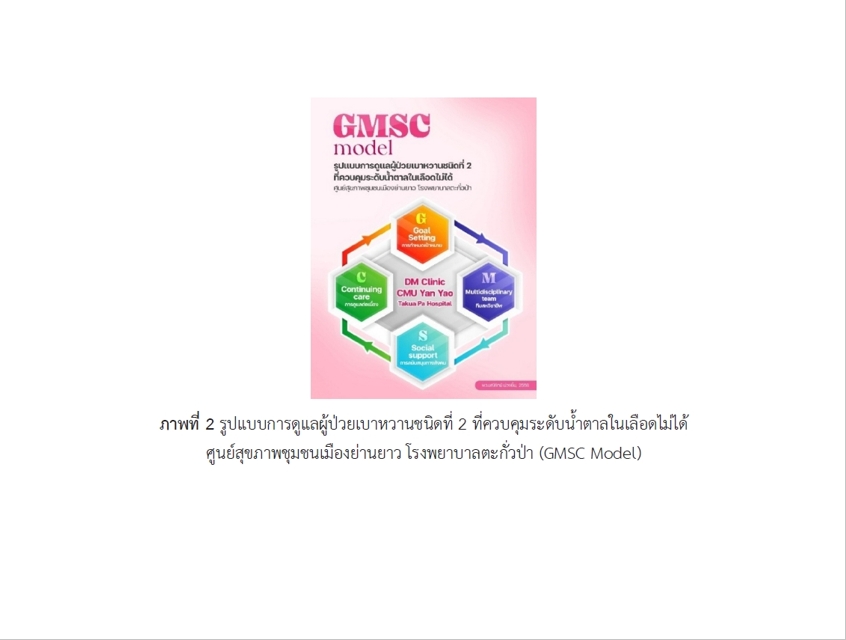
The results revealed that 1) In fiscal year 2023, the proportion of diabetic patients with HbA1c levels ≥ 7% increased from fiscal year 2022 to 56.17%. Identified problems included high sugar consumption, lack of knowledge in dietary selection, inconsistent medication adherence, and anxiety regarding the disease. Patients expressed a need for multidisciplinary team support, as well as educational resources and accessible consultation channels. 2) The developed "GMSC Model" consists of four components: Goal Setting, Multidisciplinary team, Social support, and Continuing Care. 3) After implementing the model, the experimental group showed a significant increase in health behavior scores and a reduction in HbA1c levels, performing significantly better than the control group (p < .001 and .036, respectively).
In conclusion, the GMSC Model effectively promotes health behaviors, reduces HbA1c levels, and can be applied in diabetes care within a multidisciplinary team setting.
References
Alliston, P., Jovkovic, M., Khalid, S., Fitzpatrick-Lewis, D., Ali, M. U., & Sherifali, D. (2024). The effects of diabetes self-management programs on clinical and patient-reported outcomes in older adults: A systematic review and meta-analysis. Frontiers in Clinical Diabetes and Healthcare, 17(5), 1348104. doi:10.3389/fcdhc.2024.1348104
American Diabetes Association. (2023). Standards of care in diabetes—2023. Diabetes Care, 46(Suppl. 1), S1–S291.
Boonkruachoo, A., & Kanjanapangka, P. (2023). Effectiveness of an innovative health promotion model for patients with diabetes at Laplae Hospital. Journal of Disease Prevention and Control: Phitsanulok, 10(1), 73–91.
Boonmee, P., Jaiboon, S., Wisitjaroen, K., & Kaweenantachai, D. (2024). Effects of a Self-Management Behaviors for Slowing the Progression of Diabetic Nephropathy among Diabetic Patients at Fang Hospital, Chiang Mai Province. Journal of Health Sciences Boromarajonani College of Nursing, Sunpasitthiprasong, 8(2), 1–15.
Crabtree, B. F., & Miller, W. L. (1992). A template approach to text analysis: Developing and using codebooks. In B. F. Crabtree & W. L. Miller (Eds.), Doing qualitative research in primary care: Multiple strategies (pp. 93–109). Sage Publications.
Department of Disease Control. (2021). Report on the situation of diabetes and its complications. Ministry of Public Health.
Faul, F., Erdfelder, E., Lang, A. G., & Buchner, A. (2007). G*Power 3: A flexible statistical power analysis program for the social, behavioral, and biomedical sciences. Behavior Research Methods, 39(2), 175–191.
Fraenkel, R. J., Wallen, E. N., & Hyun, H. H. (2012). How to design and evaluate research in education (8th ed.). New York: McGraw-Hill.
International Diabetes Federation. (2025). IDF diabetes atlas (11th ed.). Brussels, Belgium: Author.
Isarapanit, A., & Nawsuwan, K. (2022). Development of care model in Diabetic and Hypertention with stage 4 renal complications in Khuan Niang District Health Network, Songkhla Province. Boromarajonani College of Nursing, Uttaradit Journal, 14(1), 157–175.
Jivaramonaikul, T., & Sirimanassakul, K. (2025). Factors affecting exercise behaviour among Thai people. Weekly Epidemiological Surveillance Report, 56(10), 1–12.
Kanfer, F. H., & Gaelick-Buys, L. (1991). Self-management methods. In F. H. Kanfer & A. P. Goldstein (Eds.), Helping people change: A textbook of methods (4th ed., pp. 305–360). Oxford: Pergamon Press.
Locke, E. A., & Latham, G. P. (1990). A theory of goal setting and task performance. Englewood Cliffs, NJ: Prentice-Hall.
Nawsuwan, S., & Thongnuannual, P. (2023). Development of a social support model to promote health care behaviors among diabetic patients with uncontrolled blood sugar levels. Journal of Public Health and Innovation, 3(3), 18–31.
Ruamsuk, T. (2024). Nursing care for elderly patients with chronic obstructive pulmonary disease and bladder cancer after bladder surgery with fatigue and dizziness in the community using Orem’s nursing theory: A case study. Journal of Research for Health Promotion and Quality of Life, 4(1), 107–118.
Rupsom, M., Worawittayasrangkul, R., Rungrueng, W., & Kaewwanna, C. (2024). Effectiveness of discharge planning program for diabetic patients with hyperglycemic patients for decrease readmission rate at Nonghan Hospital, Udon Thani Province. Journal of Environmental Education Medical and Health, 9(4), 349–360.
Sari, C. W. M., Haroen, H., Juniarti, N., Amalia, L., & Pardosi, J. F. (2025). A systematic review of continuity of care strategies for enhancing diabetes self-management in older adults in Asian countries. Journal of Multidisciplinary Healthcare, 18, 5441–5459. doi:10.2147/JMDH.S536258
The Diabetes Association of Thailand. (2023). Clinical practice guidelines for diabetes, 2023. Bangkok: Srimuang Printing Co., Ltd.
The Nephrology Society of Thailand. (2022). Recommendations for the care of patients with chronic kidney disease before renal replacement therapy, 2022 (Revised edition). Bangkok: Srimuang Printing.
Traisaeng, A. (2024). Effects of a self-management support program on self-management behaviors and glycated hemoglobin levels among patients with uncontrolled type 2 diabetes mellitus. Thailand Journal of Health Promotion and Environmental Health, 47(2), 98–112.
Wachirarommaneeyakul, T. (2024). Effective of social support program among uncontrolled diabetic patients at Thungsaliam Hospital, Sukhothai Province. Nursing, Health, and Public Health Journal, 3(3), 1–13.
Wichian, K. (1995). Statistics for research (5th ed.). Srinakharinwirot University Press.
Wongsreesha, W., Saensupa, W., & Niamdaeng, P. (2024). Development of a health behavior modification model to reduce glycated hemoglobin (HbA1C) levels among diabetic patients through self-management awareness during the COVID-19 situation at Nakae Hospital, Nakhon Phanom Province. Journal of Environmental Health and Community Health, 9(5), 220–228.
World Health Organization. (2022). Package of essential noncommunicable (PEN) disease interventions for primary health care. Geneva: World Health Organization.
Yan Yao Health Center. (2024). Diabetes clinic patient record files, 2022–2024. Duplicated document, Department of Social Medicine, Takuapa Hospital, Phangnga Province.
Downloads
Published
How to Cite
Issue
Section
License

This work is licensed under a Creative Commons Attribution-NonCommercial-NoDerivatives 4.0 International License.