ปัจจัยที่มีอิทธิพลต่อความรักใคร่ผูกพันระหว่างมารดาและทารกในมารดาที่ได้รับการผ่าตัดคลอดแบบฉุกเฉิน
คำสำคัญ:
การผ่าตัดคลอดแบบฉุกเฉิน, ความรักใคร่ผูกพันระหว่างมารดาและทารก, การรับรู้ความสามารถของตนเองในการดูแลบุตร, ความเหนื่อยล้า, การสนับสนุนทางการพยาบาลบทคัดย่อ
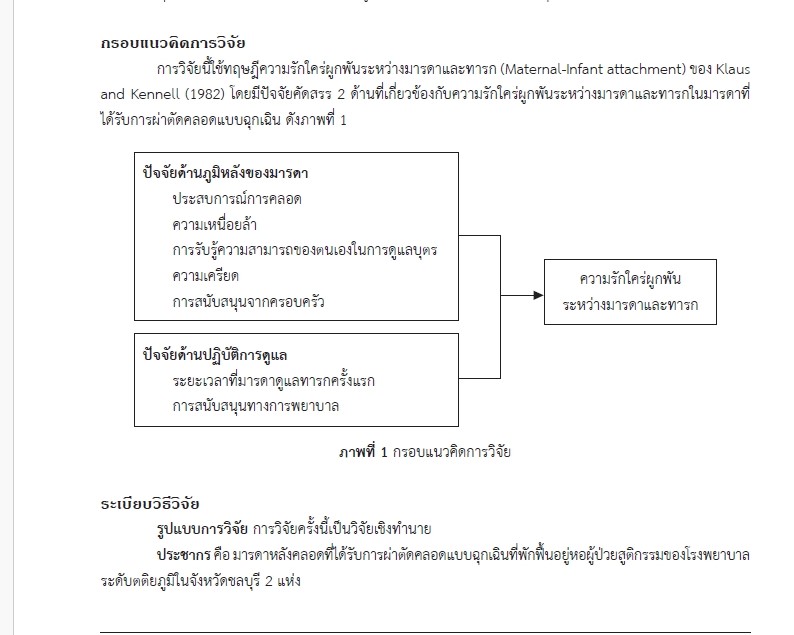
การวิจัยเชิงทำนายนี้มีวัตถุประสงค์เพื่อศึกษาปัจจัยทำนายความรักใคร่ผูกพันระหว่างมารดาและทารกในมารดาที่ได้รับการผ่าตัดคลอดแบบฉุกเฉิน กลุ่มตัวอย่างคือ มารดาที่ได้รับการผ่าตัดคลอดแบบฉุกเฉินที่พักฟื้นในหอผู้ป่วยสูติกรรมของโรงพยาบาลระดับตติยภูมิในจังหวัดชลบุรี 2 แห่ง จำนวน 142 ราย ช่วงเดือนกุมภาพันธ์ถึงสิงหาคม พ.ศ. 2568 เก็บข้อมูลด้วยแบบสอบถามข้อมูลส่วนบุคคล แบบสอบถามประสบการณ์การคลอด แบบสอบถามความเหนื่อยล้า แบบสอบถามการรับรู้ความสามารถของตนเองในการดูแลบุตร แบบสอบถามความเครียด แบบสอบถามการสนับสนุนจากครอบครัว แบบสอบถามการสนับสนุนทางการพยาบาล แบบสอบถามความรักใคร่ผูกพันระหว่างมารดาและทารก และแบบบันทึกระยะเวลาที่มารดาดูแลทารกครั้งแรก วิเคราะห์ข้อมูลด้วยสถิติเชิงพรรณนาและสถิติถดถอยพหุคูณ
ผลการวิจัยพบว่า กลุ่มตัวอย่างมีความรักใคร่ผูกพันระหว่างมารดาและทารกเฉลี่ยเท่ากับ 78.44 (SD = 5.71) โดยการรับรู้ความสามารถของตนเองในการดูแลบุตร (β = .35, p < .001) ความเหนื่อยล้า (β = -.23, p = .003) และการสนับสนุนทางการพยาบาล (β = .15, p = .04) สามารถร่วมกันทำนายความรักใคร่ผูกพันระหว่างมารดาและทารกได้ร้อยละ 23.9 (Adjusted R2 = .239, F(3,138) = 15.80, p < .001)
ข้อเสนอแนะจากการวิจัย ควรส่งเสริมการรับรู้ความสามารถของมารดาในการดูแลบุตร ควบคู่กับการลดความเหนื่อยล้า และพัฒนาการสนับสนุนทางการพยาบาลอย่างเป็นระบบ เพื่อเสริมสร้างความรักใคร่ผูกพันระหว่างมารดาและทารกในมารดาที่ได้รับการผ่าตัดคลอดแบบฉุกเฉิน
เอกสารอ้างอิง
Bandura, A. (1997). Self-efficacy: The exercise of control. New York, NY: W. H. Freeman.
Burns, N., & Grove, S. K. (2009). The practice of nursing research: Appraisal, synthesis and generation of evidence (6th ed.). St. Louis, MO: Saunders Elsevier.
Cohen, J. (1988). Statistical power analysis for the behavioral sciences (2nd ed.). Hillsdale, NJ: Lawrence Erlbaum Associates.
Cunningham, F. G., Leveno, K. J., Dashe, J. S., Hoffman, B. L., Spong, C. Y., & Casey, B. M. (2022). Williams obstetrics (26th ed.). New York, NY: McGraw Hill.
Darnal, N., & Dangal, G. (2020). Maternal and fetal outcome in emergency versus elective caesarean section. Journal of Nepal Health Research Council, 18(2), 186–189. doi:10.33314/jnhrc.v18i2.2093
Deys, L. J., Torowicz, D. L., Roberts, K. E., & Conry, J. M. (2021). What are women’s experiences of immediate skin-to-skin contact at caesarean section birth: An integrative literature review. Midwifery, 100, 103063. doi:10.1016/j.midw.2021.103063
Doyle, F. L., Dickson, S. J., Eapen, V., Frick, P. J., Kimonis, E. R., Hawes, D. J., ... Dadds, M. R. (2023). Towards preventative psychiatry: Concurrent and longitudinal predictors of postnatal maternal-infant bonding. Child Psychiatry & Human Development, 54(6), 1723–1736. doi:10.1007/s10578-022-01365-0
Enkhmaa, D., Enkhtaivan, O., Batsuuri, B., Erdenebileg, N., Baatar, T., Bayanbileg, S., ... Shirchinjav, A. (2025). Trends in cesarean section in a tertiary referral hospital: Time-series analysis. Central Asian Journal of Medical Sciences, 11(2), 69–83. doi:10.24079/CAJMS.2025.02.003
Israel, G. D. (1992). Determining sample size. Retrieved from https://www.gjimt.ac.in/wp-content/uploads/2017/10/2_Glenn-D.-Israel_Determining-Sample-Size.pdf
Jantaburee, N., Phumonsakul, S., & Theerakulchai, J. (2019). Relationships between selected factors and maternal-infant attachment of unplanned cesarean section mothers. Journal of The Police Nurses, 11(2), 387–395. [In Thai]
Kadiroglu, T., & Tufekci, F. G. (2022). Effect of infant care training on maternal bonding, motherhood self-efficacy, and self-confidence in mothers of preterm newborns. Maternal and Child Health Journal, 26(1), 131–138. doi:10.1007/s10995-021-03287-0
Karakas, N. M., & Dagli, F. S. (2019). The importance of attachment in infant and influencing factors. Turk Pediatri Arsivi, 54(2), 76–81. doi:10.14744/TurkPediatriArs.2018.80269
Klaus, M. H., & Kennell, J. H. (1982). Parent-infant bonding (2nd ed.). St. Louis, MO: Mosby.
Makeen, M., Farrell, L. M., LaSorda, K. R., Deng, Y., Altamirano, V., Jarvis, O., ... Lim, G. (2022). Associations between postpartum pain, mood, and maternal-infant attachment and parenting outcomes. Scientific Reports, 12(1), 17814. doi:10.1038/s41598-022-21793-1
Manuela, F., Barcos-Munoz, F., Monaci, M. G., Lordier, L., Camejo, M. P., Almeida, J. S., ... Borradori-Tolsa, C. (2021). Maternal stress, depression, and attachment in the neonatal intensive care unit before and during the COVID pandemic: An exploratory study. Frontiers in Psychology, 12, 734640. doi:10.3389/fpsyg.2021.734640
Monaco, K. V. (2011). Maternal representations of attachment as affected by conditions of proximity and separation. (Master’s thesis). South Orange, NJ: Seton Hall University.
Muslu, A., Erciyas, S. K., Cindas, P., & Atan, S. U. (2022). The relationship between women’s childbirth experiences and their maternal attachment and the risk of postpartum depression. European Journal of Clinical and Experimental Medicine, 20(4), 435–442. doi:10.15584/ejcem.2022.4.9
Nungalee, S. (2004). The effect of using the perceived self-efficacy promoting program on child rearing behavior during postpartal period of first-time adolescent mothers. (Master’s thesis). Bangkok: Chulalongkorn University. [In Thai]
Oruc, M., & Kukulu, K. (2022). The relationship between maternal function and maternal attachment of women during the postpartum period. Journal of Reproductive and Infant Psychology, 40(3), 288–298. doi:10.1080/02646838.2021.1962824.
Phutong, P., Phumonsakul, S., & Pongrua, P. (2018). Predicting factors of maternal-infant attachment of mothers whose infants were hospitalized in the sick newborn unit. Kuakarun Journal of Nursing, 25(2), 64–77. [In Thai]
Pooripanyakunn, S. (1996). The effect of antenatal counselling to pregnant adolescent mothers on maternal-infant bonding in different marital relationship. (Master’s thesis). Bangkok: Srinakharinwirot University. [In Thai]
Saeliw, P., Kantaruksa, K., & Chaloumsuk, N. (2015). Perceptions of childbirth experience, social support, and maternal role attainment among mothers with cesarean section. Nursing Journal, 42, 69–81. [In Thai]
Tachasuksri, T., Krungkraipetch, N., Jeerawongpanich, K., & Intaput, P. (2024). Development of occupational health and safety application for reproductive female workers in industrial factory, Eastern Economic Corridor. (Research report). Faculty of Nursing: Burapha University. [In Thai]
Wang, Y., Gu, J., Zhang, F., & Xu, X. (2023). The effect of perceived social support on postpartum stress: The mediating roles of marital satisfaction and maternal postnatal attachment. BMC Women’s Health, 23(1), 482–492. doi:10.1186/s12905-023-02593-9
Wongpakaran, N., & Wongpakaran, T. (2010). The Thai version of the PSS-10: An investigation of its psychometric properties. BioPsychoSocial Medicine, 4, 6. doi:10.1186/1751-0759-4-6
Yesilcinar, I., Yavan, T., Karasahin, K. E., & Yenen, M. C. (2017). The identification of the relationship between the perceived social support, fatigue levels, and maternal attachment during the postpartum period. The Journal of Maternal-Fetal & Neonatal Medicine, 30(10), 1213–1220. doi:10.1080/14767058.2016.1209649
ดาวน์โหลด
เผยแพร่แล้ว
รูปแบบการอ้างอิง
ฉบับ
ประเภทบทความ
สัญญาอนุญาต

อนุญาตภายใต้เงื่อนไข Creative Commons Attribution-NonCommercial-NoDerivatives 4.0 International License.