Factors Influencing Maternal-Infant Attachment Among Mothers With Emergency Cesarean Section
Keywords:
Emergency cesarean section, Maternal-infant attachment, Maternal self-efficacy in infant care, Fatigue, Nursing supportAbstract
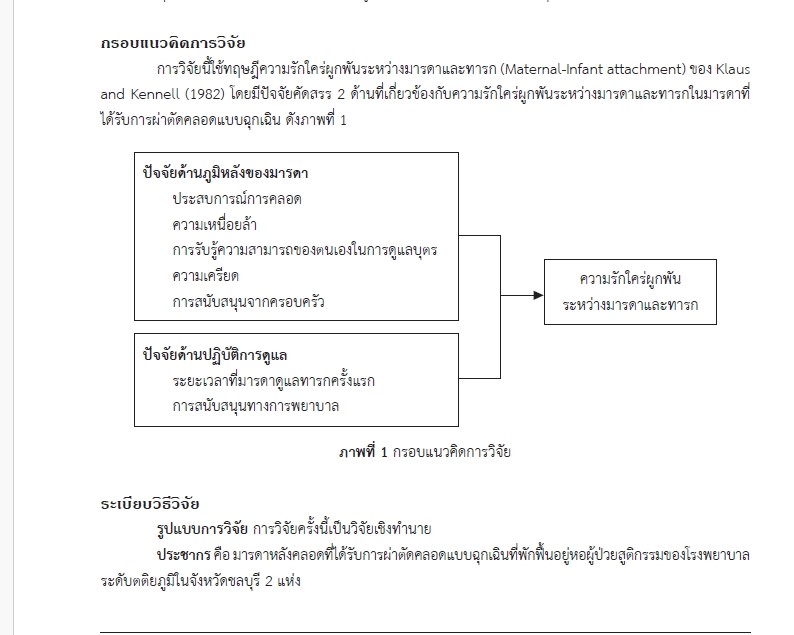
This predictive study aimed to examine the factors predicting maternal-infant attachment among mothers who underwent an emergency cesarean section. The participants were 142 postpartum mothers recovering in the obstetric wards of two tertiary care hospitals in Chonburi Province. Data were collected from February to August 2025 using a set of structured questionnaires, including personal information, childbirth experience, fatigue, maternal self-efficacy in infant care, stress, family support, nursing support, maternal-infant attachment, and a maternal first caregiving time record form. Data were analyzed using descriptive statistics and multiple regression analysis.
The results showed that the mean score of maternal-infant attachment was 78.44 (SD = 5.71). Maternal self-efficacy in infant care (β = .35, p < .001), fatigue (β = -.23, p = .003), and nursing support (β = .15, p = .04) collectively predicted 23.9% of the variance in maternal-infant attachment (Adjusted R2 = .239, F(3,138) = 15.80, p < .001).
The findings suggest that nurses should promote maternal self-efficacy in infant care, reduce maternal fatigue, and provide systematic nursing support to enhance maternal-infant attachment among mothers with emergency cesarean section.
References
Bandura, A. (1997). Self-efficacy: The exercise of control. New York, NY: W. H. Freeman.
Burns, N., & Grove, S. K. (2009). The practice of nursing research: Appraisal, synthesis and generation of evidence (6th ed.). St. Louis, MO: Saunders Elsevier.
Cohen, J. (1988). Statistical power analysis for the behavioral sciences (2nd ed.). Hillsdale, NJ: Lawrence Erlbaum Associates.
Cunningham, F. G., Leveno, K. J., Dashe, J. S., Hoffman, B. L., Spong, C. Y., & Casey, B. M. (2022). Williams obstetrics (26th ed.). New York, NY: McGraw Hill.
Darnal, N., & Dangal, G. (2020). Maternal and fetal outcome in emergency versus elective caesarean section. Journal of Nepal Health Research Council, 18(2), 186–189. doi:10.33314/jnhrc.v18i2.2093
Deys, L. J., Torowicz, D. L., Roberts, K. E., & Conry, J. M. (2021). What are women’s experiences of immediate skin-to-skin contact at caesarean section birth: An integrative literature review. Midwifery, 100, 103063. doi:10.1016/j.midw.2021.103063
Doyle, F. L., Dickson, S. J., Eapen, V., Frick, P. J., Kimonis, E. R., Hawes, D. J., ... Dadds, M. R. (2023). Towards preventative psychiatry: Concurrent and longitudinal predictors of postnatal maternal-infant bonding. Child Psychiatry & Human Development, 54(6), 1723–1736. doi:10.1007/s10578-022-01365-0
Enkhmaa, D., Enkhtaivan, O., Batsuuri, B., Erdenebileg, N., Baatar, T., Bayanbileg, S., ... Shirchinjav, A. (2025). Trends in cesarean section in a tertiary referral hospital: Time-series analysis. Central Asian Journal of Medical Sciences, 11(2), 69–83. doi:10.24079/CAJMS.2025.02.003
Israel, G. D. (1992). Determining sample size. Retrieved from https://www.gjimt.ac.in/wp-content/uploads/2017/10/2_Glenn-D.-Israel_Determining-Sample-Size.pdf
Jantaburee, N., Phumonsakul, S., & Theerakulchai, J. (2019). Relationships between selected factors and maternal-infant attachment of unplanned cesarean section mothers. Journal of The Police Nurses, 11(2), 387–395. [In Thai]
Kadiroglu, T., & Tufekci, F. G. (2022). Effect of infant care training on maternal bonding, motherhood self-efficacy, and self-confidence in mothers of preterm newborns. Maternal and Child Health Journal, 26(1), 131–138. doi:10.1007/s10995-021-03287-0
Karakas, N. M., & Dagli, F. S. (2019). The importance of attachment in infant and influencing factors. Turk Pediatri Arsivi, 54(2), 76–81. doi:10.14744/TurkPediatriArs.2018.80269
Klaus, M. H., & Kennell, J. H. (1982). Parent-infant bonding (2nd ed.). St. Louis, MO: Mosby.
Makeen, M., Farrell, L. M., LaSorda, K. R., Deng, Y., Altamirano, V., Jarvis, O., ... Lim, G. (2022). Associations between postpartum pain, mood, and maternal-infant attachment and parenting outcomes. Scientific Reports, 12(1), 17814. doi:10.1038/s41598-022-21793-1
Manuela, F., Barcos-Munoz, F., Monaci, M. G., Lordier, L., Camejo, M. P., Almeida, J. S., ... Borradori-Tolsa, C. (2021). Maternal stress, depression, and attachment in the neonatal intensive care unit before and during the COVID pandemic: An exploratory study. Frontiers in Psychology, 12, 734640. doi:10.3389/fpsyg.2021.734640
Monaco, K. V. (2011). Maternal representations of attachment as affected by conditions of proximity and separation. (Master’s thesis). South Orange, NJ: Seton Hall University.
Muslu, A., Erciyas, S. K., Cindas, P., & Atan, S. U. (2022). The relationship between women’s childbirth experiences and their maternal attachment and the risk of postpartum depression. European Journal of Clinical and Experimental Medicine, 20(4), 435–442. doi:10.15584/ejcem.2022.4.9
Nungalee, S. (2004). The effect of using the perceived self-efficacy promoting program on child rearing behavior during postpartal period of first-time adolescent mothers. (Master’s thesis). Bangkok: Chulalongkorn University. [In Thai]
Oruc, M., & Kukulu, K. (2022). The relationship between maternal function and maternal attachment of women during the postpartum period. Journal of Reproductive and Infant Psychology, 40(3), 288–298. doi:10.1080/02646838.2021.1962824.
Phutong, P., Phumonsakul, S., & Pongrua, P. (2018). Predicting factors of maternal-infant attachment of mothers whose infants were hospitalized in the sick newborn unit. Kuakarun Journal of Nursing, 25(2), 64–77. [In Thai]
Pooripanyakunn, S. (1996). The effect of antenatal counselling to pregnant adolescent mothers on maternal-infant bonding in different marital relationship. (Master’s thesis). Bangkok: Srinakharinwirot University. [In Thai]
Saeliw, P., Kantaruksa, K., & Chaloumsuk, N. (2015). Perceptions of childbirth experience, social support, and maternal role attainment among mothers with cesarean section. Nursing Journal, 42, 69–81. [In Thai]
Tachasuksri, T., Krungkraipetch, N., Jeerawongpanich, K., & Intaput, P. (2024). Development of occupational health and safety application for reproductive female workers in industrial factory, Eastern Economic Corridor. (Research report). Faculty of Nursing: Burapha University. [In Thai]
Wang, Y., Gu, J., Zhang, F., & Xu, X. (2023). The effect of perceived social support on postpartum stress: The mediating roles of marital satisfaction and maternal postnatal attachment. BMC Women’s Health, 23(1), 482–492. doi:10.1186/s12905-023-02593-9
Wongpakaran, N., & Wongpakaran, T. (2010). The Thai version of the PSS-10: An investigation of its psychometric properties. BioPsychoSocial Medicine, 4, 6. doi:10.1186/1751-0759-4-6
Yesilcinar, I., Yavan, T., Karasahin, K. E., & Yenen, M. C. (2017). The identification of the relationship between the perceived social support, fatigue levels, and maternal attachment during the postpartum period. The Journal of Maternal-Fetal & Neonatal Medicine, 30(10), 1213–1220. doi:10.1080/14767058.2016.1209649
Downloads
Published
How to Cite
Issue
Section
License

This work is licensed under a Creative Commons Attribution-NonCommercial-NoDerivatives 4.0 International License.