ปัจจัยที่มีสัมพันธ์กับความเครียดของนักศึกษาพยาบาลในมหาวิทยาลัยเอกชนแห่งหนึ่ง
คำสำคัญ:
ความเครียด, นักศึกษาพยาบาล, ผลการเรียน, ความสัมพันธ์ในครอบครัว, การจัดการความเครียดบทคัดย่อ
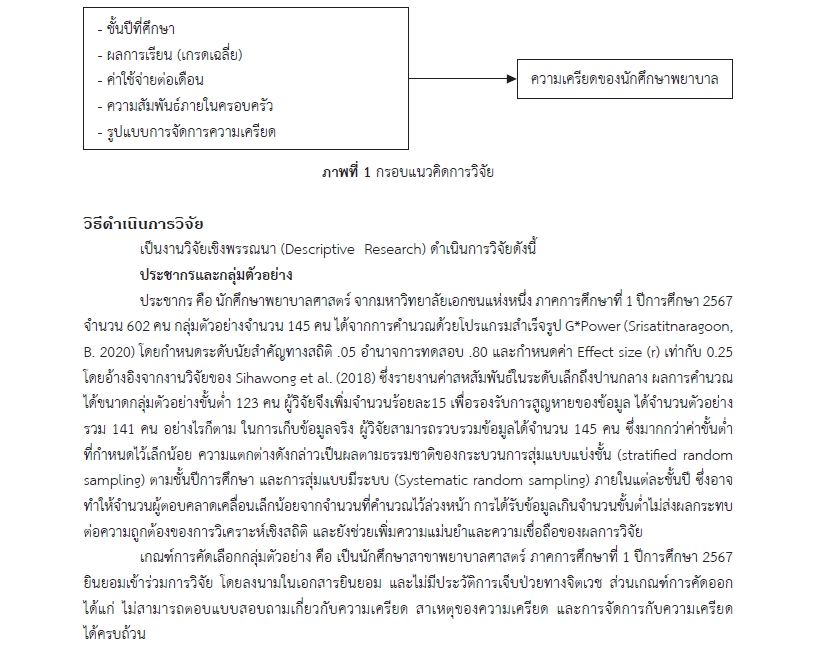
การวิจัยเชิงพรรณนานี้มีวัตถุประสงค์เพื่อศึกษาระดับความเครียดของนักศึกษาพยาบาล มหาวิทยาลัยเอกชนแห่งหนึ่ง และศึกษาความสัมพันธ์ระหว่างชั้นปีการศึกษา ผลการเรียน ค่าใช้จ่ายต่อเดือน ความสัมพันธ์ในครอบครัว และรูปแบบการจัดการความเครียด กับคะแนนความเครียดของนักศึกษาพยาบาล กลุ่มตัวอย่างเป็นนักศึกษาพยาบาลจำนวน 145 คน ได้จากการสุ่มแบบแบ่งชั้นและการสุ่มอย่างมีระบบ เครื่องมือวิจัยประกอบด้วยแบบสอบถามข้อมูลส่วนบุคคลและแบบประเมินความเครียดสวนปรุง 20 ข้อ วิเคราะห์ข้อมูลด้วยสถิติพรรณนา และค่าสหสัมพันธ์สเปียร์แมน
ผลการศึกษาพบว่า นักศึกษาพยาบาลส่วนใหญ่มีความเครียดระดับมาก (ร้อยละ 64.10) มีวิธีการจัดการความเครียดแบบมุ่งเน้นการจัดการปัญหา (ร้อยละ 44.83) และด้านความสัมพันธ์ในครอบครัว พบว่าส่วนใหญ่มีการพูดคุยเพื่อแก้ไขปัญหาร่วมกัน (ร้อยละ 67.59) ผลการวิเคราะห์ความสัมพันธ์พบว่า ผลการเรียนมีความสัมพันธ์เชิงลบระดับต่ำกับความเครียดอย่างมีนัยสำคัญทางสถิติ (rs = −.218, p < .05) ขณะที่ความสัมพันธ์ในครอบครัวมีความสัมพันธ์ทางบวกระดับปานกลางกับความเครียดอย่างมีนัยสำคัญทางสถิติ (rs = .35, p < .05) ส่วนชั้นปีที่ศึกษา ค่าใช้จ่ายต่อเดือน และรูปแบบการจัดการความเครียดไม่พบความสัมพันธ์กับความเครียดอย่างมีนัยสำคัญทางสถิติ (p > .05) โดยสรุป ผลการศึกษาสะท้อนให้เห็นว่าผลการเรียนและความสัมพันธ์ในครอบครัวเป็นปัจจัยที่มีบทบาทต่อระดับความเครียดของนักศึกษาพยาบาล ซึ่งผลการวิจัยนี้จะช่วยให้หน่วยงานสถาบันการศึกษานำไปใช้วางแผนกิจกรรมส่งเสริมสุขภาพจิตที่ดีสำหรับนักศึกษาพยาบาล
เอกสารอ้างอิง
Alsaraireh, F., Al-Oran, H., & Magharbeh, W. A. (2023). The impact of stress on sleep pattern and academic performance among nursing students in Jordan: A cross-sectional study. ASEAN Journal of Psychiatry, 24(4), 1 - 15. doi:10.54615/2231-7805.47303
Aryuwat, P., Holmgren, J., Asp, M., Lövenmark, A., Radabutr, M., & Sandborgh, M. (2024). Factors associated with resilience among Thai nursing students in the context of clinical education: A cross-sectional study. Education Sciences, 14(1), 78. doi:10.3390/educsci14010078
Berdida, D. J. E., & Grande, R. A. N. (2023). Academic stress, COVID-19 anxiety, and quality of life among nursing students: The mediating role of resilience. International Nursing Review, 70(1), 34–42. doi:10.1111/inr.12774
Cheng, W. L. S., Chow, P. P. K., Wong, F. M. F., & Ho, M. M. (2023). Associations among stressors, perceived stress, and psychological distress in nursing students: A mixed methods longitudinal study of a Hong Kong sample. Frontiers in Psychology, 14, Article 1234354. doi:10.3389/fpsyg.2023.1234354
Department of Mental Health. (2000). Manual for the Suanprung Stress Test–20 (SPST–20). Bangkok, Thailand: Veterans Organization Press. [In Thai]
Hamadi, H. Y., Zakari, N. M. A., Jibreel, E., Al Nami, F. N., Smida, J. A. S., & Ben Haddad, H. H. (2021). Stress and coping strategies among nursing students in clinical practice during COVID-19. Nursing Reports, 11(3), 629–639. doi:10.3390/nursrep11030060
Labrague, L. J. (2024). Stress levels, sources of stress, and coping mechanisms among student nurses: An umbrella review. Nursing Reports, 14(1), 362–375. doi:10.3390/nursrep14010028
Labrague, L. J., McEnroe-Petitte, D. M., Papathanasiou, I. V., Edet, O. B., Tsaras, K., Leocadio, M. C., & Colet, P. (2018). Stress and coping strategies among nursing students: An international study. Journal of Mental Health, 27(5), 402–408. doi:10.1080/09638237.2017.1417552
Lavoie-Tremblay, M., Sanzone, L., Aubé, T., & Paquet, M. (2022). Sources of stress andcoping strategies among undergraduate nursing students across all years. Canadian Journal of Nursing Research, 54(3), 261–271. doi:10.1177/08445621211028076
Lazarus, R. S., & Folkman, S. (1984). Stress, appraisal, and coping. New York, NY: Springer.
Li, F., Zeng, Y., Fu, Y., Wang, Y., Lin, T., Deng, Q., & Li, J. (2024). Stressors and coping styles of nursing students in the middle period of clinical practicum: A qualitative study. BMC Nursing, 23(1), 394. doi:10.1186/s12912-024-02063-z
Lin, P. C., Chang, Y. W., & Chang, Y. H. (2025). Mediating effects of resilience on the relationship between stress and professional commitment among nursing students. Nurse Educator, 50(2), E90–E95. doi:10.1097/NNE.0000000000001768
Loureiro, F., Peças, D., Neves, A. C., & Antunes, A. V. (2024). Coping strategies and social support in nursing students during clinical practice: A scoping review. Nursing Open, 11(2), e2112. doi:10.1002/nop2.2112
Ma, H., Zou, J., Zhong, Y., Li, J., & He, J. (2022). Perceived stress, coping style and burnout of Chinese nursing students in late-stage clinical practice. Nurse Education in Practice, 62, 103385. doi:10.1016/j.nepr.2022.103385
Molina, S., & Racal, S. J. (2018). Stress, coping, and mental health status among nursing students at a private university in Nakhon Pathom, Thailand. Global Health Management Journal, 2(3), 63–69. doi:10.35898/GHMJ-23263
Naz, A. M., Khan, S., Manzoor, S., Rehman, K. U., Aslam, Z., & Noor, N. (2024). Relationship between resilience, social support and psychological well-being in nursing students. Journal of Research in Nursing, 29(8), 718–731. doi:10.1177/17449871241278854
Niamnuy, N., Klaywong, K., Piwsaart, R., & Inrueng, S. (2025). A study of stress and depression in health science students at a university in Bangkok, Thailand. Journal of Health Science and Medical Research, 43(2). Retrieved from https://www.jhsmr.org/index.php/jhsmr/article/view/1130/1300 [In Thai]
Thamnamsin, K., Noitung, S., Punyapet, K., & Sorat, W. (2021). Factors affecting to stress among nursing students in a private nursing college, Bangkok. Journal of Health and Health Management, 7(1), 60–75.
Shehadeh, J., Hamdan-Mansour, A. M., Halasa, S. N., Hani, M. H. B., Nabolsi, M. M., Thultheen, I., & Nassar, O. S. (2020). Academic stress and self-efficacy as predictors of academic satisfaction among nursing students. The Open Nursing Journal, 14(1), 92–99. doi:10.2174/1874434602014010092
Sihawong, S., Fuangdee, N., Yanaram, N., Noinang, N., Anai, N., Boonchuen, T., . . . Poyan, T. (2018). Factors causing to stress of nursing students, Ubon Ratchathani University. Journal of Health Sciences and Wellness, 21(42), 93–106.
Srisatitnaragoon, B. (2020). Effect size, power analysis, and sample size estimation using G*Power. Bangkok: Chulalongkorn University Press. [In Thai]
Vo, T. N., Chiu, H.-Y., Chuang, Y.-H., & Huang, H.-C. (2023). Prevalence of stress and anxiety among nursing students: A systematic review and meta-analysis. Nurse Educator, 48(3), E90–E95. doi:10.1097/NNE.0000000000001343
Yuhuan, Z., Pengyue, Z., Dong, C., Qichao, N., Dong, P., Anqi, S., . . . Zhixin, D. (2022). The association between academic stress, social support, and self-regulatory fatigue among nursing students: A cross-sectional study based on a structural equation modelling approach. BMC Medical Education, 22(1), 789. doi:10.1186/s12909-022-03829-2
Zhang, J., Meng, J., & Wen, X. (2025). The relationship between stress and academic burnout in college students. Frontiers in Psychology, 16, 1517920. doi:10.3389/fpsyg.2025.1517920
Zhang, X., Guo, L., Wang, Y., Li, Y., Gui, J., Yang, X., & Lei, Y. (2024). Effect of stress on study skills self-efficacy in nursing students. BMC Nursing, 23, 839. doi:10.1186/s12912-024-02500-z
Zhou, L., Sukpasjaroen, K., Wu, Y., Gao, L., Chankoson, T., & Cai, E. (2022). Perceived social support promotes nursing students’ psychological wellbeing. Frontiers in Psychology, 13, 835134. doi:10.3389/fpsyg.2022.835134
ดาวน์โหลด
เผยแพร่แล้ว
รูปแบบการอ้างอิง
ฉบับ
ประเภทบทความ
สัญญาอนุญาต

อนุญาตภายใต้เงื่อนไข Creative Commons Attribution-NonCommercial-NoDerivatives 4.0 International License.