Factors Associated with Stress Among Nursing Students at a Private University
Keywords:
Stress, Nursing students, Academic achievement, Family relationship, Stress managementAbstract
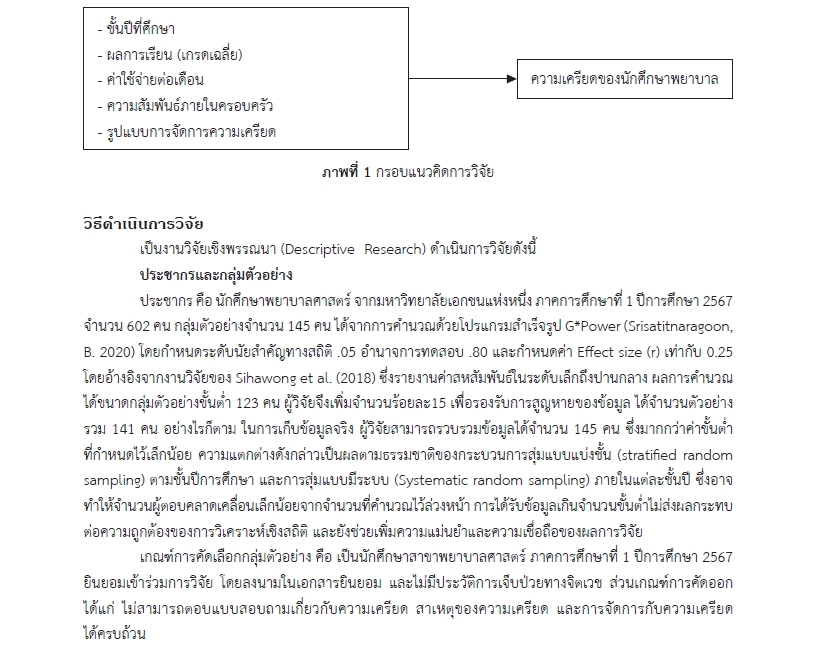
This descriptive research aimed to study the stress levels among nursing students at a private university and to examine the relationships between academic year level, academic performance, monthly expenses, family relationships, and stress‐management styles with students’ stress scores. The sample consisted of 145 nursing students selected through stratified sampling and systematic random sampling. The research instruments included a personal information questionnaire and the20 item Suanprung Stress Assessment Scale. Data were analyzed using descriptive statistics and Spearman’s correlation coefficients.
The findings revealed that the majority of nursing students experienced high levels of stress (64.10%). The predominant stress‑management strategy was problem‑focused coping (44.83%). Regarding family relationships, the majority reported engaging in mutual discussion to solve problems (67.59%). The correlation analysis showed that academic performance had a low negative correlation with stress, which was statistically significant (rs = −.218, p < .05), while, family relationships showed a moderate positive correlation with stress at a statistically significant level (rs = .35, p < .05). Academic year level, monthly expenses, and stress‑management styles were not significantly associated with stress (p > .05). In conclusion, the results reflect that academic performance and family relationships play important roles in influencing stress levels among nursing students. These findings can inform educational institutions in planning and implementing mental health–promoting activities that promote good mental health for nursing students.
References
Alsaraireh, F., Al-Oran, H., & Magharbeh, W. A. (2023). The impact of stress on sleep pattern and academic performance among nursing students in Jordan: A cross-sectional study. ASEAN Journal of Psychiatry, 24(4), 1 - 15. doi:10.54615/2231-7805.47303
Aryuwat, P., Holmgren, J., Asp, M., Lövenmark, A., Radabutr, M., & Sandborgh, M. (2024). Factors associated with resilience among Thai nursing students in the context of clinical education: A cross-sectional study. Education Sciences, 14(1), 78. doi:10.3390/educsci14010078
Berdida, D. J. E., & Grande, R. A. N. (2023). Academic stress, COVID-19 anxiety, and quality of life among nursing students: The mediating role of resilience. International Nursing Review, 70(1), 34–42. doi:10.1111/inr.12774
Cheng, W. L. S., Chow, P. P. K., Wong, F. M. F., & Ho, M. M. (2023). Associations among stressors, perceived stress, and psychological distress in nursing students: A mixed methods longitudinal study of a Hong Kong sample. Frontiers in Psychology, 14, Article 1234354. doi:10.3389/fpsyg.2023.1234354
Department of Mental Health. (2000). Manual for the Suanprung Stress Test–20 (SPST–20). Bangkok, Thailand: Veterans Organization Press. [In Thai]
Hamadi, H. Y., Zakari, N. M. A., Jibreel, E., Al Nami, F. N., Smida, J. A. S., & Ben Haddad, H. H. (2021). Stress and coping strategies among nursing students in clinical practice during COVID-19. Nursing Reports, 11(3), 629–639. doi:10.3390/nursrep11030060
Labrague, L. J. (2024). Stress levels, sources of stress, and coping mechanisms among student nurses: An umbrella review. Nursing Reports, 14(1), 362–375. doi:10.3390/nursrep14010028
Labrague, L. J., McEnroe-Petitte, D. M., Papathanasiou, I. V., Edet, O. B., Tsaras, K., Leocadio, M. C., & Colet, P. (2018). Stress and coping strategies among nursing students: An international study. Journal of Mental Health, 27(5), 402–408. doi:10.1080/09638237.2017.1417552
Lavoie-Tremblay, M., Sanzone, L., Aubé, T., & Paquet, M. (2022). Sources of stress andcoping strategies among undergraduate nursing students across all years. Canadian Journal of Nursing Research, 54(3), 261–271. doi:10.1177/08445621211028076
Lazarus, R. S., & Folkman, S. (1984). Stress, appraisal, and coping. New York, NY: Springer.
Li, F., Zeng, Y., Fu, Y., Wang, Y., Lin, T., Deng, Q., & Li, J. (2024). Stressors and coping styles of nursing students in the middle period of clinical practicum: A qualitative study. BMC Nursing, 23(1), 394. doi:10.1186/s12912-024-02063-z
Lin, P. C., Chang, Y. W., & Chang, Y. H. (2025). Mediating effects of resilience on the relationship between stress and professional commitment among nursing students. Nurse Educator, 50(2), E90–E95. doi:10.1097/NNE.0000000000001768
Loureiro, F., Peças, D., Neves, A. C., & Antunes, A. V. (2024). Coping strategies and social support in nursing students during clinical practice: A scoping review. Nursing Open, 11(2), e2112. doi:10.1002/nop2.2112
Ma, H., Zou, J., Zhong, Y., Li, J., & He, J. (2022). Perceived stress, coping style and burnout of Chinese nursing students in late-stage clinical practice. Nurse Education in Practice, 62, 103385. doi:10.1016/j.nepr.2022.103385
Molina, S., & Racal, S. J. (2018). Stress, coping, and mental health status among nursing students at a private university in Nakhon Pathom, Thailand. Global Health Management Journal, 2(3), 63–69. doi:10.35898/GHMJ-23263
Naz, A. M., Khan, S., Manzoor, S., Rehman, K. U., Aslam, Z., & Noor, N. (2024). Relationship between resilience, social support and psychological well-being in nursing students. Journal of Research in Nursing, 29(8), 718–731. doi:10.1177/17449871241278854
Niamnuy, N., Klaywong, K., Piwsaart, R., & Inrueng, S. (2025). A study of stress and depression in health science students at a university in Bangkok, Thailand. Journal of Health Science and Medical Research, 43(2). Retrieved from https://www.jhsmr.org/index.php/jhsmr/article/view/1130/1300 [In Thai]
Thamnamsin, K., Noitung, S., Punyapet, K., & Sorat, W. (2021). Factors affecting to stress among nursing students in a private nursing college, Bangkok. Journal of Health and Health Management, 7(1), 60–75.
Shehadeh, J., Hamdan-Mansour, A. M., Halasa, S. N., Hani, M. H. B., Nabolsi, M. M., Thultheen, I., & Nassar, O. S. (2020). Academic stress and self-efficacy as predictors of academic satisfaction among nursing students. The Open Nursing Journal, 14(1), 92–99. doi:10.2174/1874434602014010092
Sihawong, S., Fuangdee, N., Yanaram, N., Noinang, N., Anai, N., Boonchuen, T., . . . Poyan, T. (2018). Factors causing to stress of nursing students, Ubon Ratchathani University. Journal of Health Sciences and Wellness, 21(42), 93–106.
Srisatitnaragoon, B. (2020). Effect size, power analysis, and sample size estimation using G*Power. Bangkok: Chulalongkorn University Press. [In Thai]
Vo, T. N., Chiu, H.-Y., Chuang, Y.-H., & Huang, H.-C. (2023). Prevalence of stress and anxiety among nursing students: A systematic review and meta-analysis. Nurse Educator, 48(3), E90–E95. doi:10.1097/NNE.0000000000001343
Yuhuan, Z., Pengyue, Z., Dong, C., Qichao, N., Dong, P., Anqi, S., . . . Zhixin, D. (2022). The association between academic stress, social support, and self-regulatory fatigue among nursing students: A cross-sectional study based on a structural equation modelling approach. BMC Medical Education, 22(1), 789. doi:10.1186/s12909-022-03829-2
Zhang, J., Meng, J., & Wen, X. (2025). The relationship between stress and academic burnout in college students. Frontiers in Psychology, 16, 1517920. doi:10.3389/fpsyg.2025.1517920
Zhang, X., Guo, L., Wang, Y., Li, Y., Gui, J., Yang, X., & Lei, Y. (2024). Effect of stress on study skills self-efficacy in nursing students. BMC Nursing, 23, 839. doi:10.1186/s12912-024-02500-z
Zhou, L., Sukpasjaroen, K., Wu, Y., Gao, L., Chankoson, T., & Cai, E. (2022). Perceived social support promotes nursing students’ psychological wellbeing. Frontiers in Psychology, 13, 835134. doi:10.3389/fpsyg.2022.835134
Downloads
Published
How to Cite
Issue
Section
License

This work is licensed under a Creative Commons Attribution-NonCommercial-NoDerivatives 4.0 International License.