ปัจจัยที่มีความสัมพันธ์กับภาวะสับสนเฉียบพลันของผู้ป่วยสูงอายุหลังผ่าตัดช่องท้อง
คำสำคัญ:
ผู้ป่วยสูงอายุ, ผ่าตัดช่องท้อง, ภาวะสับสนเฉียบพลัน, ปัจจัยที่สัมพันธ์บทคัดย่อ
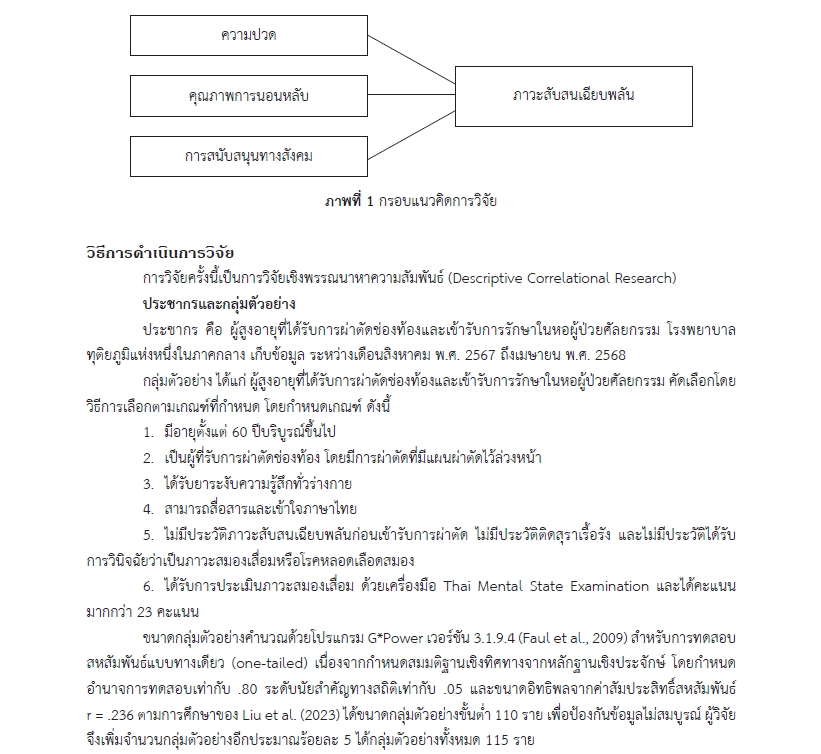
ภาวะสับสนเฉียบพลันเป็นภาวะแทรกซ้อนที่พบบ่อยในผู้สูงอายุที่เข้ารับการผ่าตัดช่องท้องและทำให้เสี่ยงต่อการเกิดผลลัพธ์ทางสุขภาพที่ไม่ดี การวิจัยนี้เป็นการวิจัยเชิงบรรยาย มีวัตถุประสงค์เพื่อศึกษาความชุกของภาวะสับสนเฉียบพลันและศึกษาความสัมพันธ์ระหว่างความปวด คุณภาพการนอนหลับ และการสนับสนุนทางสังคมกับการเกิดภาวะสับสนเฉียบพลันในผู้สูงอายุหลังผ่าตัดช่องท้อง กลุ่มตัวอย่าง ได้แก่ ผู้สูงอายุที่เข้ารับการผ่าตัดช่องท้องแบบวางแผนล่วงหน้า จำนวน 115 ราย คัดเลือกตามเกณฑ์คุณสมบัติที่กำหนด เครื่องมือที่ใช้ประกอบด้วย แบบสอบถามข้อมูลทั่วไปและภาวะสุขภาพ แบบทดสอบสมรรถภาพสมองของไทย แบบประเมินความปวด แบบประเมินคุณภาพการนอนหลับ แบบประเมินการสนับสนุนทางสังคม และแบบประเมินภาวะสับสนเฉียบพลัน วิเคราะห์ข้อมูลด้วยสถิติพรรณนาและสถิติสหสัมพันธ์สเปียร์แมน
ผลการวิจัยพบว่า กลุ่มตัวอย่างส่วนใหญ่เป็นเพศชาย ร้อยละ 52.2 อายุเฉลี่ย 67.2 ปี (SD = 6.65) ได้รับการวินิจฉัยว่าเป็นมะเร็งลำไส้ใหญ่ ร้อยละ 47.8 และมะเร็งลำไส้ตรง ร้อยละ 35.7 ได้รับการผ่าตัดแบบ Low anterior resection ร้อยละ 39.1 และ Hemicolectomy ร้อยละ 27 กลุ่มตัวอย่างมีภาวะสับสนเฉียบพลัน ร้อยละ 37.4 ผลการวิเคราะห์ความสัมพันธ์พบว่า ภาวะสับสนเฉียบพลันมีความสัมพันธ์ทางบวกอย่างมีนัยสำคัญทางสถิติกับความปวด (rs= .206, p = .027) และคุณภาพการนอนหลับ (rs = .322, p < .001) แต่มีความสัมพันธ์ทางลบกับการสนับสนุนทางสังคม (rs = –.365, p < .001)
ข้อเสนอแนะจากผลการวิจัย ได้แก่ พยาบาลควรประเมินภาวะสับสนเฉียบพลันของผู้สูงอายุที่เข้ารับการผ่าตัดช่องท้องอย่างต่อเนื่องตั้งแต่แรกรับไว้จนกระทั่งจำหน่ายออกจากโรงพยาบาล และควรพัฒนาโปรแกรมเพื่อป้องกันภาวะสับสนเฉียบพลันของผู้สูงอายุที่เข้าผ่าตัดในโรงพยาบาลจากปัจจัยที่มีความสัมพันธ์อย่างมีนัยสำคัญทางสถิติ
เอกสารอ้างอิง
Buysse, D. J., Reynolds, C. F., Monk, T. H., Berman, S. R., & Kupfer, D. J. (1989). The Pittsburgh Sleep Quality Index: A new instrument for psychiatric practice and research. Psychiatry Research, 28(2), 193-213. https://doi.org/10.1016/0165-1781(89)90047-4
Canales, C., Wann, L., Blitz, J., & Whittington, R. (2025). The older adult surgical patient: A review of optimization and gaps in clinical practice. Perioperative Medicine, 14, 104. https://doi.org/10.1186/s13741-025-00593-x
Department of Medical Services. (2024). Statistics of surgery in Thailand, 2020–2022. Bangkok, Thailand: Ministry of Public Health. [In Thai]
Faul, F., Erdfelder, E., Buchner, A., & Lang, A.-G. (2009). Statistical power analyses using G*Power 3.1: Tests for correlation and regression analyses. Behavior Research Methods, 41(4), 1149–1160. https://doi.org/10.3758/BRM.41.4.1149
Gaudreau, J.-D., Gagnon, P., Harel, F., Tremblay, A., & Roy, M.-A. (2005). Fast, systematic, and continuous delirium assessment in hospitalized patients: The Nursing Delirium Screening Scale. Journal of Pain and Symptom Management, 29(4), 368–375. https://doi.org/10.1016/j.jpainsymman.2004.07.009
Guo, Y., Li, X., Wang, Y., & Zhang, H. (2024). Preoperative sleep problems and risk of postoperative delirium in elderly patients undergoing abdominal surgery. BMC Geriatrics, 24, 118. https://doi.org/10.1186/s12877-024-04659-3
Hawker, G. A., Mian, S., Kendzerska, T., & French, M. (2011). Measures of adult pain: Visual Analog Scale for Pain (VAS Pain), Numeric Rating Scale for Pain (NRS Pain), McGill Pain Questionnaire (MPQ), Short-Form McGill Pain Questionnaire (SF-MPQ), Chronic Pain Grade Scale (CPGS), Short Form-36 Bodily Pain Scale (SF-36 BPS), and Measure of
Intermittent and Constant Osteoarthritis Pain (ICOAP). Arthritis Care & Research, 63(S11), S240–S252. https://doi.org/10.1002/acr.20543
Kim, E. M., Li, G., & Kim, M. (2020). Development of postoperative delirium in older adults undergoing surgery: A systematic review. Geriatric Nursing, 41(2), 136-143. https://doi.org/10.1016/j.gerinurse.2019.09.003
Kunprayoung, S., Jullamate, P., & Piboon, C. (2025). Factors associated with postoperative delirium among older adults undergoing abdominal surgery in Thailand. Thai Journal of Nursing Research, 29(1), 22-37.
Lenz, E. R., Pugh, L. C., Milligan, R. A., Gift, A., & Suppe, F. (1997). The middle-range theory of unpleasant symptoms: An update. Advances in Nursing Science, 19(3), 14-27. https://doi.org/10.1097/00012272-199703000-00003
Li, J., Fan, Y., Luo, R., Wang, Y., Yin, N., Qi, W., . . . Jing, J. (2025). Family involvement in preventing delirium in critically ill patients: A systematic review and meta-analysis, International Journal of Nursing Studies, 161, 104937. https://doi.org/10.1016/j.ijnurstu.2024.104937
Liu, Y., Zhang, H., Chen, X., & Wang, J. (2023). Poor preoperative sleep quality and postoperative delirium in older surgical patients: A prospective cohort study. BMC Anesthesiology, 23, 211. https://doi.org/10.1186/s12871-023-02144-8
Marcantonio, E. R. (2017). Delirium in hospitalized older adults. The New England Journal of Medicine, 377(15), 1456-1466. https://doi.org/10.1056/NEJMcp1605501
McCaffery, M., & Pasero, C. (1999). Pain: Clinical manual (2nd ed.). St. Louis: Mosby.
Meunhong, S., Surit, P., & Doungkaew, K. (2023). Postoperative complications among older adults undergoing abdominal surgery in general hospitals. Journal of Thailand Nursing and Midwifery Council, 38(4), 78-92.
Monge, M., Alvarez, P., & Castillo, R. (2025). Incidence and predictors of postoperative delirium among elderly surgical patients: A multicenter study. Aging Clinical and Experimental Research, 37(2), 455-463. https://doi.org/10.1007/s40520-024-02871-2
Nazemi, A. K., Gowd, A. K., Carmouche, J. J., & Blevins, J. L. (2017). Prevention and management of postoperative delirium in elderly patients following elective spinal surgery. Clinical Spine Surgery, 30(3), 112-119. https://doi.org/10.1097/BSD.0000000000000448
Ou-Yang, C.-L., Ma, L.-B., Wu, X.-D., Ma, Y.-L., Liu, Y.-H., Tong, L., . . . Mi, W.-D. (2024). Association of sleep quality on the night of operative day with postoperative delirium in elderly patients: A prospective cohort study. European Journal of Anaesthesiology, 41(3), 226-233. https://doi.org/10.1097/EJA.0000000000001952
Prechaterasat, N. (2021). Incidence and risk factors of postoperative delirium in older adults after major surgery. Thai Journal of Nursing Council, 36(2), 65-79.
Rengel, K. F., Hayhurst, C. J., Pandharipande, P. P., & Hughes, C. G. (2020). Long-term cognitive and functional impairments after critical illness. Anesthesia & Analgesia, 130(3), 527-536. https://doi.org/10.1213/ANE.0000000000004646
Rengel, K. F., Pandharipande, P. P., & Hughes, C. G. (2019). Postoperative delirium. La Presse Médicale, 47(4 Pt 2), e53–e64. https://doi.org/10.1016/j.lpm.2018.03.012
Somnuke, P. (2022). Postoperative delirium among older adults in surgical wards: Incidence and associated factors. Journal of Health Science Research, 16(1), 33-45.
Tamargo, R. J., Strath, L. J., & Cruz-Almeida, Y. (2025). Pain, sleep disturbance, and postoperative delirium in older surgical patients. Journal of Geriatric Surgery, 10(1), 15-27.
Tang, C., Li, Y., & Xu, H. (2022). Social support and postoperative delirium among hospitalized older adults. BMC Geriatrics, 22, 744. https://doi.org/10.1186/s12877-022-03412-7
Todd, O. M., Smith, T. O., & Martin, F. C. (2017). Preoperative sleep disturbance and postoperative delirium. Age and Ageing, 46(3), 431-438. https://doi.org/10.1093/ageing/afw220
Wang, N. Y., Hirao, A., & Sieber, F. (2022). Association between postoperative delirium and cognitive decline in older adults undergoing major surgery. Journal of the American Geriatrics Society, 70(1), 123-131. https://doi.org/10.1111/jgs.17435
Wang, Y.-Y., Yue, J.-R., Xie, D.-M., Carter, P., Li, Q.-L., Gartaganis, S. L., . . . Inouye, S. K. (2020). Effect of the tailored, family-involved Hospital Elder Life Program on postoperative delirium and function in older adults: A randomized clinical trial. JAMA Internal Medicine, 180(1), 17–25. https://doi.org/10.1001/jamainternmed.2019.4446
White, N., Bazo-Alvarez, J. C., Koopmans, M., West, E., & Sampson, E. L. (2024). Understanding the association between pain and delirium in older hospital inpatients: Systematic review and meta-analysis. Age and Ageing, 53(4), afae073. https://doi.org/10.1093/ageing/afae073
Wongpakaran, T., & Wongpakaran, N. (2012). A revised Thai multi-dimensional scale of perceived social support. Psychiatry Investigation, 9(2), 161-168. https://doi.org/10.4306/pi.2012.9.2.161
Zimet, G. D., Dahlem, N. W., Zimet, S. G., & Farley, G. K. (1988). The Multidimensional Scale Perceived Social Support. Journal of Personality Assessment, 52(1), 30–41. https://doi.org/10.1207/s15327752jpa5201_2
Zhang, H., Zhao, X., Li, Y., & Chen, J. (2023). Hospital environmental factors and sleep quality among older adults after surgery. BMC Geriatrics, 23(1), 514. https://doi.org/10.1186/s12877-023-04152-8
Zheng, W., Luo, A., Wu, X., & Li, L. (2023). Preoperative sleep disturbance and postoperative delirium in older adults: A systematic review and meta-analysis. Frontiers in Aging Neuroscience, 15, 1187643. https://doi.org/10.3389/fnagi.2023.1187643
ดาวน์โหลด
เผยแพร่แล้ว
รูปแบบการอ้างอิง
ฉบับ
ประเภทบทความ
สัญญาอนุญาต

อนุญาตภายใต้เงื่อนไข Creative Commons Attribution-NonCommercial-NoDerivatives 4.0 International License.