Factors Related to Postoperative Delirium Among Older Patients Undergoing Abdominal Surgery
Keywords:
Older patients, Abdominal surgery, Postoperative delirium, Related factorsAbstract
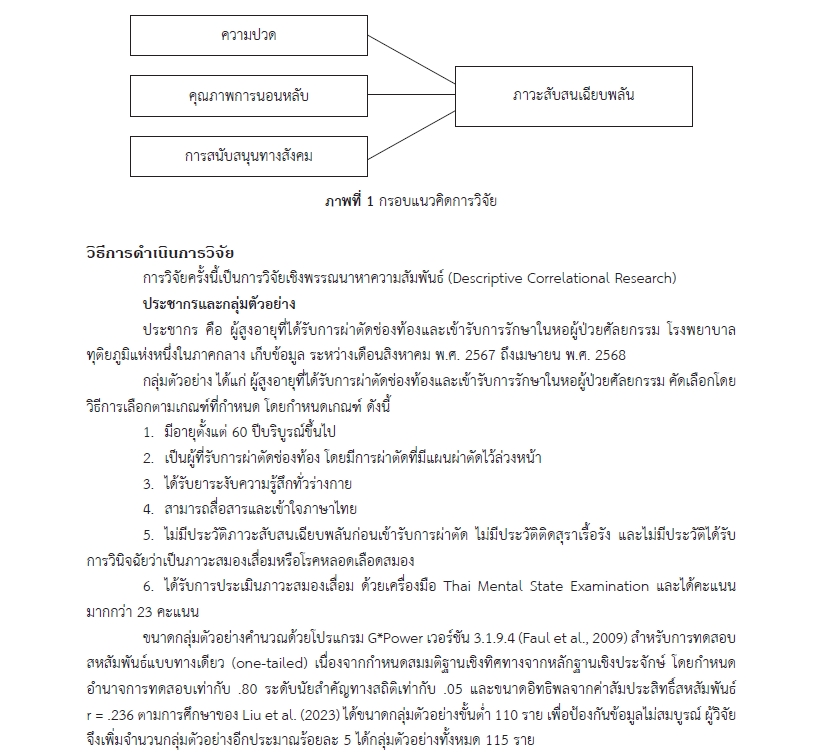
Postoperative delirium is a common complication among older adults undergoing major surgery and is associated with adverse health outcomes. This descriptive correlational study aimed to determine the prevalence of postoperative delirium and examine the relationships of pain, sleep quality, and social support with postoperative delirium among older patients undergoing abdominal surgery. The sample comprised 115 older patients who underwent elective abdominal surgery and met the eligibility criteria. Data were collected using a demographic and health information questionnaire, the Thai Mental State Examination, the Numeric Rating Scale, the Pittsburgh Sleep Quality Index, a social support questionnaire, and the Nursing Delirium Screening Scale. Data were analyzed using descriptive statistics and Spearman’s rank correlation coefficient.
The majority of participants were male (52.2%), with a mean age of 67.2 years (SD = 6.65). The most common diagnoses were colon cancer (47.8%) and rectal cancer (35.7%), and the most common procedures were low anterior resection (39.1%) and hemicolectomy (27.0%). Postoperative delirium occurred in 37.4% of participants. Postoperative delirium was positively correlated with pain (rₛ = .206, p = .027) and poorer sleep quality (rₛ = .322, p < .001), and negatively correlated with social support (rₛ = −.365, p < .001).
The findings suggest that nurses should systematically assess postoperative delirium in older surgical patients and implement preventive care focusing on pain management, sleep promotion, and social support. Further research should develop and evaluate a multicomponent delirium-prevention program based on these significant factors.
References
Buysse, D. J., Reynolds, C. F., Monk, T. H., Berman, S. R., & Kupfer, D. J. (1989). The Pittsburgh Sleep Quality Index: A new instrument for psychiatric practice and research. Psychiatry Research, 28(2), 193-213. https://doi.org/10.1016/0165-1781(89)90047-4
Canales, C., Wann, L., Blitz, J., & Whittington, R. (2025). The older adult surgical patient: A review of optimization and gaps in clinical practice. Perioperative Medicine, 14, 104. https://doi.org/10.1186/s13741-025-00593-x
Department of Medical Services. (2024). Statistics of surgery in Thailand, 2020–2022. Bangkok, Thailand: Ministry of Public Health. [In Thai]
Faul, F., Erdfelder, E., Buchner, A., & Lang, A.-G. (2009). Statistical power analyses using G*Power 3.1: Tests for correlation and regression analyses. Behavior Research Methods, 41(4), 1149–1160. https://doi.org/10.3758/BRM.41.4.1149
Gaudreau, J.-D., Gagnon, P., Harel, F., Tremblay, A., & Roy, M.-A. (2005). Fast, systematic, and continuous delirium assessment in hospitalized patients: The Nursing Delirium Screening Scale. Journal of Pain and Symptom Management, 29(4), 368–375. https://doi.org/10.1016/j.jpainsymman.2004.07.009
Guo, Y., Li, X., Wang, Y., & Zhang, H. (2024). Preoperative sleep problems and risk of postoperative delirium in elderly patients undergoing abdominal surgery. BMC Geriatrics, 24, 118. https://doi.org/10.1186/s12877-024-04659-3
Hawker, G. A., Mian, S., Kendzerska, T., & French, M. (2011). Measures of adult pain: Visual Analog Scale for Pain (VAS Pain), Numeric Rating Scale for Pain (NRS Pain), McGill Pain Questionnaire (MPQ), Short-Form McGill Pain Questionnaire (SF-MPQ), Chronic Pain Grade Scale (CPGS), Short Form-36 Bodily Pain Scale (SF-36 BPS), and Measure of
Intermittent and Constant Osteoarthritis Pain (ICOAP). Arthritis Care & Research, 63(S11), S240–S252. https://doi.org/10.1002/acr.20543
Kim, E. M., Li, G., & Kim, M. (2020). Development of postoperative delirium in older adults undergoing surgery: A systematic review. Geriatric Nursing, 41(2), 136-143. https://doi.org/10.1016/j.gerinurse.2019.09.003
Kunprayoung, S., Jullamate, P., & Piboon, C. (2025). Factors associated with postoperative delirium among older adults undergoing abdominal surgery in Thailand. Thai Journal of Nursing Research, 29(1), 22-37.
Lenz, E. R., Pugh, L. C., Milligan, R. A., Gift, A., & Suppe, F. (1997). The middle-range theory of unpleasant symptoms: An update. Advances in Nursing Science, 19(3), 14-27. https://doi.org/10.1097/00012272-199703000-00003
Li, J., Fan, Y., Luo, R., Wang, Y., Yin, N., Qi, W., . . . Jing, J. (2025). Family involvement in preventing delirium in critically ill patients: A systematic review and meta-analysis, International Journal of Nursing Studies, 161, 104937. https://doi.org/10.1016/j.ijnurstu.2024.104937
Liu, Y., Zhang, H., Chen, X., & Wang, J. (2023). Poor preoperative sleep quality and postoperative delirium in older surgical patients: A prospective cohort study. BMC Anesthesiology, 23, 211. https://doi.org/10.1186/s12871-023-02144-8
Marcantonio, E. R. (2017). Delirium in hospitalized older adults. The New England Journal of Medicine, 377(15), 1456-1466. https://doi.org/10.1056/NEJMcp1605501
McCaffery, M., & Pasero, C. (1999). Pain: Clinical manual (2nd ed.). St. Louis: Mosby.
Meunhong, S., Surit, P., & Doungkaew, K. (2023). Postoperative complications among older adults undergoing abdominal surgery in general hospitals. Journal of Thailand Nursing and Midwifery Council, 38(4), 78-92.
Monge, M., Alvarez, P., & Castillo, R. (2025). Incidence and predictors of postoperative delirium among elderly surgical patients: A multicenter study. Aging Clinical and Experimental Research, 37(2), 455-463. https://doi.org/10.1007/s40520-024-02871-2
Nazemi, A. K., Gowd, A. K., Carmouche, J. J., & Blevins, J. L. (2017). Prevention and management of postoperative delirium in elderly patients following elective spinal surgery. Clinical Spine Surgery, 30(3), 112-119. https://doi.org/10.1097/BSD.0000000000000448
Ou-Yang, C.-L., Ma, L.-B., Wu, X.-D., Ma, Y.-L., Liu, Y.-H., Tong, L., . . . Mi, W.-D. (2024). Association of sleep quality on the night of operative day with postoperative delirium in elderly patients: A prospective cohort study. European Journal of Anaesthesiology, 41(3), 226-233. https://doi.org/10.1097/EJA.0000000000001952
Prechaterasat, N. (2021). Incidence and risk factors of postoperative delirium in older adults after major surgery. Thai Journal of Nursing Council, 36(2), 65-79.
Rengel, K. F., Hayhurst, C. J., Pandharipande, P. P., & Hughes, C. G. (2020). Long-term cognitive and functional impairments after critical illness. Anesthesia & Analgesia, 130(3), 527-536. https://doi.org/10.1213/ANE.0000000000004646
Rengel, K. F., Pandharipande, P. P., & Hughes, C. G. (2019). Postoperative delirium. La Presse Médicale, 47(4 Pt 2), e53–e64. https://doi.org/10.1016/j.lpm.2018.03.012
Somnuke, P. (2022). Postoperative delirium among older adults in surgical wards: Incidence and associated factors. Journal of Health Science Research, 16(1), 33-45.
Tamargo, R. J., Strath, L. J., & Cruz-Almeida, Y. (2025). Pain, sleep disturbance, and postoperative delirium in older surgical patients. Journal of Geriatric Surgery, 10(1), 15-27.
Tang, C., Li, Y., & Xu, H. (2022). Social support and postoperative delirium among hospitalized older adults. BMC Geriatrics, 22, 744. https://doi.org/10.1186/s12877-022-03412-7
Todd, O. M., Smith, T. O., & Martin, F. C. (2017). Preoperative sleep disturbance and postoperative delirium. Age and Ageing, 46(3), 431-438. https://doi.org/10.1093/ageing/afw220
Wang, N. Y., Hirao, A., & Sieber, F. (2022). Association between postoperative delirium and cognitive decline in older adults undergoing major surgery. Journal of the American Geriatrics Society, 70(1), 123-131. https://doi.org/10.1111/jgs.17435
Wang, Y.-Y., Yue, J.-R., Xie, D.-M., Carter, P., Li, Q.-L., Gartaganis, S. L., . . . Inouye, S. K. (2020). Effect of the tailored, family-involved Hospital Elder Life Program on postoperative delirium and function in older adults: A randomized clinical trial. JAMA Internal Medicine, 180(1), 17–25. https://doi.org/10.1001/jamainternmed.2019.4446
White, N., Bazo-Alvarez, J. C., Koopmans, M., West, E., & Sampson, E. L. (2024). Understanding the association between pain and delirium in older hospital inpatients: Systematic review and meta-analysis. Age and Ageing, 53(4), afae073. https://doi.org/10.1093/ageing/afae073
Wongpakaran, T., & Wongpakaran, N. (2012). A revised Thai multi-dimensional scale of perceived social support. Psychiatry Investigation, 9(2), 161-168. https://doi.org/10.4306/pi.2012.9.2.161
Zimet, G. D., Dahlem, N. W., Zimet, S. G., & Farley, G. K. (1988). The Multidimensional Scale Perceived Social Support. Journal of Personality Assessment, 52(1), 30–41. https://doi.org/10.1207/s15327752jpa5201_2
Zhang, H., Zhao, X., Li, Y., & Chen, J. (2023). Hospital environmental factors and sleep quality among older adults after surgery. BMC Geriatrics, 23(1), 514. https://doi.org/10.1186/s12877-023-04152-8
Zheng, W., Luo, A., Wu, X., & Li, L. (2023). Preoperative sleep disturbance and postoperative delirium in older adults: A systematic review and meta-analysis. Frontiers in Aging Neuroscience, 15, 1187643. https://doi.org/10.3389/fnagi.2023.1187643
Downloads
Published
How to Cite
Issue
Section
License

This work is licensed under a Creative Commons Attribution-NonCommercial-NoDerivatives 4.0 International License.