ประสิทธิผลของรูปแบบการดูแลผู้ป่วยไตเรื้อรังระยะสุดท้ายที่มีค่าโพแทสเซียม และฟอสฟอรัสสูง ในคลินิกโรคไตเรื้อรัง โรงพยาบาลหลังสวน จังหวัดชุมพร
คำสำคัญ:
รูปแบบการดูแลผู้ป่วย, ผู้ป่วยไตเรื้อรังระยะสุดท้าย, โพแทสเซียมสูง, ฟอสฟอรัสสูงบทคัดย่อ
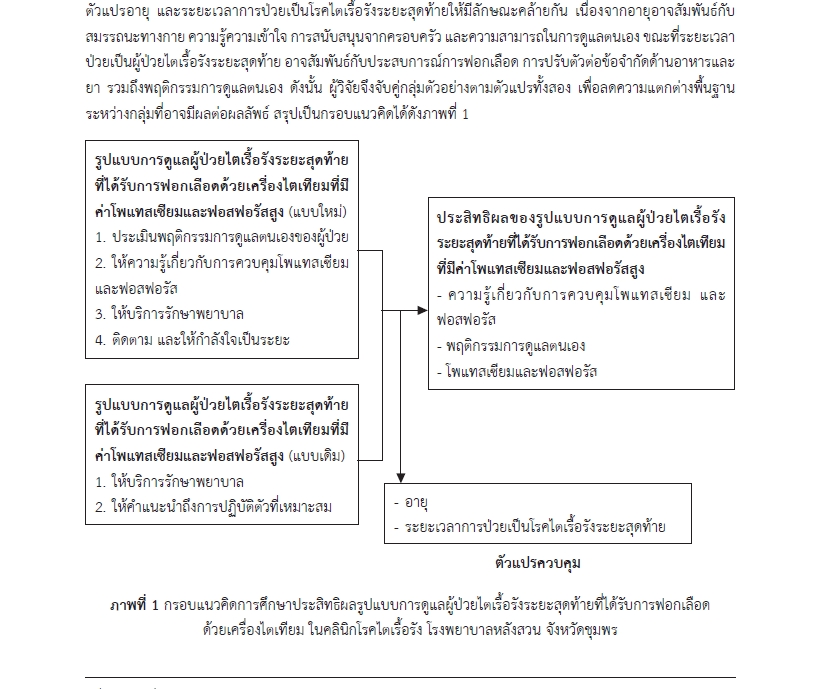
การวิจัยกึ่งทดลองแบบสองกลุ่มวัดก่อน-หลังนี้ มีวัตถุประสงค์เพื่อศึกษาประสิทธิผลและความพึงพอใจต่อรูปแบบการดูแลผู้ป่วยไตเรื้อรังระยะสุดท้ายที่มีค่าโพแทสเซียมและฟอสฟอรัสสูง กลุ่มตัวอย่างเป็นผู้ป่วยไตเรื้อรังระยะสุดท้ายที่มีโพแทสเซียมในเลือดมากกว่า 5.5 มิลลิโมล/ลิตร และฟอสฟอรัสสูงมากกว่า 4.5 มิลลิกรัม/เดซิลิตร จำนวน 80 คน แบ่งเป็นกลุ่มทดลองและกลุ่มเปรียบเทียบ กลุ่มละ 40 คน กลุ่มทดลองใช้รูปแบบการดูแลผู้ป่วยไตเรื้อรังระยะสุดท้ายที่มีค่าโพแทสเซียมและฟอสฟอรัสสูง ซึ่งประกอบด้วย 1) การประเมินพฤติกรรมการดูแลตนเองของผู้ป่วย 2. การให้ความรู้เกี่ยวกับการควบคุมโพแทสเซียมและฟอสฟอรัส 3. การให้บริการรักษาพยาบาล 4. การติดตามและให้กำลังใจผู้ป่วยเป็นระยะ กลุ่มเปรียบเทียบใช้รูปแบบเดิมที่เคยปฏิบัติ ประกอบด้วย 1) การให้บริการรักษาพยาบาล และ 2) การให้คำแนะนำเกี่ยวกับการปฏิบัติตัวที่เหมาะสม ดำเนินการเป็นเวลา 3 เดือน เครื่องมือวิจัย ได้แก่ รูปแบบการดูแลผู้ป่วยไตเรื้อรังระยะสุดท้ายที่มีค่าโพแทสเซียมและฟอสฟอรัสสูง แบบสอบถาม และแบบบันทึกข้อมูลสุขภาพ วิเคราะห์ข้อมูลโดยใช้สถิติเชิงพรรณนา การทดสอบไคสแควร์ การทดสอบทีอิสระ และการทดสอบทีคู่
ผลการวิจัยพบว่า หลังได้รับรูปแบบการดูแล กลุ่มทดลองมีค่าเฉลี่ยโพแทสเซียมและฟอสฟอรัสลดลง 1.1 มิลลิโมล/ลิตร และ 1.0 มิลลิกรัม/เดซิลิตร ตามลำดับ และ มีค่าต่ำกว่ากลุ่มที่ได้รับรูปแบบเดิมที่เคยปฏิบัติ 1.0 มิลลิโมล/ลิตร และ 0.9 มิลลิกรัม/เดซิลิตร ตามลำดับ มีคะแนนเฉลี่ยความรู้เกี่ยวกับการควบคุมโพแทสเซียมและฟอสฟอรัส และพฤติกรรมเกี่ยวกับการควบคุมโพแทสเซียมและฟอสฟอรัส การรับประทานยาที่ดีขึ้น 1.1, 1.2, 4.9, 4.0 และ 1.0 คะแนน และคะแนนเฉลี่ยสูงกว่ากลุ่มที่ได้รับรูปแบบแบบเดิมที่เคยปฏิบัติ 09, 1.0, 4.5, 5.4 และ 1.3 คะแนน ตามลำดับ อย่างมีนัยสำคัญทางสถิติ (p-value < 0.05) ทั้งนี้ ผู้ป่วยมีความพึงพอใจต่อรูปแบบการดูแลผู้ป่วยไตเรื้อรังระยะสุดท้ายในระดับมาก ร้อยละ 82.5
ผลการศึกษาสนับสนุนศักยภาพของรูปแบบดังกล่าว และอาจพิจารณานำไปประยุกต์ใช้ในบริบทที่ใกล้เคียงพร้อมติดตามและประเมินผลเพิ่มเติม
เอกสารอ้างอิง
Alfonzo, A., Harrison, A., Baines, R., Chu, A., Mann, S., & MacRury, M. (2023). UKKA clinical practice guideline: Management of hyperkalaemia in adults. UK Kidney Association. Retrieved from https://www.ukkidney.org/health-professionals/guidelines/treatment-acute-hyperkalaemia-adults-0
Artprajan P, Chandrasiri V, Soontornchai S. (2024). Effects of behavior promotion program for dietary phosphorus control in chronic kidney disease patients undergoing hemodialysis. Regional Health Promotion Center 9 Journal, 18(1), 179-192.
Beckie T. A. (1989). Supportive-educative telephone program: impact on knowledge and anxiety after coronary artery bypass graft surgery. Heart Lung, 18, 46-55.
Chaiwattanatrakul S. (2018). Developing model for the prevention of volume overload of end stage renal disease among hemodialysis patients in NongBua Lam Phu hospital. Journal of Health Science and Community Public Health, 1(2), 131-146. [In Thai]
Cockwell, P., & Fisher, L. A. (2020). The global burden of chronic kidney disease. The Lancet. 395(10225), 662-664. Doi:org/10.1016/S0140-6736(19)32977-0
Cohen J. (1988). Statistical power analysis for the behavioral sciences. Hillsdale NJ.: Lawrence Erl¬baum Associate.
Fangsin V. (2024). The effectiveness of health promoting program for older patients with diabetes, subdistrict health promoting hospital, pranburi hospital network. Journal of Social Science and Cultural, 8(8), 45-58.
Gojaseni P,Tungsang K. (2016). Epidemiology of chronic kidney disease and scope of the problems in Thailand: Burden of disease and economic impact. In: Kantachuwetsiri S, Janjarerntana V, Chailimpamontri V, Trakarnwanit T, Gojaseni P, Yusabuy A, Kingwattanakun P, editors. Textbook of chronic kidney disease. Bangkok: Text and journal publication.
Green, L.W. & Kreuter, M.W. (2005). Health program planning: An educational and ecological approach (4th ed). McGraw-Hill: New York.
jeentae H. (2025). The effect of self-management program on phosphorus control behavior and blood phosphorus level of end-stage kidney disease undergoing hemodialysis at Inburi Hospital. Journal of Environmental Education Medical and Health, 10(1), 620-629.
Kidney Disease: Improving Global Outcomes (KDIGO) CKD-MBD Update Work Group. (2017). KDIGO 2017 clinical practice guideline update for the diagnosis, evaluation, prevention, and treatment of chronic kidney disease–mineral and bone disorder (CKD-MBD). Kidney International Supplements, 7(1), 1–59. https://doi.org/10.1016/j.kisu.2017.04.001
Kidney Disease: Improving Global Outcomes (KDIGO). (2024). KDIGO 2024 clinical practice guideline for the evaluation and management of chronic kidney disease. Kidney International, 105(4S), S117–S314. https://kdigo.org/guidelines/ckd-evaluation-and-management/
Kim, H., & Cho, M.-K. (2025). Development and effectiveness of dietary self-care promotion program using online community for hemodialysis patients: A pilot randomized controlled trial. Asian Nursing Research, 19(2), 126–135. https://doi.org/10.1016/j.anr.2025.01.007
Kovesdy, C. P., Matsushita, K., Sang, Y., Brunskill, N. J., Carrero, J. J., Chodick, G., Hasegawa, T., Heerspink, H. J. L., Hirayama, A., Landman, G. W. D., Levin, A., Nitsch, D., Wheeler, D. C., Coresh, J., & Hallan, S. I. (2017). Serum potassium and adverse outcomes across the range of kidney function: A CKD prognosis consortium meta-analysis. European Heart Journal, 39(17), 1535–1542. https://doi.org/10.1093/eurheartj/ehy100
Langsuan Hospital. (2024). Dialysis patient statistics at Langsuan hospital. Chumphon: Langsuan Hospital. [unpublished institutional data]
Likert, R. (1932). A technique for the measurement of attitudes. Archives of Psychology, 22(140), 5–55.
Mahisanun T (2020). The effect of integrated exercise-Thai Hermit’s exercises program on fatigue in persons with chronic kidney disease receiving hemodialysis. Udonthani Hospital Medical Journal, 28(3), 366-73. [In Thai]
National Institutes of Health, Office of Dietary Supplements. (n.d.). Phosphorus: Fact sheet for health professionals. Retrieved from https://ods.od.nih.gov/factsheets/Phosphorus-HealthProfessional/
Ouirdani, M., Boutib, A., Azizi, A., Chergaoui, S., Saad, E. M., Hilali, A., Marfak, A., & Youlyouz-Marfak, I. (2024). Impact of nutrition education on various health-related components of hemodialysis patients: A systematic review. Healthcare, 12(12), 1197. https://doi.org/10.3390/healthcare12121197
Putruttanamaneekun, C. (2022). Symptom interference in Thai patients with end-stage renal disease undergoing hemodialysis, Journal of Research in Nursing-Midwifery and Health Sciences, 42(2), 12–22. https://he02.tci-thaijo.org/index.php/nur-psu/article/view/254886/175749
Sayankena S. (2024). Comprehensive palliative care system for patients with end-stage renal disease, Kuchinarai Crown Prince hospital, 2024. Journal of Environmental and Community Health, 9(4), 423-431. [In Thai]
St-Jules, D. E., Woolf, K., Pompeii, M. L., Sevick, M. A., & Steiber, A. L. (2021). Effect of phosphate-specific diet therapy on phosphate levels in adults undergoing maintenance hemodialysis: A systematic review and meta-analysis. Clinical Journal of the American Society of Nephrology, 16(1), 75–84.
Tanaka, M. (2022). Orem’s nursing self-care deficit theory: A theoretical analysis focusing on its philosophical and sociological foundation. Nursing Forum, 57(3), 480-485. https://doi.org/10.1111/nuf.12696
Wanner, C., Amann, K., & Shoji, T. (2018). The heart and vascular system in dialysis. The Lancet, 391(10141), 283–295. https://doi.org/10.1016/S0140-6736(17)30508-6
Yoophong C. (2023). The pact of self-management software on knowledge and self-care of patients with chronic kidney disease undergoing peritoneal dialysis. Retrieved from https://bkpho.moph.go.th/ssjweb/bkresearch/require/files/post-doc/20231010141058.pdf? [In Thai]
ดาวน์โหลด
เผยแพร่แล้ว
รูปแบบการอ้างอิง
ฉบับ
ประเภทบทความ
สัญญาอนุญาต

อนุญาตภายใต้เงื่อนไข Creative Commons Attribution-NonCommercial-NoDerivatives 4.0 International License.