The Effectiveness of a Care Model for End-stage Renal Disease Patients with Hyperkalemia and Hyperphosphatemia in the Nephrology clinic, Lang Suan Hospital, Chumphon Province
Keywords:
Patient care model, End-stage renal disease, Hyperkalemia, HyperphosphatemiaAbstract
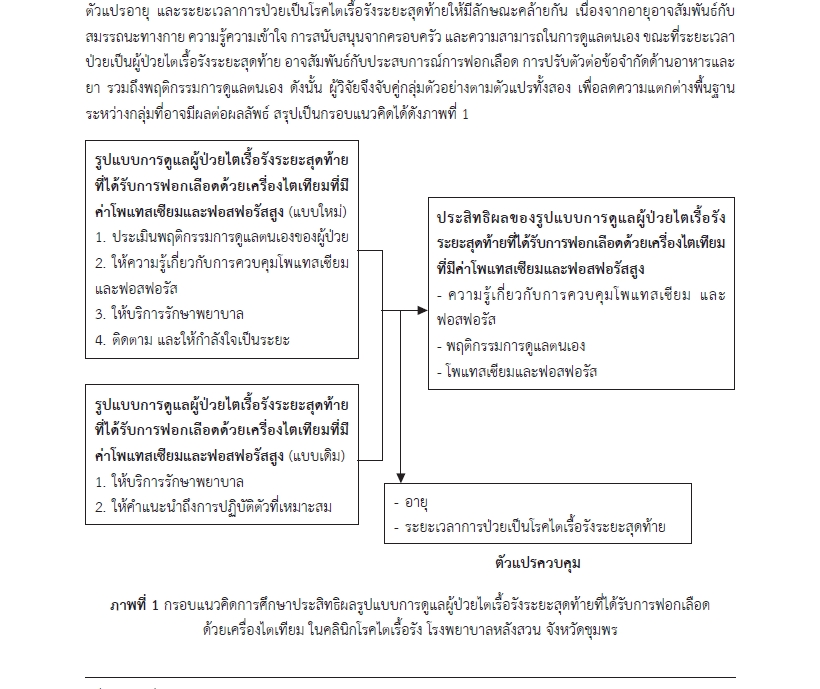
This two-group pretest–posttest quasi-experimental study aimed to examine the effectiveness and satisfaction with a care model for patients with end-stage kidney disease with hyperkalemia and hyperphosphatemia. The sample comprised 80 patients with end-stage kidney disease who had serum potassium levels >5.5 mmol/L and serum phosphorus levels > 4.5 mg/dL. Participants were assigned to an experimental group and a comparison group, with 40 participants in each group. The experimental group received the care model, which comprised: 1) assessment of patients’ self-care behaviors; 2) education on potassium and phosphorus control; 3) provision of healthcare services; and 4) periodic follow-up and encouragement. The comparison group received usual care, consisting of healthcare services and advice on appropriate self-care practices. The intervention was implemented for 3 months. Research instruments included the care model, questionnaires, and health-record forms. Data were analyzed using descriptive statistics, the chi-square test, independent-samples t-test, and paired-samples t-test.
The findings showed that, after receiving the care model, the experimental group had mean reductions in serum potassium and phosphorus of 1.1 mmol/L and 1.0 mmol/L, respectively. These values were lower than those observed in the usual-care group by 1.0 mmol/L and 0.9 mg/dL, respectively. Mean scores for knowledge of potassium and phosphorus control, behaviors related to potassium and phosphorus control, and medication-taking behavior improved by 1.1, 1.2, 4.9, 4.0, and 1.0 points, respectively, and were higher than those in the usual-care group by 0.9, 1.0, 4.5, 5.4, and 1.3 points, respectively (p < 0.05). In addition, 82.5% of patients reported a high level of satisfaction with the care model.
The findings support the potential of this care model and suggest that it may be considered for adaptation in similar settings, with further monitoring and evaluation.
References
Alfonzo, A., Harrison, A., Baines, R., Chu, A., Mann, S., & MacRury, M. (2023). UKKA clinical practice guideline: Management of hyperkalaemia in adults. UK Kidney Association. Retrieved from https://www.ukkidney.org/health-professionals/guidelines/treatment-acute-hyperkalaemia-adults-0
Artprajan P, Chandrasiri V, Soontornchai S. (2024). Effects of behavior promotion program for dietary phosphorus control in chronic kidney disease patients undergoing hemodialysis. Regional Health Promotion Center 9 Journal, 18(1), 179-192.
Beckie T. A. (1989). Supportive-educative telephone program: impact on knowledge and anxiety after coronary artery bypass graft surgery. Heart Lung, 18, 46-55.
Chaiwattanatrakul S. (2018). Developing model for the prevention of volume overload of end stage renal disease among hemodialysis patients in NongBua Lam Phu hospital. Journal of Health Science and Community Public Health, 1(2), 131-146. [In Thai]
Cockwell, P., & Fisher, L. A. (2020). The global burden of chronic kidney disease. The Lancet. 395(10225), 662-664. Doi:org/10.1016/S0140-6736(19)32977-0
Cohen J. (1988). Statistical power analysis for the behavioral sciences. Hillsdale NJ.: Lawrence Erl¬baum Associate.
Fangsin V. (2024). The effectiveness of health promoting program for older patients with diabetes, subdistrict health promoting hospital, pranburi hospital network. Journal of Social Science and Cultural, 8(8), 45-58.
Gojaseni P,Tungsang K. (2016). Epidemiology of chronic kidney disease and scope of the problems in Thailand: Burden of disease and economic impact. In: Kantachuwetsiri S, Janjarerntana V, Chailimpamontri V, Trakarnwanit T, Gojaseni P, Yusabuy A, Kingwattanakun P, editors. Textbook of chronic kidney disease. Bangkok: Text and journal publication.
Green, L.W. & Kreuter, M.W. (2005). Health program planning: An educational and ecological approach (4th ed). McGraw-Hill: New York.
jeentae H. (2025). The effect of self-management program on phosphorus control behavior and blood phosphorus level of end-stage kidney disease undergoing hemodialysis at Inburi Hospital. Journal of Environmental Education Medical and Health, 10(1), 620-629.
Kidney Disease: Improving Global Outcomes (KDIGO) CKD-MBD Update Work Group. (2017). KDIGO 2017 clinical practice guideline update for the diagnosis, evaluation, prevention, and treatment of chronic kidney disease–mineral and bone disorder (CKD-MBD). Kidney International Supplements, 7(1), 1–59. https://doi.org/10.1016/j.kisu.2017.04.001
Kidney Disease: Improving Global Outcomes (KDIGO). (2024). KDIGO 2024 clinical practice guideline for the evaluation and management of chronic kidney disease. Kidney International, 105(4S), S117–S314. https://kdigo.org/guidelines/ckd-evaluation-and-management/
Kim, H., & Cho, M.-K. (2025). Development and effectiveness of dietary self-care promotion program using online community for hemodialysis patients: A pilot randomized controlled trial. Asian Nursing Research, 19(2), 126–135. https://doi.org/10.1016/j.anr.2025.01.007
Kovesdy, C. P., Matsushita, K., Sang, Y., Brunskill, N. J., Carrero, J. J., Chodick, G., Hasegawa, T., Heerspink, H. J. L., Hirayama, A., Landman, G. W. D., Levin, A., Nitsch, D., Wheeler, D. C., Coresh, J., & Hallan, S. I. (2017). Serum potassium and adverse outcomes across the range of kidney function: A CKD prognosis consortium meta-analysis. European Heart Journal, 39(17), 1535–1542. https://doi.org/10.1093/eurheartj/ehy100
Langsuan Hospital. (2024). Dialysis patient statistics at Langsuan hospital. Chumphon: Langsuan Hospital. [unpublished institutional data]
Likert, R. (1932). A technique for the measurement of attitudes. Archives of Psychology, 22(140), 5–55.
Mahisanun T (2020). The effect of integrated exercise-Thai Hermit’s exercises program on fatigue in persons with chronic kidney disease receiving hemodialysis. Udonthani Hospital Medical Journal, 28(3), 366-73. [In Thai]
National Institutes of Health, Office of Dietary Supplements. (n.d.). Phosphorus: Fact sheet for health professionals. Retrieved from https://ods.od.nih.gov/factsheets/Phosphorus-HealthProfessional/
Ouirdani, M., Boutib, A., Azizi, A., Chergaoui, S., Saad, E. M., Hilali, A., Marfak, A., & Youlyouz-Marfak, I. (2024). Impact of nutrition education on various health-related components of hemodialysis patients: A systematic review. Healthcare, 12(12), 1197. https://doi.org/10.3390/healthcare12121197
Putruttanamaneekun, C. (2022). Symptom interference in Thai patients with end-stage renal disease undergoing hemodialysis, Journal of Research in Nursing-Midwifery and Health Sciences, 42(2), 12–22. https://he02.tci-thaijo.org/index.php/nur-psu/article/view/254886/175749
Sayankena S. (2024). Comprehensive palliative care system for patients with end-stage renal disease, Kuchinarai Crown Prince hospital, 2024. Journal of Environmental and Community Health, 9(4), 423-431. [In Thai]
St-Jules, D. E., Woolf, K., Pompeii, M. L., Sevick, M. A., & Steiber, A. L. (2021). Effect of phosphate-specific diet therapy on phosphate levels in adults undergoing maintenance hemodialysis: A systematic review and meta-analysis. Clinical Journal of the American Society of Nephrology, 16(1), 75–84.
Tanaka, M. (2022). Orem’s nursing self-care deficit theory: A theoretical analysis focusing on its philosophical and sociological foundation. Nursing Forum, 57(3), 480-485. https://doi.org/10.1111/nuf.12696
Wanner, C., Amann, K., & Shoji, T. (2018). The heart and vascular system in dialysis. The Lancet, 391(10141), 283–295. https://doi.org/10.1016/S0140-6736(17)30508-6
Yoophong C. (2023). The pact of self-management software on knowledge and self-care of patients with chronic kidney disease undergoing peritoneal dialysis. Retrieved from https://bkpho.moph.go.th/ssjweb/bkresearch/require/files/post-doc/20231010141058.pdf? [In Thai]
Downloads
Published
How to Cite
Issue
Section
License

This work is licensed under a Creative Commons Attribution-NonCommercial-NoDerivatives 4.0 International License.