ความทุกข์ใจจากโรคเบาหวาน พฤติกรรมการดูแลตนเอง ความเชื่อมั่นในการจัดการโรคที่มีอิทธิพลต่อการควบคุมระดับน้ำตาลในเลือดของผู้ป่วยเบาหวานชนิดที่ 2 จังหวัดอุตรดิตถ์
คำสำคัญ:
ความทุกข์ใจจากโรคเบาหวาน, ความเชื่อมั่นในการจัดการโรค, พฤติกรรมการดูแลตนเอง, การควบคุมระดับน้ำตาลในเลือด, ตัวแปรสื่อแบบอนุกรมบทคัดย่อ
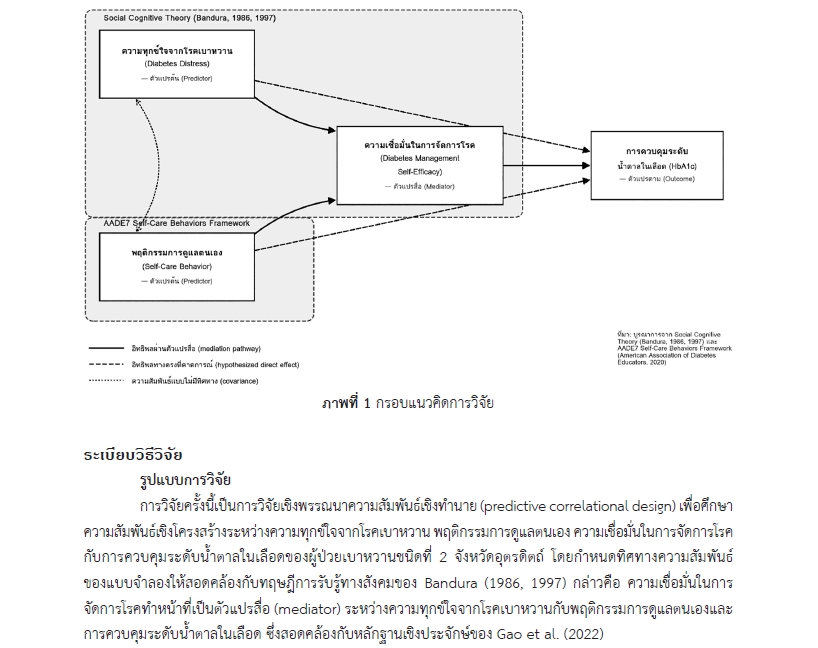
การวิจัยเชิงพรรณนาความสัมพันธ์เชิงทำนายแบบภาคตัดขวางครั้งนี้มีวัตถุประสงค์เพื่อศึกษาระดับและความสัมพันธ์ระหว่างความทุกข์ใจจากโรคเบาหวาน ความเชื่อมั่นในการจัดการโรค พฤติกรรมการดูแลตนเอง กับการควบคุมระดับน้ำตาลในเลือด และเพื่อทดสอบบทบาทตัวแปรสื่อแบบอนุกรมของความเชื่อมั่นในการจัดการโรคและพฤติกรรมการดูแลตนเอง ในความสัมพันธ์ระหว่างความทุกข์ใจจากโรคเบาหวานกับการควบคุมระดับน้ำตาลในเลือดของผู้ป่วยเบาหวานชนิดที่ 2 จังหวัดอุตรดิตถ์ โดยใช้ทฤษฎีการรับรู้ทางสังคมร่วมกับกรอบพฤติกรรมการดูแลตนเอง AADE7 เป็นกรอบแนวคิด กลุ่มตัวอย่างเป็นผู้ป่วยเบาหวานชนิดที่ 2 จำนวน 450 ราย จากหน่วยบริการสุขภาพ 3 ระดับ ได้จากการสุ่มแบบหลายขั้นตอน เครื่องมือวิจัยประกอบด้วยแบบวัดความทุกข์ใจจากโรคเบาหวาน (DDS-17) แบบวัดความเชื่อมั่นในการจัดการโรค (T-DMSES) และแบบสอบถามพฤติกรรมการดูแลตนเอง (SDSCA) ส่วนค่า HbA1c สืบค้นจากเวชระเบียน วิเคราะห์ข้อมูลด้วยสถิติเชิงพรรณนา สัมประสิทธิ์สหสัมพันธ์แบบ Pearson และ PROCESS macro Model 6 ด้วยวิธี bootstrapping 5,000 รอบ
ผลการวิจัยพบว่าความทุกข์ใจจากโรคเบาหวาน ความเชื่อมั่นในการจัดการโรค และพฤติกรรมการดูแลตนเองโดยรวมอยู่ในระดับปานกลาง โดยร้อยละ 41.1 มีความทุกข์ใจระดับสูง ค่า HbA1c เฉลี่ยร้อยละ 8.10 และควบคุมได้ตามเป้าหมายเพียงร้อยละ 24.7 ความทุกข์ใจมีความสัมพันธ์กับค่า HbA1c ผ่านความเชื่อมั่นในการจัดการโรคเพียงตัวเดียว (อิทธิพลทางอ้อม = 0.24, 95% Boot CI [0.14, 0.36]) และผ่านความเชื่อมั่นในการจัดการโรคกับพฤติกรรมการดูแลตนเองตามลำดับ (อิทธิพลทางอ้อม = 0.10, 95% Boot CI [0.05, 0.16]) ขณะที่เส้นทางผ่านพฤติกรรมการดูแลตนเองเพียงตัวเดียวไม่มีนัยสำคัญ อิทธิพลทางอ้อมรวมคิดเป็นร้อยละ 53.3 ของอิทธิพลรวม และความทุกข์ใจยังคงสัมพันธ์ทางตรงกับค่า HbA1c ซึ่งสอดคล้องกับรูปแบบตัวแปรสื่อบางส่วน แบบจำลองอธิบายความแปรปรวนของค่า HbA1c ได้ร้อยละ 26.8
ผลการศึกษาชี้ว่าความเชื่อมั่นในการจัดการโรคเป็นกลไกสำคัญที่เชื่อมโยงความทุกข์ใจกับพฤติกรรมการดูแลตนเองและการควบคุมระดับน้ำตาลในเลือด อย่างไรก็ตาม ข้อมูลเป็นแบบภาคตัดขวางจึงไม่สามารถสรุปความเป็นเหตุเป็นผลได้ ผลการวิจัยใช้เป็นข้อมูลพื้นฐานสำหรับการพัฒนาและทดลองใช้โปรแกรมการพยาบาลนำร่องที่เสริมสร้างความเชื่อมั่นในการจัดการโรคควบคู่กับการลดความทุกข์ใจจากโรคเบาหวานในคลินิกเบาหวาน
เอกสารอ้างอิง
American Association of Diabetes Educators. (2020). An effective model of diabetes care and education: Revising the AADE7 Self-Care Behaviors®. The Diabetes Educator, 46(2), 139–160. https://doi.org/10.1177/0145721719894903
American Diabetes Association Professional Practice Committee. (2024). 6. Glycemic goals and hypoglycemia: Standards of care in diabetes—2024. Diabetes Care, 47(Suppl. 1), S111–S125. https://doi.org/10.2337/dc24-S006
Bandura, A. (1986). Social foundations of thought and action: A social cognitive theory. Prentice-Hall.
Bandura, A. (1997). Self-efficacy: The exercise of control. W. H. Freeman.
Cohen, J. (1988). Statistical power analysis for the behavioral sciences (2nd ed.). Lawrence Erlbaum Associates.
Faul, F., Erdfelder, E., Buchner, A., & Lang, A.-G. (2009). Statistical power analyses using G*Power 3.1: Tests for correlation and regression analyses. Behavior Research Methods, 41(4), 1149–1160. https://doi.org/10.3758/BRM.41.4.1149
Fisher, L., Hessler, D. M., Polonsky, W. H., & Mullan, J. (2012). When is diabetes distress clinically meaningful? Establishing cut points for the Diabetes Distress Scale. Diabetes Care, 35(2), 259–264. https://doi.org/10.2337/dc11-1572
Fisher, L., Mullan, J. T., Arean, P., Glasgow, R. E., Hessler, D., & Masharani, U. (2010). Diabetes distress but not clinical depression or depressive symptoms is associated with glycemic control in both cross-sectional and longitudinal analyses. Diabetes Care, 33(1), 23–28. https://doi.org/10.2337/dc09-1238
Fritz, M. S., & MacKinnon, D. P. (2007). Required sample size to detect the mediated effect. Psychological Science, 18(3), 233–239. https://doi.org/10.1111/j.1467-9280.2007.01882.x
Gao, Y., Xiao, J., Han, Y., Ji, J., Jin, H., Mawen, D. G., Zhong, Y., Lu, Q., Zhuang, X., & Ma, Q. (2022). Self-efficacy mediates the associations of diabetes distress and depressive symptoms with type 2 diabetes management and glycemic control. General Hospital Psychiatry, 78, 87–95. https://doi.org/10.1016/j.genhosppsych.2022.06.003
Hayes, A. F. (2022). Introduction to mediation, moderation, and conditional process analysis: A regression-based approach (3rd ed.). Guilford Press.
Kim, H.-Y. (2013). Statistical notes for clinical researchers: Assessing normal distribution (2) using skewness and kurtosis. Restorative Dentistry & Endodontics, 38(1), 52–54. https://doi.org/10.5395/rde.2013.38.1.52
Kim, J. H. (2019). Multicollinearity and misleading statistical results. Korean Journal of Anesthesiology, 72(6), 558–569. https://doi.org/10.4097/kja.19087
Koo, T. K., & Li, M. Y. (2016). A guideline of selecting and reporting intraclass correlation coefficients for reliability research. Journal of Chiropractic Medicine, 15(2), 155–163. https://doi.org/10.1016/j.jcm.2016.02.012
Little, R. J. A. (1988). A test of missing completely at random for multivariate data with missing values. Journal of the American Statistical Association, 83(404), 1198–1202. https://doi.org/10.1080/01621459.1988.10478722
Maxwell, S. E., & Cole, D. A. (2007). Bias in cross-sectional analyses of longitudinal mediation. Psychological Methods, 12(1), 23–44. https://doi.org/10.1037/1082-989X.12.1.23
Parviniannasab, A. M., Faramarzian, Z., Hosseini, S. A., Hamidizadeh, S., & Bijani, M. (2024). The effect of social support, diabetes management self-efficacy, and diabetes distress on resilience among patients with type 2 diabetes: A moderated mediation analysis. BMC Public Health, 24, Article 477. https://doi.org/10.1186/s12889-024-18022-x
Podsakoff, P. M., MacKenzie, S. B., Lee, J.-Y., & Podsakoff, N. P. (2003). Common method biases in behavioral research: A critical review of the literature and recommended remedies. Journal of Applied Psychology, 88(5), 879–903. https://doi.org/10.1037/0021-9010.88.5.879
Polonsky, W. H., Fisher, L., Earles, J., Dudl, R. J., Lees, J., Mullan, J., & Jackson, R. A. (2005). Assessing psychosocial distress in diabetes: Development of the Diabetes Distress Scale. Diabetes Care, 28(3), 626–631. https://doi.org/10.2337/diacare.28.3.626
Sakboonyarat, B., Pima, W., Chokbumrungsuk, C., Pimpak, T., Khunsri, S., Ukritchon, S., Imjaijitt, W., Mungthin, M., Kaewput, W., Bhopdhornangkul, B., Sathavarodom, N., Tatsanavivat, P., & Rangsin, R. (2021). National trends in the prevalence of glycemic control among patients with type 2 diabetes receiving continuous care in Thailand from 2011 to 2018. Scientific Reports, 11, Article 14260. https://doi.org/10.1038/s41598-021-93733-4
Sangruangake, M., Jirapornkul, C., & Hurst, C. (2017). Psychometric properties of diabetes management self-efficacy in Thai type 2 diabetes mellitus patients: A multicenter study. International Journal of Endocrinology, 2017, Article 2503156. https://doi.org/10.1155/2017/2503156
Sun, H., Saeedi, P., Karuranga, S., Pinkepank, M., Ogurtsova, K., Duncan, B. B., Stein, C., Basit, A., Chan, J. C. N., Mbanya, J. C., Pavkov, M. E., Ramachandaran, A., Wild, S. H., James, S., Herman, W. H., Zhang, P., Bommer, C., Kuo, S., Boyko, E. J., & Magliano, D. J. (2022). IDF Diabetes Atlas: Global, regional and country-level diabetes prevalence estimates for 2021 and projections for 2045. Diabetes Research and Clinical Practice, 183, Article 109119. https://doi.org/10.1016/j.diabres.2021.109119
Thanakwang, K., Thinganjana, W., & Konggumnerd, R. (2014). Psychometric properties of the Thai version of the Diabetes Distress Scale in diabetic seniors. Clinical Interventions in Aging, 9, 1353–1361. https://doi.org/10.2147/CIA.S67200
Toobert, D. J., Hampson, S. E., & Glasgow, R. E. (2000). The summary of diabetes self-care activities measure: Results from 7 studies and a revised scale. Diabetes Care, 23(7), 943–950. https://doi.org/10.2337/diacare.23.7.943
Tunsuchart, K., Lerttrakarnnon, P., Srithanaviboonchai, K., Likhitsathian, S., & Skulphan, S. (2020). Type 2 diabetes mellitus related distress in Thailand. International Journal of Environmental Research and Public Health, 17(7), Article 2329. https://doi.org/10.3390/ijerph17072329
Van der Bijl, J., van Poelgeest-Eeltink, A., & Shortridge-Baggett, L. (1999). The psychometric properties of the diabetes management self-efficacy scale for patients with type 2 diabetes mellitus. Journal of Advanced Nursing, 30(2), 352–359. https://doi.org/10.1046/j.1365-2648.1999.01077.x
ดาวน์โหลด
เผยแพร่แล้ว
รูปแบบการอ้างอิง
ฉบับ
ประเภทบทความ
สัญญาอนุญาต

อนุญาตภายใต้เงื่อนไข Creative Commons Attribution-NonCommercial-NoDerivatives 4.0 International License.