Diabetes Distress, Self-Care Behaviors, Diabetes Management Self-Efficacy, influencing Glycemic Control Among Patients with Type 2 Diabetes in Uttaradit Province
Keywords:
Diabetes distress, Dabetes management self-efficacy, Self-care behaviors, Glycemic control, Serial mediationAbstract
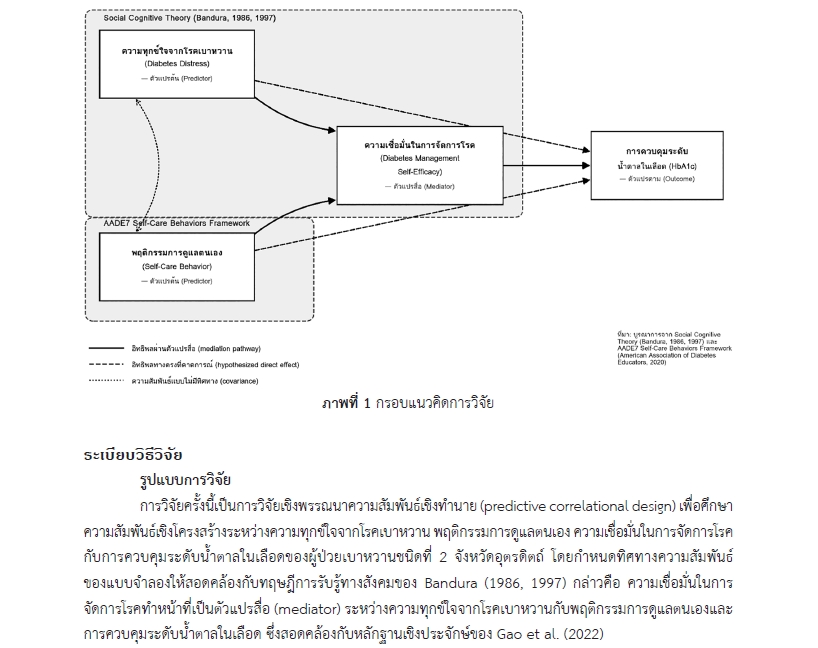
This cross-sectional predictive correlational study aimed to examine the levels of and relationships among diabetes distress, diabetes management self-efficacy, self-care behaviors, and glycemic control, and to test the serial mediating roles of self-efficacy and self-care behaviors in the association between diabetes distress and glycemic control among patients with type 2 diabetes in Uttaradit Province, Thailand. The conceptual framework integrated Social Cognitive Theory with the AADE7 Self-Care Behaviors framework. A total of 450 patients were recruited from three levels of health facilities through multistage random sampling. Data were collected using the Diabetes Distress Scale (DDS-17), the Thai version of the Diabetes Management Self-Efficacy Scale (T-DMSES), and the Summary of Diabetes Self-Care Activities (SDSCA), and HbA1c values were retrieved from medical records. Data were analyzed using descriptive statistics, Pearson's correlation, and PROCESS macro Model 6 with 5,000 bootstrap resamples.
Diabetes distress, self-efficacy, and self-care behaviors were at moderate levels overall, with 41.1% of participants reporting high distress. The mean HbA1c was 8.10%, and only 24.7% achieved the glycemic target. Diabetes distress was associated with HbA1c through self-efficacy alone (indirect effect = 0.24, 95% Boot CI [0.14, 0.36]) and through self-efficacy and self-care behaviors in sequence (indirect effect = 0.10, 95% Boot CI [0.05, 0.16]), whereas the path through self-care behaviors alone was not significant. The total indirect effect accounted for 53.3% of the total effect, and the direct association between distress and HbA1c remained significant, indicating partial mediation. The model explained 26.8% of the variance in HbA1c.
These findings suggest that diabetes management self-efficacy is a key mechanism linking diabetes distress to self-care behaviors and glycemic control. Because the data were cross-sectional, causal inferences cannot be drawn. The findings provide a basis for developing and piloting nursing programs that strengthen self-efficacy while reducing diabetes distress in diabetes clinics.
References
American Association of Diabetes Educators. (2020). An effective model of diabetes care and education: Revising the AADE7 Self-Care Behaviors®. The Diabetes Educator, 46(2), 139–160. https://doi.org/10.1177/0145721719894903
American Diabetes Association Professional Practice Committee. (2024). 6. Glycemic goals and hypoglycemia: Standards of care in diabetes—2024. Diabetes Care, 47(Suppl. 1), S111–S125. https://doi.org/10.2337/dc24-S006
Bandura, A. (1986). Social foundations of thought and action: A social cognitive theory. Prentice-Hall.
Bandura, A. (1997). Self-efficacy: The exercise of control. W. H. Freeman.
Cohen, J. (1988). Statistical power analysis for the behavioral sciences (2nd ed.). Lawrence Erlbaum Associates.
Faul, F., Erdfelder, E., Buchner, A., & Lang, A.-G. (2009). Statistical power analyses using G*Power 3.1: Tests for correlation and regression analyses. Behavior Research Methods, 41(4), 1149–1160. https://doi.org/10.3758/BRM.41.4.1149
Fisher, L., Hessler, D. M., Polonsky, W. H., & Mullan, J. (2012). When is diabetes distress clinically meaningful? Establishing cut points for the Diabetes Distress Scale. Diabetes Care, 35(2), 259–264. https://doi.org/10.2337/dc11-1572
Fisher, L., Mullan, J. T., Arean, P., Glasgow, R. E., Hessler, D., & Masharani, U. (2010). Diabetes distress but not clinical depression or depressive symptoms is associated with glycemic control in both cross-sectional and longitudinal analyses. Diabetes Care, 33(1), 23–28. https://doi.org/10.2337/dc09-1238
Fritz, M. S., & MacKinnon, D. P. (2007). Required sample size to detect the mediated effect. Psychological Science, 18(3), 233–239. https://doi.org/10.1111/j.1467-9280.2007.01882.x
Gao, Y., Xiao, J., Han, Y., Ji, J., Jin, H., Mawen, D. G., Zhong, Y., Lu, Q., Zhuang, X., & Ma, Q. (2022). Self-efficacy mediates the associations of diabetes distress and depressive symptoms with type 2 diabetes management and glycemic control. General Hospital Psychiatry, 78, 87–95. https://doi.org/10.1016/j.genhosppsych.2022.06.003
Hayes, A. F. (2022). Introduction to mediation, moderation, and conditional process analysis: A regression-based approach (3rd ed.). Guilford Press.
Kim, H.-Y. (2013). Statistical notes for clinical researchers: Assessing normal distribution (2) using skewness and kurtosis. Restorative Dentistry & Endodontics, 38(1), 52–54. https://doi.org/10.5395/rde.2013.38.1.52
Kim, J. H. (2019). Multicollinearity and misleading statistical results. Korean Journal of Anesthesiology, 72(6), 558–569. https://doi.org/10.4097/kja.19087
Koo, T. K., & Li, M. Y. (2016). A guideline of selecting and reporting intraclass correlation coefficients for reliability research. Journal of Chiropractic Medicine, 15(2), 155–163. https://doi.org/10.1016/j.jcm.2016.02.012
Little, R. J. A. (1988). A test of missing completely at random for multivariate data with missing values. Journal of the American Statistical Association, 83(404), 1198–1202. https://doi.org/10.1080/01621459.1988.10478722
Maxwell, S. E., & Cole, D. A. (2007). Bias in cross-sectional analyses of longitudinal mediation. Psychological Methods, 12(1), 23–44. https://doi.org/10.1037/1082-989X.12.1.23
Parviniannasab, A. M., Faramarzian, Z., Hosseini, S. A., Hamidizadeh, S., & Bijani, M. (2024). The effect of social support, diabetes management self-efficacy, and diabetes distress on resilience among patients with type 2 diabetes: A moderated mediation analysis. BMC Public Health, 24, Article 477. https://doi.org/10.1186/s12889-024-18022-x
Podsakoff, P. M., MacKenzie, S. B., Lee, J.-Y., & Podsakoff, N. P. (2003). Common method biases in behavioral research: A critical review of the literature and recommended remedies. Journal of Applied Psychology, 88(5), 879–903. https://doi.org/10.1037/0021-9010.88.5.879
Polonsky, W. H., Fisher, L., Earles, J., Dudl, R. J., Lees, J., Mullan, J., & Jackson, R. A. (2005). Assessing psychosocial distress in diabetes: Development of the Diabetes Distress Scale. Diabetes Care, 28(3), 626–631. https://doi.org/10.2337/diacare.28.3.626
Sakboonyarat, B., Pima, W., Chokbumrungsuk, C., Pimpak, T., Khunsri, S., Ukritchon, S., Imjaijitt, W., Mungthin, M., Kaewput, W., Bhopdhornangkul, B., Sathavarodom, N., Tatsanavivat, P., & Rangsin, R. (2021). National trends in the prevalence of glycemic control among patients with type 2 diabetes receiving continuous care in Thailand from 2011 to 2018. Scientific Reports, 11, Article 14260. https://doi.org/10.1038/s41598-021-93733-4
Sangruangake, M., Jirapornkul, C., & Hurst, C. (2017). Psychometric properties of diabetes management self-efficacy in Thai type 2 diabetes mellitus patients: A multicenter study. International Journal of Endocrinology, 2017, Article 2503156. https://doi.org/10.1155/2017/2503156
Sun, H., Saeedi, P., Karuranga, S., Pinkepank, M., Ogurtsova, K., Duncan, B. B., Stein, C., Basit, A., Chan, J. C. N., Mbanya, J. C., Pavkov, M. E., Ramachandaran, A., Wild, S. H., James, S., Herman, W. H., Zhang, P., Bommer, C., Kuo, S., Boyko, E. J., & Magliano, D. J. (2022). IDF Diabetes Atlas: Global, regional and country-level diabetes prevalence estimates for 2021 and projections for 2045. Diabetes Research and Clinical Practice, 183, Article 109119. https://doi.org/10.1016/j.diabres.2021.109119
Thanakwang, K., Thinganjana, W., & Konggumnerd, R. (2014). Psychometric properties of the Thai version of the Diabetes Distress Scale in diabetic seniors. Clinical Interventions in Aging, 9, 1353–1361. https://doi.org/10.2147/CIA.S67200
Toobert, D. J., Hampson, S. E., & Glasgow, R. E. (2000). The summary of diabetes self-care activities measure: Results from 7 studies and a revised scale. Diabetes Care, 23(7), 943–950. https://doi.org/10.2337/diacare.23.7.943
Tunsuchart, K., Lerttrakarnnon, P., Srithanaviboonchai, K., Likhitsathian, S., & Skulphan, S. (2020). Type 2 diabetes mellitus related distress in Thailand. International Journal of Environmental Research and Public Health, 17(7), Article 2329. https://doi.org/10.3390/ijerph17072329
Van der Bijl, J., van Poelgeest-Eeltink, A., & Shortridge-Baggett, L. (1999). The psychometric properties of the diabetes management self-efficacy scale for patients with type 2 diabetes mellitus. Journal of Advanced Nursing, 30(2), 352–359. https://doi.org/10.1046/j.1365-2648.1999.01077.x
Downloads
Published
How to Cite
Issue
Section
License

This work is licensed under a Creative Commons Attribution-NonCommercial-NoDerivatives 4.0 International License.