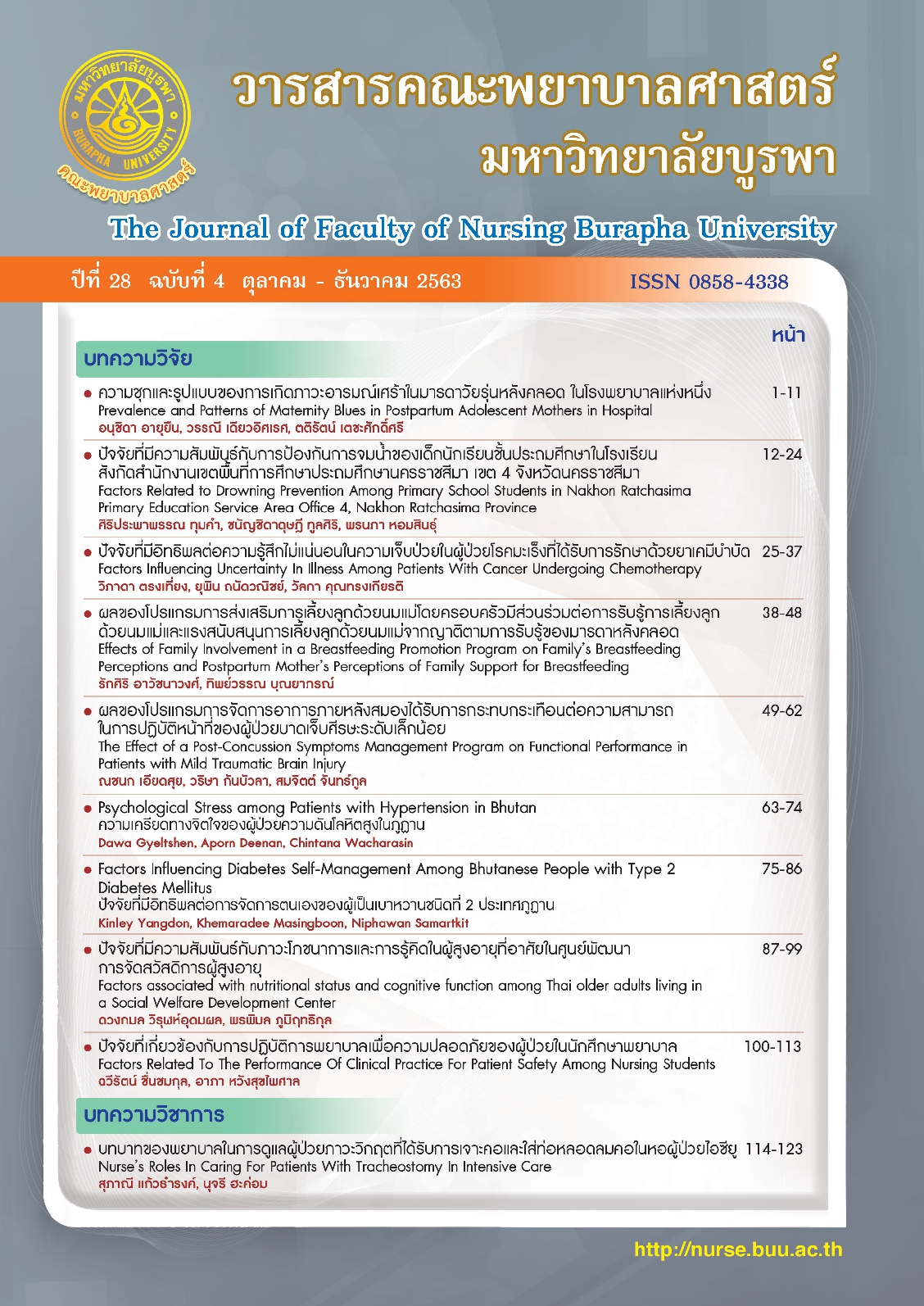
Prevalence and Patterns of Maternity Blues in Postpartum Adolescent Mothers in Hospital
Keywords:
maternity blues, adolescent mothers, prevalenceAbstract
Abstract
The purpose of this survey research was to study the prevalence and patterns of maternity blues in adolescent mothers during the first 7 days after delivery. Research participants were 115 adolescent mothers in the postpartum ward of Satuek Hospital, Buriram province. Adolescent mothers were asked to complete the Thai version of the Kennerley and Gaths Maternity Blues Questionnaire daily during the first 7 days postpartum. Data were analyzed using descriptive statistics and one-way repeated measures ANOVA.
The results showed that 49.60% of adolescent mothers (57 of 115) experienced maternity blues during the first 7 days after delivery. The typical maternity blues time pattern showed peaked on postpartum days 3, 4 and 5, and gradually decreased on days 6 and 7. The most common cluster of symptoms experienced by adolescent mothers was primary blues (21.40%). Only 3.48% of mothers experienced severe blues. The scores for each of the 7 days were significantly different (F = 48.551, p <.05). The results of this study can be used to improve care for postpartum adolescent mothers by screening and monitoring maternity blues of adolescent mothers and providing education to help prevent postpartum depression among these mothers.
References
Hongsrisawan N. (2016). Depression. Journal of Hua Chiew Chalermprakiet University, 19(38), 105-118. [In Thai]
Kennerley, H., & Gath, D. (1989). Maternity blues: I. Detection and measurement by questionnaire. British Journal of Psychiatry, 155(3), 356-362.
Letourneau, N., Stewart, M., Dennis, C. L., Hegadoren, K., Duffett‐Leger, L., & Watson, B. (2011). Effect of home‐based peer support on maternal-infant interactions among women with postpartum depression: A randomized, controlled trial. International Journal of Mental Health Nursing, 20(5), 345-357.
Manjunath, N. G., Venkatesh, G., & Rajanna (2011). Postpartum blue is common in socially and economically insecure mothers. Indian Journal of Community Medicine, 36(3), 231–233.
Moslemi, L., Tabari, M. G., Montazeri, S., & Tadayon, M. (2012). The frequency and several effective factors on baby blues. Journal of Society for Development in New Net Environment in B&H, 6(12), 4004-4008.
Nourollahpour Shiadeh, M., Kariman, N., Bakhtiari, M., Mansouri, S., & Mehravar, S. (2016). Unwanted pregnancy and its risk factors among pregnant women in Tehran, Iran. Nursing and midwifery studies, 5(3), 1-7.
O’Hara, M. W., & McCabe, J. E. (2013). Postpartum depression: Current status and future directions. Annual Review of Clinical Psychology, 2013(9), 379-407.
O'Hara, M. W., Schlechte, J. A., Lewis, D. A., & Wright, E. J. (1991). Prospective study of postpartum blues: Biologic and psychosocial factors. Archives of General Psychiatry, 48(9), 801-806.
Phuangprasonka, R., Deoisre, W., & Chunlestskul, K. (2016). Maternity blues and management strategies of Thai postpartum women. Journal of Food Health and Bioenvironmental Science, 11(2), 23-27
Piyanan M. (2000). Obstetrics (1st ed.). Bangkok: Ruen Kaew Printing. (in Thai)
Pop, V. J. M., Truijens, S. E. M., Spek, V., Wijnen, H. A., Van Son, M. J. M., & Bergink, V. (2015). A new concept of maternity blues: Is there a subgroup of women with rapid cycling mood symptoms. Journal of Affective Disorders, 2015(177), 74-79.
Reck, C., Stehle, E., Reinig, K., & Mundt , C. (2009). Maternity blues as a predictor of DSM-IV depression and anxiety disorders in the first three months postpartum. Journal of Affective Disorders, 113(1-2), 77-87.
Regional Health Promotion Center. (2017). Regional Health Promotion Center 9 Nakhon Ratchasima. Nakhon Ratchasima: Center 9 Nakhon Ratchasima. [In Thai]
Reuangrakul S. (2007). Pregnancy, psychiatric disorders and treatment (1st ed.). Bangkok: Ruen Kaew Printing. [In Thai]
Rondón, M. B. (2003). Maternity blues: Cross-cultural variations and emotional
changes. Primary Care Update for OB/GYNs, 10(4), 167-171.
Thammasuwan C. (2012). The effect of a mother's care program in which the child is admitted to the Neonatal Intensive Care Unit on anxiety and the relationship between the mother and the newborn. Master of Nursing Thesis, Advanced Midwifery Program, Graduate School, Mahidol University. [In Thai]
Worasing T. (2016). Pregnancy outcomes between teenage pregnancy and adult pregnancy. Medical Journal of Sisaket Hospital, Surin Buri Ram, 31(2) 61-69.
[In Thai]
Youngdee K, & Roomruangwong C. (2016). Depression after childbirth among mothers with obstetric complications in King Chulalongkorn Memorial Hospital. Chulalongkorn Medical Journal, 60(5), 561-574. [In Thai]
Yuki T., & Katsutoshi T. (2014). Factors associated with early postpartum maternity blues and depression tendency among Japanese mothers with full - term healthy infants. Nagoya Journal of Medical Science, 76(1-2), 129-138.