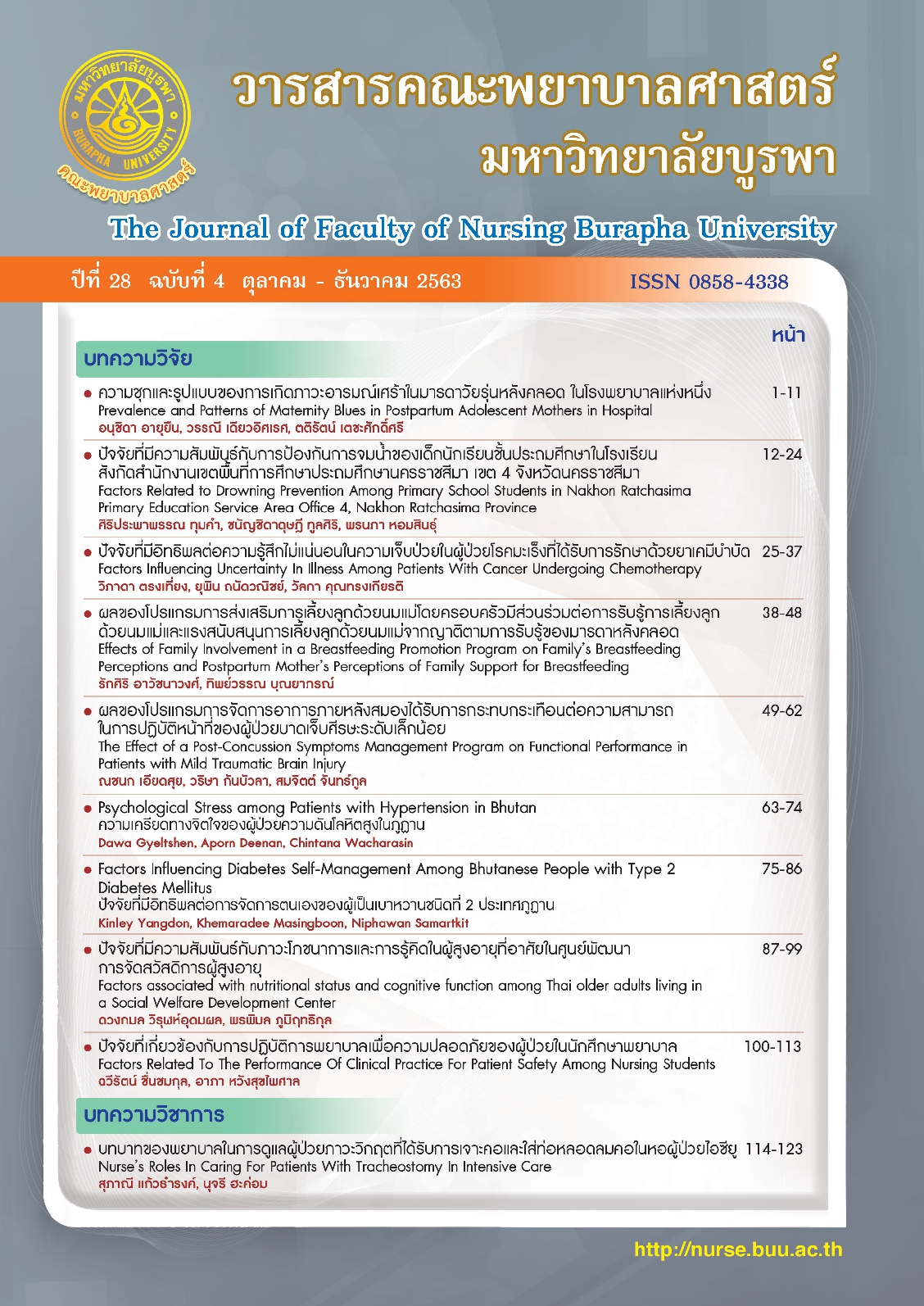
Factors Related to Drowning Prevention Among Primary School Students in Nakhon Ratchasima Primary Education Service Area Office 4, Nakhon Ratchasima Province
Keywords:
ability to make decisions, prevent drowning, primary school studentsAbstract
The purpose of this research was to identify factors related to drowning prevention among primary school students in Nakhonratchasima primary education service area office 4, Nakhonratchasima province. Multistage random sampling was used to recruit the sample of 245 primary school students in Nakhonratchasima primary education service area office 4, Nakhonratchasima province. Research instruments included questionnaires to gather data on demographic information, knowledge, decision-making ability, perceived susceptibility, physical environment, family support to prevent drowning, and drowning prevention. Descriptive statistics, point biserial correlation coefficients and Pearson’s product moment correlation coefficients were used to analyze the data.
The results revealed that the sample had moderate level mean score for drowning prevention (M = 22.27, SD = 3.88). Drowning prevention was significantly correlated with ability to make decisions to prevent drowning (r = .898, p <.001), physical environment (r = .178, p <.01), perceived susceptibility (r = .174, p <.01), and family support to prevent drowning (r = .162, p <.05). Prevention drowning knowledge and sex were not significantly correlated with drowning prevention. The findings suggest that nurses and other healthcare providers who are responsible for primary school students could apply these study results to develop activities/ programs to prevent drowning by focusing on enhancing primary school students’ ability to make decisions, the physical environment, perceived susceptibility, and family support to prevent drowning
References
among school-age children, Northeastern region. Journal of Nursing
Science Chulalongkorn University, 27(2), 72-84. [In Thai]
Chiangkraiwet, P., Kanthanut, M., & Paunprathom, N. (2013). Pediatric trauma.
Songkha: Chanmuang press.
Chivanon, N. (2016). Accidents in children: Situation and prevention. The Journal of
Faculty of Nursing Burapha Universit, 24(3), 1-12. [In Thai]
Cortés, L. M., Hargarten, S. W., & Hennes, H. M. (2006). Recommendations for water
safety and drowning prevention for travelers. Journal of Travel Medicine,
13(1), 21-34.
Division of Non Communicable Diseases. (2019). Drowning prevention plan 2019.
Retrieved from http://www.thaincd.com/document/file/drowning. [In Thai]
Division of Non Communicable Disease. (2020). Significant issues for the 2020 child
drowning prevention campaign. Retrieved from http://www.thaincd.com/
2016/mission4?tid=37 [In Thai]
Division of Non Communicable Diseases (Preventing Injury Groups from Other Causes)
Department of Disease Control. (2018). Significant issues for the 2018 child
drowning prevention campaign. Retrieved from http://moungkham.go.th/
fileupload/files/tb_files_48_1.pdf [In Thai]
Erikson, E. H. (1963). Childhood and society (2nd Ed.). New York: Norton.
Green, L. W., & Kreuter, M. W. (2005). Health program planning: An educational and
ecological approach (4th ed.). New York: McGraw-Hill Higher Education.
Hossain, M., Mani, K. K., Sidik, S. M., Hayati, K. S., & Rahman, A. K. (2015). Randomized
controlled trial on drowning prevention for parents with children aged
below five years in Bangladesh: A study protocol. BioMed Central Public
Health, 15(484), 1-7. doi: 10.1186/s12889-015-1823-1.
Kaewviengdach, C., & Hirunwatthanaku, P. (2016). Factors associated with sexual risk
behaviours among secondary school students in Nakhon Phanom province.
Journal of The Royal Thai Army Nurses, 17(3), 168-177. [In Thai]
Kasonbua, P., Nabkasorn, C., & Hengudomsub, P. (2016). Effect of humor media
program on fear of school-age children receiving intravenous infusion.
Journal of Faculty of Nursing Burapha University, 24(2), 61-71. [In Thai]
Little, R. J. A., & Rubin, D. B. (2002). Statistical analysis with missing data (2nd ed.).
New York: John Wiley & Sons.
Nakhon Ratchasima Primary Education Service Area Office 4, 2018. (2018). Student
information. Retrieved from https://data.bopp-obec.info/emis/
student.php?Area_CODE=3004&Edu_year=2562.
Polit, D. F., & Beck, C. T. (2017). Nursing research: Generating and assessing evidence
for nursing practice (10th ed.). Philadelphia: Lippincott Williams & Wilkins.
Salee, K., Chaimongkol, N., & Pongjaturawit, Y. (2015). Predictors of health risk
behaviors in late school-age children. The 6th National and International
Conference, 1(6), 54-64. Retrieved from http://journalgrad.ssru.ac.th/index.
php/5-01/issue/view/52 [In Thai]
Saroung, Y., Durongritichai, W., & Kompayak, J. (2014). The development of health
partnership for injury prevention of school-aged children in community,
Journal of Public Health Nursing, 28(2), 39-50. [In Thai]
Schyllander, J., Janson, S., Nyberg, C., Eriksson, U. B., & Stark Ekman, D. (2013). Case
analyses of all children’s drowning deaths occurring in Sweden 1998-
2007. Scandinavian Journal of Public Health, 41(2), 174-179.
Strategy and Planing Division, Office of the Permanent Secretary. (2018). Twenty-year
national strategic plan for public health. Bangkok: The War Veterans
Organization of Thailand Under Royal Patronage of His Majesty the King.
Suwantip, N., & Witthayawirasak, B. (2018). Using participatory action research for
injury prevention in child development centers, Suratthani province.
Kasetsart Journal of Social Sciences, 39(2018), 98-104. [In Thai]
Taskesen, M., Pirinccioglu, A. G., & Yaramis, A. (2015). Drowning and near-drowning in
children in the southeast of Turkey. The Journal of Academic Emergency
Medicine, 14(2), 16-25.
Tyler, M. D., Richards, D. B., Reske-Nielsen, C., Saghafi, O., Morse, E. A., Carey, R., &
Jacquet, G. A. (2017). The epidemiology of drowning in low-and middle-
income countries: A systematic review. BioMed Central Public Health,
17(413), 1-7.Retrieved from https://ulsafetyindex.org/library/the-
epidemiology-of-drowning-in-low-and-middle-income-countries-a-
systematic-review.pdf
Veetil, J. N., Parambath, V. A., Rajanbabu, B., & Suresh, S. (2017). An epidemiological
study of drowning survivors among school children. Journal of Family
Medicine and Primary Care, 6(4), 844-847. doi: 10.4103/jfmpc.jfmpc_349_16
White, K. M., Zhao, X., Hyde, M. K., & Hamilton, K. (2018). Surviving the swim:
Psychosocial influences on pool owners’ safety compliance and child
supervision behaviours. Safety Science, 106(2018), 176-183.
Willcox-Pidgeon, S., Kool, B., & Moran, K. (2018). Perceptions of the risk of drowning at
Surf beaches among New Zealand youth. International Journal of Injury
Control and Safety Promotion, 25(4), 365-371.
World Health Organization [WHO]. (2018). Global drowning report 2018. Geneva:
World Health Organization. Retrieved from https://apps.who.int/iris/bi
tstream/handle/10665/272596/9789241565585-eng.pdf