Factors Influencing Intention to Change Preconception Lifestyle Among Reproductive Age Women
Keywords:
Intention, lifestyle, preconception, reproductive womenAbstract
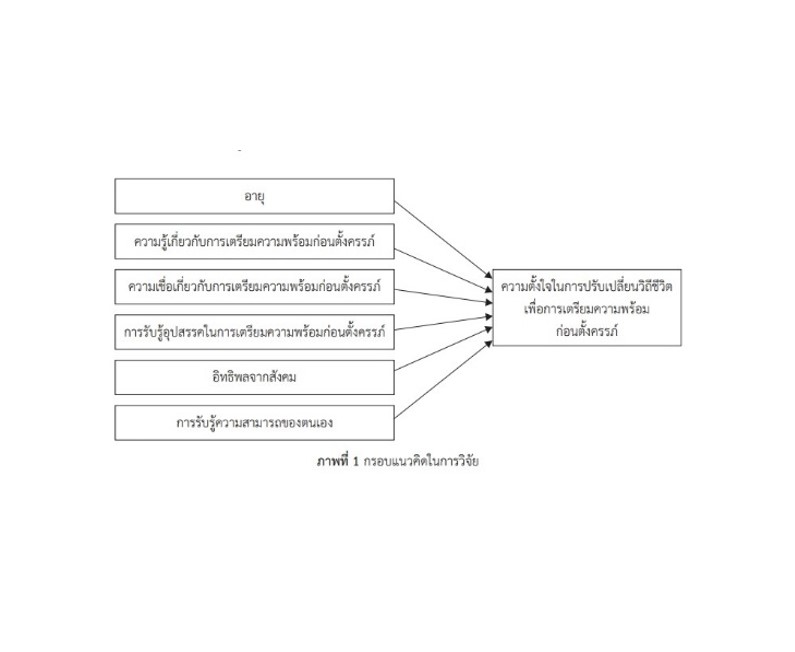
This predictive correlation study aimed to determine factors influencing intention to change preconception lifestyle among reproductive women. A systematic random sampling technique was used to recruit the sample of 397 women who visited marriage registration District Offices at Mueang Chonburi, Mueang Rayong, and Mueang Chachoengsao. Research instruments were questionnaires to gather data for demographic information, preconception knowledge, preconception belief, perceived barriers regarding preconception care, social influence, perceived self-efficacy, and intention to change preconception lifestyle. Their reliability values were .89, .80, .79, 75, .85, and .80, respectively. Data were collected from October 2021 to January 2022. Descriptive statistics and Standard multiple regression were used to analyze the data.
The results revealed that age, preconception knowledge, preconception belief, perceived barriers regarding preconception care, social influence, perceived self-efficacy together explained 54.9 % of variance in intention to change preconception lifestyle (R2 = .549, p < .001). The significant predictors of intention to change preconception lifestyle were self-efficacy (β = .642, p < .001), social influence (β = .106, p < .05), and perceived barrier regarding preconception (β = -.076, p < .05). The factors such as age, preconception knowledge, and preconception belief did not significantly predict intention to change preconception lifestyle. The findings may aid healthcare personnel to develop activities to assess and encourage women’s self-efficacy, promote their social influence, and counsel them to reduce their perception of preconception barriers. In addition, it will foster reproductive women to have a high intention to change their preconception lifestyle.
References
Ajzen, I. (2006). Constructing a theory of planned behavior questionnaire. Retrieved from https://www.researchgate.net/publication/235913732_Constructing_a_Theory_of_Planned_Behavior_Questionnaire
Amaje. E., Fikrie, A., & Utura, T. (2022). Utilization of preconception care and its associated factors among pregnant women of West Guji zone, Oromia, Ethiopia, 2021: A community-based cross-sectional study. Health Services Research and Managerial Epidemiology, 9, 1-10. doi:10.1177/23333928221088720
Brooks, C., Supramaniam, P. R., & Mittal, M. (2022). Preconception health in the well woman. The Obstetrician & Gynaecologist, 24, 58-66.
Centers for Disease Control and Prevention [CDC]. (2020). Planning for pregnancy. Retrieved from https://www.cdc.gov/preconception/planning.html
Department of Maternal and Child Health, Regional Health Promotion Center 7 Ubon Ratchathani, Department of Health. (2014). Training guide prenatal preparation course for quality parents (preconception care) for spouses. Ubon Ratchathani: We can service express. [in Thai]
Floyd, R. L., Johnson, A. K., Owens, R. J., Verbiest, S., Moore, A. C., & Boyle, C. (2013). A national action plan for promoting preconception health and health care in the United States (2012–2014). Journal of Women’s Health, 22(10), 797-802. doi: 10.1089/jwh.2013.4505
Goossens, J. (2018). Preconception health and care: Perspectives from the reproductive-aged population in Flanders [Unpublished dissertation]. Doctoral degree in Health Sciences, Ghent University.
Goossens, J., Beeckman, D., Hecke, A. V., Delbaere, I., & Verhaeghe, S. (2018). Preconception lifestyle changes in women with planned pregnancies. Midwifery, 56, 112-120.
Kaewpoung, S., Deoisres, W., & Suppaseemanont, W. (2018). Influencing of perception of pregnancy risk, knowledge, and attitude on preconception health behavior among pregnant women. The Journal of Faculty of Nursing Burapha University, 26(2), 57-66. [In Thai]
Krejcie, R. V., & Morgan, D. W. (1970). Determining sample size for research activities. Educational and Psychological Measurement, 30(3), 607-610.
Ministry of Public Health. (2017). The 2nd national reproductive health development policy and strategy (2017-2026) on the promotion of quality birth and growth. Nonthaburi: Ministry of Public Health. [In Thai]
Ministry of Public Health. (2020). Department of health to reduce HIV infection from mother to child. Retrieved from https://multimedia.anamai.moph.go.th/news/301163/ [In Thai]
Downloads
Published
How to Cite
Issue
Section
License

This work is licensed under a Creative Commons Attribution-NonCommercial-NoDerivatives 4.0 International License.