Development of a Nursing Care Model for Breast Cancer Patients Undergoing Modified Radical Mastectomy
Keywords:
Breast Cancer, Modified Radical MastectomyAbstract
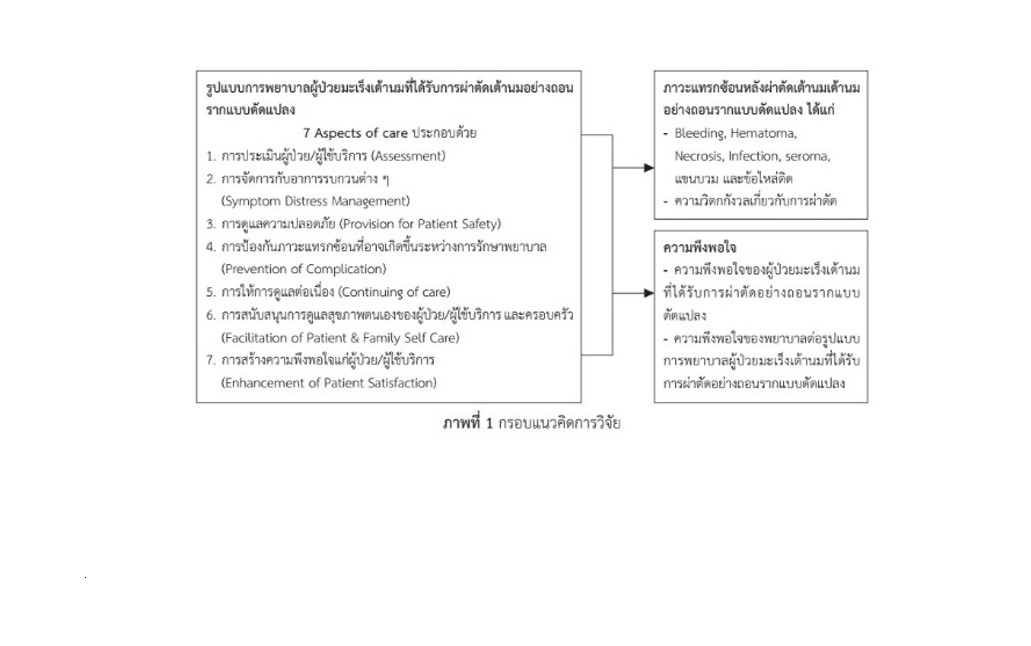
This research, centered on research and development, sought to create a nursing care model for the management of breast cancer patients undergoing Modified Radical Mastectomy (MRM). A purposive sampling method was employed, involving 19 female breast cancer patients who met the specified criteria. The research unfolded through key phases: 1) situation analysis, 2) development of the care model, 3) testing the care model in the sample group with subsequent evaluation, and 4) the implementation of the prototype of the care model.
Results indicated that, post the application of the nursing care model for breast cancer patients undergoing MRM, all 19 patients experienced no complications, achieved a range of arm movement between 70-180 degrees (n=19), and reported seroma and lymphedema rates ≤1.9 out of 89.47 (n=17), with normal anxiety levels also at 89.47 (n=17). Patient satisfaction reached the highest average (M=4.62, SD=0.56), with nurse advice, pain management, and guidance on abnormal symptoms, along with the need for medication before appointments, receiving the highest average ratings (M=4.83, SD=0.39, 0.38). Nurse satisfaction was also high, averaging (M=3.99, SD=0.66), with the benefit for the office obtaining the highest average (M=4.61, SD=0.50).
In summary, the development of nursing care controls for breast cancer patients undergoing MRM proved effective in reducing the post-surgical complications. Hence, its application is recommended to enhance the quality of nursing care.
References
American Cancer Society. (2017). Breast cancer: Lifestyle related for breast cancer. Retrieved
Cancer National Health Institute. (2017). Th screen diagnosis and treatment of CA breast. Nonthaburi: Department of Medicine, Ministry of public health.
Cheng, K. K. F., Devi, R. D., Wong, W. H., & Koh, C. (2014). Perceived symptoms and the supportive care needs of breast cancer survivors six months to five years post-treatment period. Europe Journal of Oncology Nursing, 18, 3-9.
Department of Health. (2023). Health literacy and health communication office. Retrieved from https://multimedia.anamai.moph.go.th/news/140366/
Department of Surgery, Faculty of Medicine. (2019). CA Breast. Retrieved from https://www.si.mahidol.ac.th/Th/healthdetail .asp?aid=1418
Engsirorat, T., & Chaowchuen, S. (2021). Risk factors influencing seroma formation after modified Radical Mastectomy. Srinakarin Medical Journal, 36(4), 382-388.
Female Surgery Department. (2021). Surgery care report. Surin: Surin Hospital.
Heisig, S. R., Shedden-Mora, M. C., Von Blanckenburg, P., Rief, W., Witzel, I., Albert, U. S., & Nestoriuc, Y. (2016). What do women with breast cancer expect from their treatment? Correlates of negative treatment expectations about endocrine therapy. Psycho-oncology, 25(12), 1485–1492. Retrieved from https://doi.org/10.1002/pon.4089
Kasemsuk, S., Kunjeena, V., & Siribut, D. (2019). The results of complications, length of stay, re-admission within 28 days after discharge Chiangrai Prachanukroh Hospital. Chaingrai Medical Journal, 11(2), 85-91.
Kingkeaw, J. (2017). CA Breast patient with surgery nursing care. Journal of CA Breast, 37(4), 163-170.
Kopoonsilapa, S., & Pongmasa, T. (2017). The quality of women with CA Breast during received chemical treatment Fluorouracil, Doxorubicin และ Cyclophosphamide (FAC). Journal of Health Science and Medical Research, 35(4), 378-384.
Lotrakul, M. (2001). Mental health care manual for psychiatrist. Retrieved from https://www.rama.mahidol.ac.th/ramamental/sites/default/files/public/pdf/Psychiatric%20assessment%20tools.PDF
National Cancer Institute. (2015). TAN Scale (Thai Arthrometric Navigator Scale). Retrieved from http://emis.dms.go.th/assets/upload/store/3.pdf
National Comprehensive Cancer Network. (2015). NCCN Clinical practice guidelines in oncology: Breast cancer screening and diagnosis. Retrieved from https://www.nccn.org/professionals/ physician_gls/pdf/breast-screening.pdf
Nursing Division. (2011). Hospital accreditation. Bangkok: Office of the Permanent Secretary Ministry of Public Health.
Public Health Statistic. (2019). The statistic of CA Breast. Nonthaburi: Ministry of public health.
Srisaang, K et al. (2020). The development of nursing care for pediatric with septic shock using seven aspects of care. The meeting of New Normal SHOW & SHARE at Laithong hotel Ubonrachatani province. North east Nursing council.
Stagl, J. M., Lechner, S. C., Carver, C. S., Bouchard, L. C., Gudenkauf, L. M., Jutagir, D. R., Diaz, A., Yu, Q., Blomberg, B. B., Ironson, G., Glück, S., & Antoni, M. H. (2015). A randomized controlled trial of cognitive-behavioral stress management in breast cancer: Survival and recurrence at 11-year follow-up. Breast Cancer Research and Treatment, 154(2), 319–328. doi.org/10.1007/s10549-015-3626-6
Downloads
Published
How to Cite
Issue
Section
License

This work is licensed under a Creative Commons Attribution-NonCommercial-NoDerivatives 4.0 International License.