Effects of self-care and medication promotion program on dietary and iron supplement consumption behavior and blood concentration in pregnant women with anemia at San Sai Hospital, Chiang Mai Province
Keywords:
Anemia in pregnancy, self-care and medication promotion program, Orem theory of nursing, Quasi-experimental researchAbstract
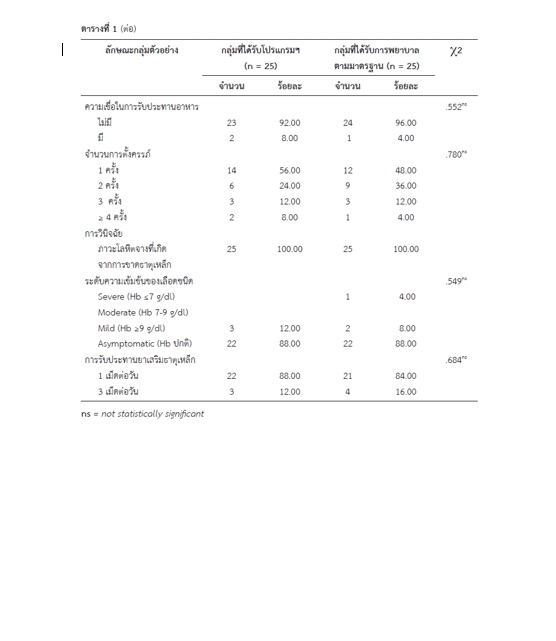
This quasi-experimental study aimed to assess the effects of a self-care and medication promotion program on dietary habits, iron supplement consumption behavior, and hematocrit levels in pregnant women with anemia at San Sai Hospital, Chiang Mai Province. A total of 50 pregnant women diagnosed with anemia and attending antenatal care at the hospital were randomly selected and divided into two groups: an experimental group (25 participants) receiving the self-care and medication promotion program and a control group (25 participants) receiving routine antenatal care. The experimental group attended sessions on food and iron supplement consumption held on Tuesdays, Wednesdays, and Fridays, while the control group attended on Mondays and Thursdays. The study was conducted between June and October 2023.
The research tools included a nutrition promotion program with lesson plans, a food and iron supplement consumption manual, a Line application for follow-up, and a consumption behavior questionnaire. Hematocrit levels were also measured. Data were analyzed using descriptive statistics, independent t-tests, and paired t-tests.
The results found that a statistically significant increase in the mean score of food consumption behavior, iron supplements and hematocrit in the experimental group compared to the control group after the implementation of the program. (t=-3.466, p<.05 (t=-3.537, p<.05) The experimental group there was an average score of food consumption behavior, iron supplements and hematocrit increased after the implementation of the program. (t=-6.913, p<.05) (t=-2.680, p<.05). Research results show that self-care and medication promotion program helps promote dietary habits and iron supplements in women with anemia during pregnancy. Therefore, antenatal care nurses can use this program to care for pregnant women with iron deficiency anemia.
References
Abd Rahman, R., Idris, I. B., Md Isa, Z., & Abd Rahman, R. (2022). The effectiveness of a theory-based intervention program for pregnant women with anemia: A randomized control trial. PLoS ONE 17(12): e0278192. https://doi.org/10.1371/journal.pone.0278192.
Abujilban, S., Hatamleh, R., & Al-Shuqerat, S. (2019). The impact of a planned health educational program on the compliance and knowledge of Jordanian pregnant women with anemia. Women & Health, 59(7), 748-759.Retrieved from https://nutrition2.anamai.moph.go.th/th/book/194488
Bureau of Reproductive Health, Department of Health, Ministry of Public Health. (2024). The 2nd National Reproductive Health Development Policy and Strategy (2017-2026) on the Promotion of Quality Birth and Growth. Retrieved from http://plan.psru.ac.th/index.php?module=policy&id=225
Bunyaprapaphan, T.,Saeng-in S., & Sirirarunrat, S. (2020). Results of the support program and provide knowledge about behavior self-care and hematocrit levels in pregnant women with iron deficiency anemia. The Journal of Faculty of Nursing Burapha University, 26(4), 40-50. [In Thai]
Department of Health, Ministry of Public Health. (2024). Information system supporting health promotion and environmental health, Department of Health: Anemia in pregnant women Health district level. Retrieved from https://dashboard.anamai.moph.go.th/dashboard/anemia?year=2023
Fatthy, A., & Ezzat, N. (2020). A smartphone-based health behavioral intervention for pregnant women with iron deficiency anemia. Egyptian Journal of Health Care,11 (2).1163-1175.
Jeno, M. (2012). Results of the support and education program to reduce anemia on self-care behavior of pregnant Muslim women. (Doctoral dissertation, Prince of Songkla University.). [In Thai]
Khampila, W., Thitiyarnviroj, B., Raksee, S., Manadee, P., Tubsai, T., & Singsiricharoenkul, S. (2022). Caring for pregnant women with Iron deficiency anemia: The challenging role of nurses. The Journal of Faculty of Nursing Burapha University 30(2),134-142. [In Thai]
Lamo, S., Yangwanichset, S., & Thitimapong, B. (2021). Effects of the nutrition promotion program on food consumption behavior and Iron supplements and blood concentration in teenage pregnant women with anemia. Nursing Journal of The Ministry of Public Health, 31(1), 224-236. [In Thai]
Nantsuphawat, N. (2020). Anemia in pregnant foreign women who receive prenatal care and give birth at San Sai Hospital. Chiang Mai Province. Journal of Primary Care and Family Medicine Systems, 3(1), 36-45. [In Thai]
Puwang, W. (2020). Prevalence and risk factors of anemia in pregnant women giving birth in hospitals. Nong Khai. Journal of Nursing, Health and Education. 18 (3).18-19[In Thai]
Rahman, R., Idris, I. B., Isa, Z., & Rahman, R. (2022). The effectiveness of a theory-based intervention program for pregnant women with anemia: A randomized control trial. PloS ONE, 17(12), e0278192. https://doi.org/10.1371/journal.pone.0278192
Rahmati, S., Delpishe, A., Azami, M., Hafezi-Ahmadi, M. R., & Sayehmiri, K. (2017). Maternal anemia during pregnancy and infant low birth weight: A systematic review and meta- analysis. International Journal Reproductive Biomed. 15(3),125–134.
Silpawittayathorn, B., & Chitpakdee, B. (2020). The use of health information technology in nursing for patient safety. .Journal of Nursing and Health Care.38(2), 6-14.
Sueram, K. (2022). Application of Orem's theory in nursing children with pneumonia: A case study. Journal of Nursing Science & Health Volume 45(3), 23-36.
Seaharattanapatum, B., Sinsuksai, N., Phumonsakul, S., & Chansatitporn, N. (2021). Effectiveness of balanced diet-iron supplement program among pregnant women with anemia: A quasi-experimental study. Pacific Rim International Journal of Nursing Research, 25(4), 653-665.
Tümkaya, M.,N., Eroğlu, K., & Karaçam, Z. (2024). The effect of Orem's self-care deficit theory-based care during pregnancy and postpartum period on health outcomes: A systematic review and meta-analysis. International Journal of Nursing Practice, 29, e13300. 1-12. doi: 10.1111/ijn.13300.
Techakamphonsarakit, L., Kantharaksa K., & Saensiriphan, N. (2018) Methods for promoting preventing anemia in pregnant women: A systematic review. Nursing Journal. 5(1), 62- 74. [In Thai]
Tongsong, T., & Wanapirak, C. (2021). Obstetrics (6th ed.). Chiang Mai: Department of Obstetrics andGynaecology, Faculty of Medicine, Chiang Mai University.
World Health Organization [WHO]. (2021). Worldwide prevalence of anemia 2016 - 2019, WHO Globaldatabase on anemia. Retrieved from https://www.who.int/data/gho/data/themes/topics/anaemia_in_women_and_children.
Downloads
Published
How to Cite
Issue
Section
License

This work is licensed under a Creative Commons Attribution-NonCommercial-NoDerivatives 4.0 International License.