Caring Experiences for Persons With Amphetamine Dependence Relapse of Family Caregivers
Keywords:
Caring Experience, Amphetamine Dependence Relapse, Family CaregiversAbstract
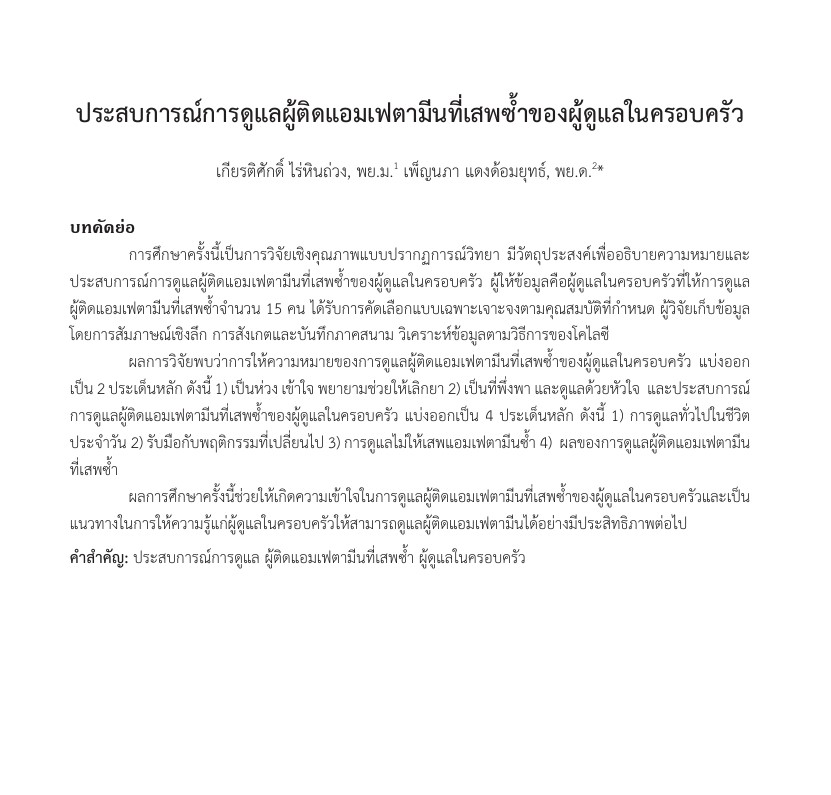
The purpose of this qualitative research was to explain caring experiences for persons with amphetamine dependence relapses of family caregivers. A qualitative research method of Husserl was applied. A purposive sample comprised 15 family caregivers recruited from the community in the Central Region of Thailand who were willing to participate in this study. An in-depth interview with tape-recorded observations and field notes was performed to collect data. Audio tapes of interviews were transcribed verbatim. Data were analyzed using Colaizzi’s method.
The research findings indicated that the meanings of caring experiences for a person with amphetamine dependence relapse of family caregivers followed 2 major themes: 1) Being concerned, understanding, and ensuring non-repetition of substance use. 2) Being dependable, take care with heart.
The research findings indicated that caring experiences for persons with amphetamine dependence relapses of family caregivers can be divided into 4 major themes: 1) General care for daily life. 2) Dealing with the changing behavior of persons with amphetamine dependence relapse. 3) Caring for preventing relapse to amphetamine use. 4) Outcomes of caring for persons with amphetamine dependence relapse.
The results of this study provide insight into the care provided by family caregivers to amphetamine addicts who relapse, serving as a guide for educating family caregivers on effective care for amphetamine addicts.
References
Barnes, G. M., Hoffman, J. H., Welte, J. W., Farrell, M. P., & Dintcheff, B. A. (2006). Effects of parental monitoring and peer deviance on substance use and delinquency. Journal of Marriage and Family, 68(4), 1084-1104.
Brecht, M. L., & Herbeck, D. M. (2013). Methamphetamine use and violent behavior: User perceptions and predictors. Journal of Drug Issues, 43(4), 468-482.
Caughlin, J. (2010). Estimating the impact of caregiving and employment on well-being. Outcomes & Insights in Health Management, 2(1), 1-7.
Chansuvarn, S., Champangern, V., Kachat, S., Photong, P., & Sripho, S. (2023). Problems and causes of recurrence among psychiatric patients using substances in the community. The Journal of Boromarjonani College of Nursing, Suphanburi, 6(2), 67-77. [In Thai]
Colaizzi, P. F. (1978). Psychological research as a phenomenologist views it. In R. S. Valle, & M. King (Eds.), Existential-phenomenological alternatives for psychology (pp. 48-71). Oxford: Oxford University Press.
Department of Mental Health, Ministry of Public Health. (2021). Guidelines for the treatment and rehabilitation of alcohol/drug/substance addicts with mental symptoms and co-occurring psychiatric disorders. Retrieved from https://mhso.dmh.go.th/fileupload/20211006504370196.pdf
Guba, E. G., & Lincoln, Y. S. (1989). Fourth generation evaluation. New York: Sage.
Husserl, E. (1969). Ideas: General introduction to pure phenomenology (5th ed.). London: George Allen & Unwin.
Kaur, A., Mahajan, S., Deepti, S. S., & Singh, T. (2018). Assessment of role of burden in caregivers of substance abusers: A study done at Swami Vivekananda Drug De-addiction Centre, Govt. Medical College, Amritsar. International Journal of Community Medicine and Public Health, 5(6), 2380-2383.
Khamkaew, A. (2023). Burden among caregivers of patients with substance use disorder. Journal of the Psychiatric Association of Thailand, 68(2), 181-193. [In Thai]
Klaraeng, W., Jiramanasawong, A., Tantajanya, P., Inngern, T., Pluangngam, N., & Surataworn, R. (2022). Lived experiences of primary caregivers in preventing relapse of the disease in schizophrenia patients. Journal of Prachomklao College of Nursing Phetchaburi Province, 5(3), 53-67. [In Thai]
Luaboonthavatchai, O. (2013). Psychiatric and mental health nursing (5th ed.). Bangkok: Faculty of Nursing, Chulalongkorn University.
MacLean, S., Hengsen, R., & Stephens, R. (2017). Critical considerations in responding to crystal methamphetamine use in Australian Aboriginal communities. Drug and Alcohol Review, 36(4), 502-508.
Maina, G., Ogenchuk, M., Phaneuf, T., & Kwame, A. (2021). “I can’t live like that”: The experience of caregiver stress of caring for a relative with substance use disorder. Substance Abuse Treatment, Prevention, and Policy, 16, 1-9.
Maltman, K., Savic, M., Manning, V., Dilkes-Frayne, E., Carter, A., & Lubman, D. (2021). Holding on and letting go: A thematic analysis of Australian parents’ styles of coping with their adult child’s methamphetamine use. Addiction Research & Theory, 28(4), 345-353.
McKetin, R., Leung, J., Stockings, E., Huo, Y., Foulds, J., Lappin, J. M., et al. (2019). Mental health outcomes associated with the use of amphetamines: A systematic review and meta-analysis. eClinical Medicine, 16, 81-97.
Musikachai, S. (2012). Family and post-treatment care for drug addicts. Retrieved from https://www.sdtc.go.th/paper/357
Narkdilok, S. (2020). The study of incident rate with relapse use of methamphetamine at Princess Mother National Institute on Drug Abuse Treatment (PMNIDAT). Journal of Addiction, 6(1), 49-51. [In Thai]
Office of the Narcotics Control Board, Ministry of Justice. (2022). The 2022 Annual report on nationwide drug suppression. Retrieved from https://www.oncb.go.th/DocLi/
Ounjai, S., Nathawin, K., Panwili, Y., Kanchanaba, S., & Kanato, M. (2017). Evaluate the matrix program on drug abuse in hospitals under the Office of the Permanent Secretary: 7 provinces, Northeast. Journal of Community Health Development Quarterly, Khon Kaen University, 5(4), 661-668. [In Thai]
Piawpongpakawat, A. (2020). Factors predicting family and community social supports on quitting methamphetamine in Nongki hospital, Buriram province. The Journal for Health Promotion and Environmental Health, 14(33), 22-34. [In Thai]
Piyavhatkul, N. (2020). Psychiatry. Khon Kaen: Department of Psychiatry, Faculty of Medicine, Khon Kaen University.
Pono, K., Lamyai, W., Chantapot, P., & Sukhawaha, S. (2018). Efficacy of co-occurring disorder (COD) intervention in patients with methamphetamine-induced psychosis. Journal of the Psychiatric Association of Thailand, 63(2), 127-140. [In Thai]
Richert, T., Svensson, B., & Johnson, B. (2021). Experiences of Swedish parents seeking social services support for their adult children with drug addiction. Journal of the Society for Social Work and Research, 12(4), 677-704.
Rong, C., Jiang, H. F., Zhang, R. W., Zhang, L. J., Zhang, J. C., Zhang, J., & Feng, X. S. (2016). Factors associated with relapse among heroin addicts: Evidence from a two-year community-based follow-up study in China. International Journal of Environmental Research and Public Health, 13, 177-188.
Schep, L. J., Slaughter, R. J., & Beasley, D. M. (2010). The clinical toxicology of methamphetamine. Clinical Toxicology, 48(7), 675-694.
Srimongkhul, P., & Wongpanarak, N. (2022). Self-perceptions of behaviors in males with schizophrenia and amphetamine addiction. Journal of the Royal Thai Army Nurses, 23(2), 408-417. [In Thai]
Staton Tindall, M., Sprang, G., & Clark, J. (2012). Caregiver drug use and arrest as correlates of child trauma exposure. Journal of Evidence-Based Social Work, 9(3), 265-282.
Thatsananchalee, P. (2011). The process of non-becoming amphetamine addict: A case study of rehabilitated person in process of correction system. Sripatum Chonburi Interdisciplinary Journal, 1(3), 36-47. [In Thai]
Thein, K. Z. K., Herberholz, C., Sandar, W. P., & Yadanar. (2021). Caring for persons with drug use disorders in the Yangon Region, Myanmar: Socioeconomic and psychological burden, coping strategies, and barriers to coping. PLOS ONE, 16(10), 1-19.
United Nations Office on Drugs and Crime. (2022). World drug report 2022. Retrieved from https://wdr.unodc.org/wdr2019/
Vathisoonthorn, P., & Chertchom, K. (2009). The success of treatment among drug-dependent patients compared between compulsory and voluntary systems. Bangkok: Drug System Development Group.
Velleman, R. D., Templeton, L. J., & Copello, A. G. (2005). The role of the family in preventing and intervening with substance use and misuse: A comprehensive review of family interventions, with a focus on young people. Drug and Alcohol Review, 24(2), 93-109.
Wachiradilok, P. (2022). A mental crisis emergency patient support under an integrated emergency medical service system in the area. Journal of Emergency Medical Services of Thailand, 2(1), 77-89. [In Thai]
Weerachai, V., Srisawang, P., & Tippayawong, T. (2010). Guideline on methadone maintenance treatment. Bangkok: Chulalongkorn University. [In Thai]
Downloads
Published
How to Cite
Issue
Section
License

This work is licensed under a Creative Commons Attribution-NonCommercial-NoDerivatives 4.0 International License.