Factors Influencing the Dietary Sodium Consumption Behavior of the Population in Nakhon Si Thammarat Province
Keywords:
Behavior, Food consumption, Sodium-rich foodsAbstract
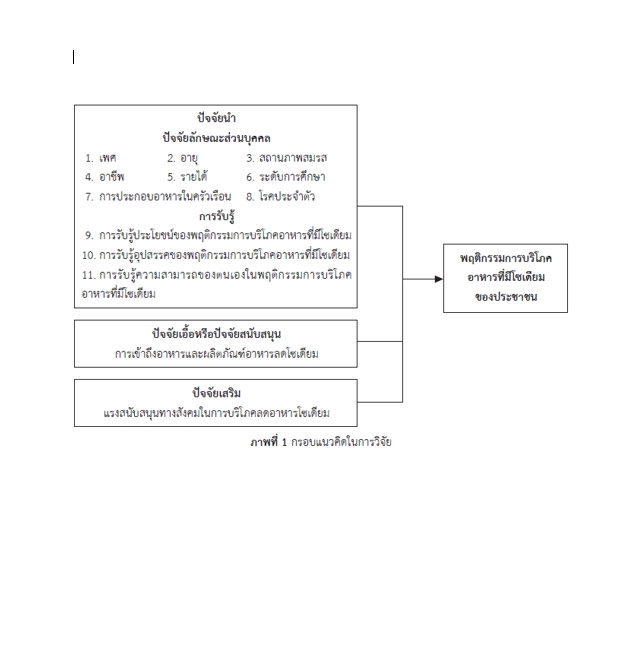
This cross-sectional survey aimed to investigate (1) key, supplementary, and facilitating factors related to sodium consumption behavior and (2) the factors affecting sodium consumption behavior among the population of Nakhon Si Thammarat Province. The study included a sample of 4,126 participants, selected through multi-stage sampling. Data were collected using a questionnaire consisting of four parts: leading factors, facilitating or supporting factors, additional factors, and behavior in consuming foods containing sodium. with a Cronbach's alpha reliability score of 0.81. Statistical analyses included descriptive statistics, odds ratios, and multiple logistic regression.
The findings revealed that perceptions of benefits (50.90%) and barriers (50.97%) were generally high, while self-efficacy regarding sodium reduction was low (50.92%). Access to low-sodium foods and products was limited (58.41%), but social support for reducing sodium intake was high (50.53%). Overall, a high proportion of the population exhibited behaviors associated with consuming sodium-rich foods (55.45%). After controlling for variables, factors influencing sodium consumption behavior included age, marital status, occupation, income adequacy, education level, home cooking practices, the presence of chronic diseases, perceptions of benefits and barriers, self-efficacy, and social support.
The results suggest that the Ministry of Public Health should enhance public awareness of sodium consumption and strengthen community networks to support efforts in reducing sodium intake.
References
Department of Disease Control, Ministry of Health. (2016). Strategy for reducing salt and sodium consumption in Thailand, 2016-2025. Nonthaburi. [In Thai]
Green, L. and Kreuter, M. (2005). Health program planning: An educational and ecological approach. (4th ed.). New York: McGraw Hill.
Grillo, A., Salvi, L., Coruzzi, P., Salvi, P., & Parati, G. (2019). Sodium intake and hypertension. Nutrients, 11(9), 1970. https://doi.org/10.3390/nu11091970.
Intersalt Cooperative Research Group. (1988). Intersalt: An international study of electrolyte excretion and blood pressure. Results for 24 hour urinary sodium and potassium excretion. BMJ. 297, 319–328.
Kanhasura, S. and Chupanit, P. (2023). High sodium diet intake behavior and related factors among adults in Me-Aaung district, Udonthani province. Academic Journal of Community Public Health, 9(4), 154-165.
Komcheab, J. (2013). The relationship between knowledge, perception of barriers, perception of benefits of social support, perception of self-efficacy, and sodium salt consumption behavior of patients with heart failure. Master's thesis in nursing
science. Bangkok: Chulalongkorn University. [In Thai]
Muangpe, P. and Jariya, W. (2023). Predictive factors of reducing salt and sodium consumption behavior among people with risk of hy¬pertension in Nong Phai district, Phetchabun province. Journal of Health Science, 32(1), 19-30.
Nakhon Si Thammarat Provincial Health Office. (2024). Demographic data. Nonthaburi: Ministry of Health. [In Thai]
Non-Communicable Diseases Division. (2023). Guidelines for implementing salt and sodium consumption reduction at the provincial level. Department of Disease Control, Ministry of Health. [In Thai]
Poonsri, Moungkum, S., & Masingboon, K. (2024). Factors influencing eating behavior among people with type 2 diabetes mellitus. The Journal of Faculty of Nursing Burapha University, 32(1), 14-25.
Promkaew, O., Luansri, M., Khrongyut, R., & Jaisoosuek, W. (2022). A study of assessing knowledge, awareness, and sodium consumption behavior of population in a village in Ubon Ratchathani province. The Office of Disease Prevention and Control 9th Nakhon Ratchasima Journal, 28(1), 5-15.
Strategy and Plans Group Bureau of Non-Communicable Diseases. (2017). Department of Disease Control. 5-year national NCD prevention and control strategic plan (2017 – 2021). Bangkok, Emotion Art. [In Thai]
Tirakanan, S. (1999). Social science research methodology: Guidelines for implementation. Bangkok: Chulalongkorn University. [In Thai]
Thirakulpharit, P. (2016). Factors affecting sodium consumption behavior of households at Bangmak sub-district, Kantang district, Trang province. Trang: Sirindhorn College of Public Health, Trang. [In Thai]
World Health Organization. (2017). Best buys and other recommended interventions for the prevention and control of noncommunicable diseases. Geneva: World Health Organization.
Woraphongsathorn, S. (2015). Research in health education. Bangkok: Printing Section Ramkhamhaeng University
Downloads
Published
How to Cite
Issue
Section
License

This work is licensed under a Creative Commons Attribution-NonCommercial-NoDerivatives 4.0 International License.