ผลของกลุ่มกิจกรรมบำบัดเสริมสร้างแรงจูงใจในการเลิกบุหรี่ต่อความรู้และความพร้อม ในการเลิกบุหรี่ สำหรับผู้ที่เป็นโรคจิตเภท
คำสำคัญ:
กิจกรรมบำบัดเสริมสร้างแรงจูงใจ , ความรู้เกี่ยวกับการฟื้นฟูสภาพปอด, การเลิกบุหรี่, ผู้ที่เป็นโรคจิตเภทบทคัดย่อ
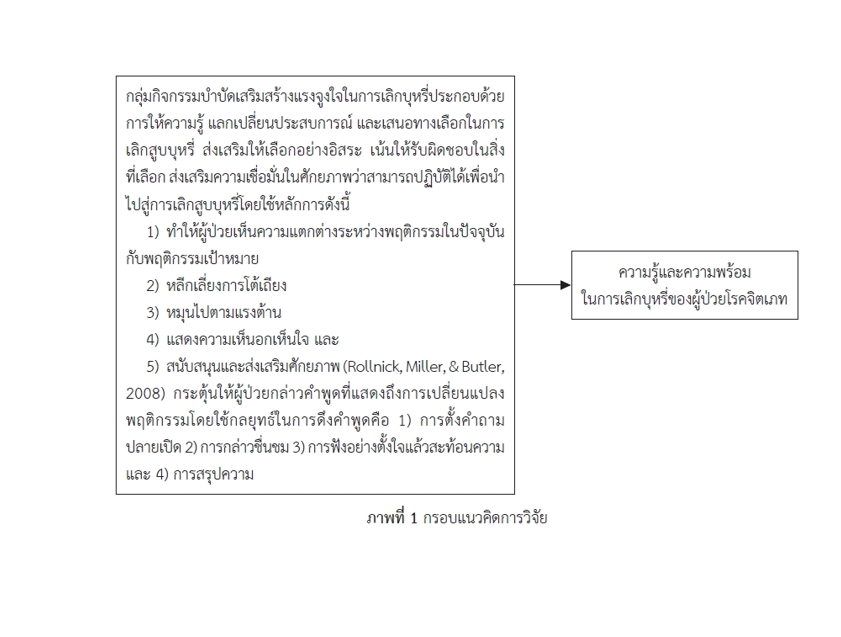
การวิจัยกึ่งทดลอง เพื่อศึกษาผลของกลุ่มกิจกรรมบำบัดเสริมสร้างแรงจูงใจในการเลิกบุหรี่ต่อความรู้และความพร้อมในการเลิกบุหรี่ สำหรับผู้ที่เป็นโรคจิตเภทใช้รูปแบบการศึกษาแบบกลุ่มเดียววัดผลก่อนและหลังการทดลอง กลุ่มตัวอย่าง คือ ผู้ป่วยที่ได้รับการวินิจฉัยจากจิตแพทย์ตามคู่มือการวินิจฉัยโรค (ICD-10) ว่า เป็นโรคจิตเภท (schizophrenia) และ มีประวัติการสูบบุหรี่ จำนวน 40 คน โดยสุ่มอย่างง่ายจากผู้ที่มีคุณสมบัติตามเกณฑ์ที่กำหนด เครื่องมือที่ใช้ในการวิจัย ประกอบด้วย กลุ่มกิจกรรมบำบัดเสริมสร้างแรงจูงใจในการเลิกบุหรี่ แบบสอบถามข้อมูลส่วนบุคคล แบบประเมินความพร้อมในการเลิกบุหรี่ แบบทดสอบความรู้เกี่ยวกับบุหรี่ ที่มีค่าสัมประสิทธิ์อัลฟ่าของครอนบาค เท่ากับ 0.89 , 0.94 วิเคราะห์ข้อมูลโดยใช้สถิติเชิงพรรณนาและสถิติการทดสอบค่าที
ผลการเปรียบเทียบความแตกต่างของค่าเฉลี่ยคะแนนความพร้อมในการเลิกบุหรี่และความรู้เกี่ยวกับบุหรี่ หลังการทดลอง พบว่า ค่าเฉลี่ยคะแนนความพร้อมในการเลิกบุหรี่ (ก่อนการทดลอง M = 5.15, SD = 1.93; หลังการทดลอง M= 7.33 SD= 1.94) และค่าเฉลี่ยคะแนนความรู้เกี่ยวกับบุหรี่ (ก่อนการทดลอง M = 8.23 , SD = .95; หลังการทดลอง M= 9.45 SD= 0.75) สูงกว่าก่อนการทดลองอย่างมีนัยสำคัญทางสถิติที่ระดับ p < .001
จากผลการวิจัยมีข้อเสนอแนะว่า พยาบาลจิตเวชควรมีการทำกลุ่มกิจกรรมบำบัดเสริมสร้างแรงจูงใจในการเลิกบุหรี่เพื่อเพิ่มความรู้และความพร้อมในการเลิกบุหรี่สำหรับผู้ที่เป็นโรคจิตเภท
เอกสารอ้างอิง
Anti-Smoking Campaign Foundation. (2017). Essential information: Smoking is harmful to people with high blood pressure [Brochure, in Thai]. Bangkok: Campaign Foundation for Non-Smoking.
Bualakorn, N. (2017). The effects of a motivation enhancement therapy program with family involvement on the medication adherence of inpatients with co-occurring schizophrenia and alcohol use disorder [Master’s thesis, Thammasat University]. [In Thai]
Burns, N., & Grove, S. K. (2009). The practice of nursing research: Appraisal, synthesis and generation of evidence (6th ed.). St. Louis, MO: W.B. Saunders.
Chaibuppha, J., Hengudomsub, P., & Vatanasin, D. (2018). The effects of motivational enhancement program on smoking cessation of perceived self-efficacy and behaviors among male clients. The Journal of Nursing Burapha University, 26(1), 10–20. [In Thai]
David, C. D. (2012). Nicotine and tobacco. U.S. National Library of Medicine. Retrieved from: http://www.nlm.nih.gov/medlineplus/ency/article/000953.htm
Dechkong, T., & Tipachot, T. (2023). Motivational interviewing techniques for changing health behaviors. Retrieved from: https://www.dmh-elibrary.org/Items/show/1529 [In Thai]
Ding, J. B., & Hu, K. (2021). Cigarette smoking and schizophrenia: Etiology, clinical, pharmacological, and treatment implications. Schizophrenia Research and Treatment, 2021, Article ID 7698030. https://doi.org/10.1155/2021/7698030
Hongthin, P. (2015). The effects of an incentive program for smoking cessation in orthopedic surgery patients [Master’s thesis, Chulalongkorn University]. [In Thai]
Keawlai, K., Tewela, S., & Soodtiphet, S. (2023). Effect of a motivation enhancing program together with therapy on self-management behavior of patients with substance-induced psychosis. Journal of Nursing and Health Sciences, 8(3), 187–196. [In Thai]
Lotrakul, M., & Sukhanit, P. (2018). Psychiatry Ramathibodi (4th ed.). Bangkok: Department of Psychiatry, Faculty of Medicine, Ramathibodi Hospital, Mahidol University. [In Thai]
McCreadie, R. G., & Kelly, C. (2000). Patient with schizophrenia who smoke: Private disaster. The British Journal of Psychiatry, 176(2), 109.
Miller, W. R., & Rollnick, S. (2002). Motivational interviewing: Preparing people to change. New York, NY: The Guilford Press.
Pinwihok, S., Kanogsunthornrat, N., & Panpakdee, O. (2018). The effects of motivational enhancement combined with hand reflexology on quit smoking behavior and nicotine withdrawal symptoms in tobacco addicted patients. Kurkukarn Journal of Nursing, 25(1), 90–105. [In Thai]
Polit, D. F., & Hungler, B. P. (1999). Nursing research: Principles and methods (6th ed.). Philadelphia, PA: Lippincott Williams & Wilkins.
Raya, P., Benjakul, S., Panit, M. K., Kengkrapanit, T., & Latthnana Nanta, K. (2015). The outcome of the support program: Quitting smoking according to the stage model to change people’s behavior in Wang Won Subdistrict, Kantang District, Trang Province. Journal of Boromarajonani College of Nursing Bangkok, 31(2), 9–25. [In Thai]
Rollnick, S., Miller, W. R., & Butler, C. C. (2008). Motivational interviewing in health care: Helping patients change behavior. New York, NY: Guilford Press.
Sangchancha, P., Phukhuao, D., Sombatmai, S., Sarubon, N., Noknoi, S., & Uthis, P. (2010). Training manual: Counseling and therapy to enhance motivation in patients with alcohol use disorders. Chiang Mai: Vanida Printing. [In Thai]
Satra, T., Wannasewok, K., Atsariyaswig, W., & Luisirirojanakul, J. (2017). Prevalence of nicotine dependence in schizophrenic patients, Siriraj hospital, Bangkok. Journal of the Psychiatric Association of Thailand, 62(4), 289–296.
Strasser, K. M. (2002). Smoking reduction and cessation for people with schizophrenia. Retrieved from: http://www.health.vic.gov.au/mentalhealth/publications/
Thailand Information Center for Civil Rights and Investigative Journalism [TCIJ]. (2023). Make the truth evident. https://www.tcijthai.com/news/2017/22/current/7357 [In Thai]
Wattihasakaki, K. (2016). Guide to treating tobacco addiction for nurses. Nonthaburi: Monphriya Graphic. [In Thai]
ดาวน์โหลด
เผยแพร่แล้ว
รูปแบบการอ้างอิง
ฉบับ
ประเภทบทความ
สัญญาอนุญาต

อนุญาตภายใต้เงื่อนไข Creative Commons Attribution-NonCommercial-NoDerivatives 4.0 International License.