Predicting Factors of Negative Automatic Thoughts among Amphetamine-Dependent Youth in a Prison in the Eastern Region
Keywords:
Negative Automatic Thoughts, Amphetamine-Dependent Youth, Central PrisonAbstract
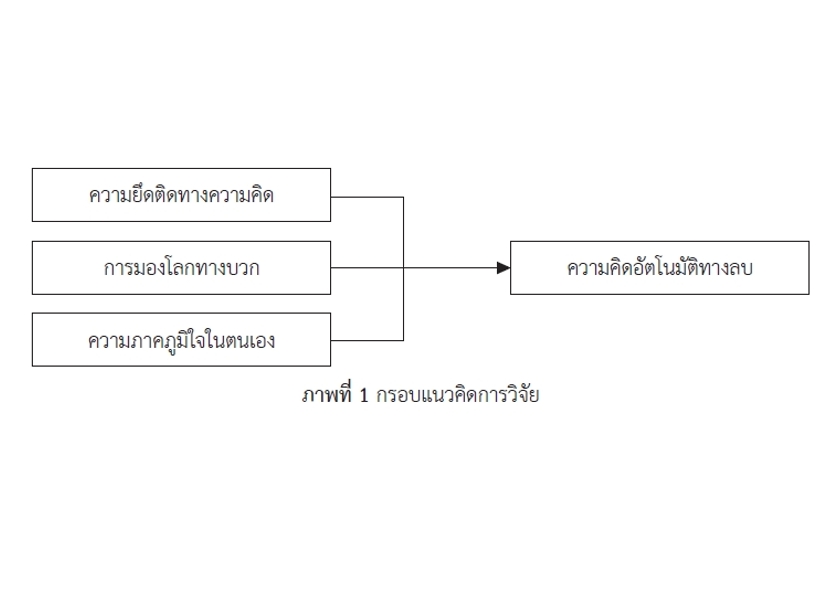
This study was a predictive correlation descriptive research aimed at examining the predicting factors of negative automatic thoughts among amphetamine-dependent youth in Chonburi Central Prison. The sample comprised 450 amphetamine-dependent youth in Chonburi Central Prison. The research instruments included a personal data questionnaire, a negative automatic thoughts questionnaire, a self-esteem questionnaire, a cognitive fusion questionnaire, and optimism questionnaires. The data were analyzed through descriptive statistics and stepwise multiple regression analysis.
The findings revealed that amphetamine-dependent youth had an average score of negative automatic thoughts of 57.60 (SD = 19.896). The most significant predicting factors that influence negative automatic thoughts were cognitive fusion (β = .497, p < .001), followed by optimism (β = -.211, p < .001) and self-esteem (β = .129, p < .01). Collectively, these factors could together significantly explain the variance of negative automatic thoughts for 42.40% (R² = .424, p < .001).
The results provide crucial information for professional nurses in prison settings to develop programs or activities that focus on reducing cognitive fusion and enhancing optimism and self-esteem, ultimately aiming to decrease negative automatic thoughts in this youth population.
References
Beck, J. S. (2021). Cognitive behavior therapy: Basics and beyond (3rd ed.). New York, NY: The Guilford Press.
Chailanka, P., Thepthien, B., & Chucharoen, P. (2017). Depression, automatic negative thought, attitude distortion and cognitive distortion of methamphetamine addicts age 18-24 years. KKU Journal for Public Health Research, 10(1), 73-85.
Chang, E. C. (1996). Cultural differences in optimism, pessimism, and coping: Predictors of subsequent adjustment in Asian American and Caucasian American college students. Journal of Counseling Psychology, 43, 113-123.
Eamsuphasit, S. (2019). Theory and techniques of behavioral modification (9th ed.). Bangkok, Thailand: Chulalongkorn University Press.
Faul, F., Erdfelder, E., Lang, A.-G., & Buchner, A. (2007). G*Power 3: A flexible statistical power analysis program for the social, behavioral, and biomedical sciences. Behavior Research Methods, 39, 175–191.
Hayes, S. C., Luoma, J. B., Bond, F. W., Masuda, A., & Lillis, J. (2006). ACT: Model, processes and outcomes. Behaviour Research and Therapy, 44(1), 1-25.
Hollon, S. D., & Kendall, P. C. (1980). Cognitive self-statements in depression: Development of an automatic thoughts questionnaire. Cognitive Therapy and Research, 4(4), 383-395.
Kantiya, W., & Uthis, P. (2022). Selected factors related to depression of prisoners with methamphetamine dependence. Journal of Nursing Science Chulalongkorn University, 34(1), 78-91.
Khidsanguan, S. (2023). Factors affecting mental health among female prisoners in Chonburi Women’s Correctional Institution. Regional Health Promotion Center 9, 17(1), 167-180.
Lakthong, S., & Chaimongkol, N. (2021). Restoring life period: The experience of recovery as told by drug-treated male youth. Journal of The Royal Thai Army Nurses, 22(1), 370-379.
Majer, J. M., Jason, L. A., & Olson, B. D. (2004). Optimism, abstinence self-efficacy, and self-mastery: A comparative analysis of cognitive resources. Assessment, 1, 57-63.
Mathurapotpong, S. (2012). Hope, optimism, and resilience as predictors of performance, job satisfaction, work happiness, and organizational commitment. Veridian E-Journal, SU, 5(3), 306-318.
Office of the Narcotics Control Board. (2024). Report on monitoring the spread of narcotic drugs from forensic medicine/forensic science project (the first quarter of 2024). Bangkok, Thailand: Office of the Narcotics Control Board, Ministry of Justice.
Peden, A. R., Hall, L. A., Rayens, M. K., & Beebe, L. (2000). Negative thinking mediates the effect of self-esteem on depressive symptoms in college women. Nursing Research, 49(4), 201-207.
Popa, C. O., Rus, A. V., Lee, W. C., Cojocaru, C., Schenk, A., Vacara, V., & Bredicean, C. (2022). The relation between negative automatic thoughts and psychological inflexibility in schizophrenia. Journal of Clinical Medicine, 11(3), 871.
Rosenberg, M. (1979). Conceiving the self. New York, NY: Basic Books.
Sanseeha, L. (1993). Depression and negative automatic thoughts of late adolescents (Unpublished Master’s thesis). Chiang Mai University, Thailand.
Scheier, M. F., & Carver, C. S. (1985). Optimism, coping, and health: Assessment and implications of generalized outcome expectancies. Health Psychology, 4, 219-247.
Silpakit, P., & Silpakit, O. (2016). The psychometric property of Rosenberg Self-Esteem Scale in Thai youth. Journal of Mental Health Thailand, 24(1), 15-28.
Suphapan, S., & Sukonthaphirom Na Phatthalung, A. (2015). A study of the relationship between self-esteem and risk behaviors for HIV infection among inmates in a therapeutic community program at a northeastern correctional facility. Chulalongkorn Medical Journal, 59(1), 75-89.
Vatanasin, D. (2023). Adolescent depression: Basic concepts and nursing care (2nd ed.). Chiang Mai, Thailand: Wanida Press.
Vatanasin, D., Thapinta, D., Thompson, E. A., & Thungiaroenkul, P. (2012). Testing a model of depression among Thai adolescents. Journal of Child and Adolescent Psychiatric Nursing, 25(4), 195-206.
Vatanasin, D., Hengudomsub, P., Vatanasin, S., Asarath, T., Chupan, S., & Srisopa, P. (2015). Factors predicting depression among health science students. Journal of Faculty of Nursing Burapha University, 23(4), 31-47.
Vattanasin, D., & Dallas, J. C. (2021). Psychometric properties test of the cognitive fusion questionnaire (Thai version). Journal of Nursing Burapha University, 29(1), 80–92.
United Nations Office on Drugs and Crime (UNODC). (2024). World drug report 2024. New York, NY: United Nations.
Yavuzer, Y., Karatas, Z., Civilidag, A., & Gundogdu, R. (2014). The role of peer pressure, automatic thoughts and self-esteem on adolescents' aggression. Eurasian Journal of Educational Research, 54, 61-78.
Downloads
Published
How to Cite
Issue
Section
License

This work is licensed under a Creative Commons Attribution-NonCommercial-NoDerivatives 4.0 International License.