The Effects of a Virtual Simulation-Based Learning Management Program on Virtual Simulation Learning Skills and Nursing Process Skills among Nursing Students
Keywords:
Nursing process, Learning management, Simulation-based Learning situations, Nursing studentsAbstract
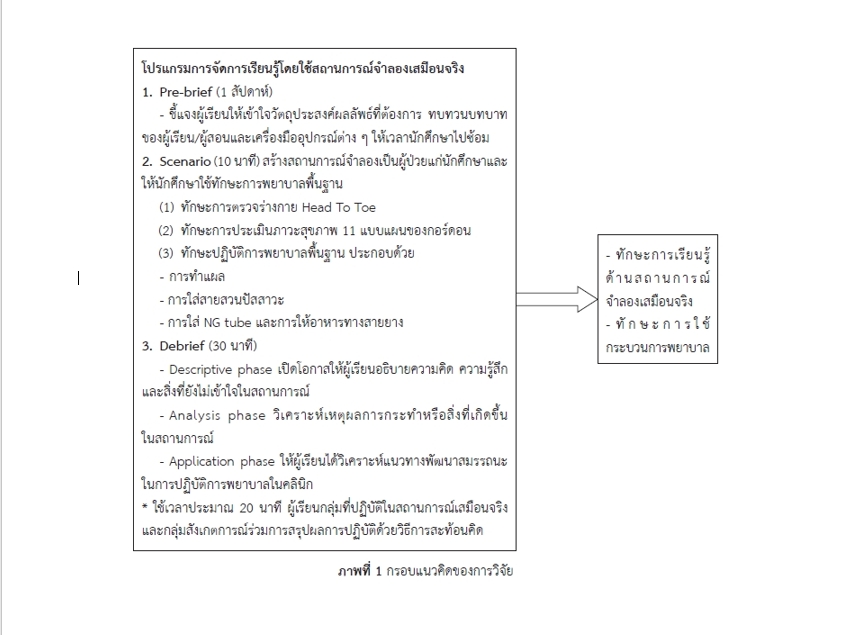
This quasi-experimental one-group pretest-posttest study aimed to compare nursing students' virtual simulation learning skills and nursing process skills before and after receiving the virtual simulation-based learning management program. A simple random sampling method was used to recruit the sample of 60 second-year nursing students enrolled at a university in Bangkok. Research instruments included: (1) a virtual simulation-based learning management program, (2) a virtual simulation learning skill assessment tool, and (3) a nursing process skill assessment tool. The content validity indices of the tools were .92 and .95, respectively, with reliability coefficients of .92 and .93. Data were analyzed using descriptive statistics and paired t-tests.
The results showed that, after participating in the virtual simulation-based learning program, students had significantly higher scores in virtual simulation learning skills compared to before the intervention (t = 6.70, p < .05), and significantly higher scores in nursing process skills (t = 11.76, p < .05).
These findings suggest that nursing institutes can apply the virtual simulation-based learning management program as a preparatory approach prior to clinical nursing laboratory practice.
References
Aldhafeeri, F., & Alosaimi, D. (2020). Perception of satisfaction and self-confidence with high-fidelity simulation among nursing students in government universities. Perception, 11(11), 137–149.
Benner, P. (1984). From novice to expert: Excellence and power in clinical nursing practice. Menlo Park, CA: Addison-Wesley.
Chaemchaeng, S., Atthamethakul, W., Niluem, R., & Wongyara, N. (2021). The effect of learning using virtual simulation on nursing problem solving ability and confidence in nursing practice with patients with health problems of nursing students. Journal of Phra Chom Klao College of Nursing, 4(3), 178–194. [In Thai]
Chaisak, M. (2014). Methods of nursing clinical teaching. Bangkok: Thanaplace. [In Thai]
Gersten, R., Fuchs, L. S., Compton, D., Coyne, M., Greenwood, C., & Innocenti, M. S. (2005). Quality indicators for group experimental and quasi-experimental research in special education. Exceptional Children, 71(2), 149–164.
Groom, J. A., Henderson, D., & Sittner, B. J. (2014). NLN/Jeffries simulation framework state of the science project: Simulation design characteristics. Clinical Simulation in Nursing, 10(7), 337-344.
Kim, J., Park, J. H., & Shin, S. (2016). Effectiveness of simulation-based nursing education depending on fidelity: A meta-analysis. BMC medical education, 16(1), 1-8.
Kolb, A. Y., & Kolb, D. A. (2005). Learning styles and learning spaces: Enhancing experiential learning in higher education. Academy of Management Learning & Education, 4(2), 193–212.
Kolb, D. A. (1984). Experience learning: Experience as the source of learning and development. New Jersey: Prentice-Hall.
Kumkong, M., Leejaroen, P., Aramrom, Y., & Jitwiboon, A. (2016). The effect of simulation scenarios on nursing students’ self-confidence in caring for and performing advanced resuscitation for critically ill and emergency patients. Journal of Nursing and Public Health Southern College Network, 3(3), 52–64. [In Thai]
Maneejak, N., & Yasri, P. (2018). Nursing students’ perception toward high fidelity simulation. PSAKU International Journal of Interdisciplinary Research, 7(2), 104–111.
Mohamed, F. M., & Fashafsheh, I. H. (2019). The effect of nursing process education on critical thinking skills of nursing students. American Journal of Nursing Research, 7(4), 546–553.
Najjar, R. H., Lyman, B., & Miehl, N. (2015). Nursing students’ experiences with high-fidelity simulation. International Journal of Nursing Education Scholarship, 12(1), 27–35.
Nucharoenkoon, S. (1997). Self-care: The art and science of nursing. Bangkok: V.J. Printing. [In Thai]
Polit, D. F., & Beck, C. T. (2008). Nursing research: Generating and assessing evidence for nursing practice (8th ed.). Philadelphia: Lippincott Williams & Wilkins.
Sindhuchai, S., Ubolwan, K., & Boonsilp, S. (2017). The effect of learning management using virtual simulation on knowledge, satisfaction, and self-confidence of fourth-year nursing students in professional skills practice before graduation. Ramathibodi Nursing Journal, 23(1), 113–127. [In Thai]
Song, Y. A. (2014). Effect of simulation-based practice by applying problem-based learning on problem-solving processes, self-confidence in clinical performance, and nursing competence. Korean Journal of Women Health Nursing, 20(4), 246–254.
Srichanpal, W., Thathan, S., & Frukfon, K. (2021). The effects of simulation-based learning on nursing students' self-efficacy in caring for patients with septic shock. Royal Thai Army Nursing Journal, 22(1), 283–293. [In Thai]
Tanner, C. A. (2006). Thinking like a nurse: A research-based model of clinical judgment in nursing. Journal of Nursing Education, 45(6), 204-211.
Tutticci, N., Coyer, F., Lewis, P. A., & Ryan, M. (2016). High-fidelity simulation: Descriptive analysis of student learning styles. Clinical Simulation in Nursing, 12(11), 511–521.
Vitumetha, M., Nipathhattapong, S., & Lamsamang, M., & Techangkoon. L. (2016). Development of guidelines for promoting the ability to use the nursing process among nursing students. Thai Journal of Cardio-Thoracic Nursing, 27(2), 100–113. [In Thai]
Yoo, J. H., & Kim, Y. J. (2018). Factors influencing nursing students' flow experience during simulation-based learning. Clinical Simulation in Nursing, 24, 1–8.
Downloads
Published
How to Cite
Issue
Section
License

This work is licensed under a Creative Commons Attribution-NonCommercial-NoDerivatives 4.0 International License.