The Effectiveness of Psychosocial Therapy Programs on Depressive Symptoms in Thai Elderly Patients with Major Depressive Disorder : Meta-analysis
Keywords:
Depression, Depressive Disorder, Psychosocial Therapy, Systematic Review, Meta-AnalysisAbstract
This study was a meta-analysis aimed at synthesizing the effectiveness of psychosocial therapy programs on depressive symptoms in the elderly with major depressive disorder in Thailand. Data were retrieved from six databases in Thailand and ASEAN countries, including the Thai-Journal Citation Index (TCI), Thai Thesis Database, ASEAN Citation Index (ACI), the Digital Research Database of the National Research Council of Thailand (Digital NRD), the Mental Health and Psychiatry Research Database, and Chulalongkorn University Intellectual Repository. Systematic review and meta-analytic approaches were applied. Experimental or quasi-experimental studies conducted in Thailand and published between 2014 and 2024, focusing on Thai elderly individuals diagnosed with major depressive disorder, were selected. Studies reporting sufficient statistical data for effect size calculation using SPSS were included.
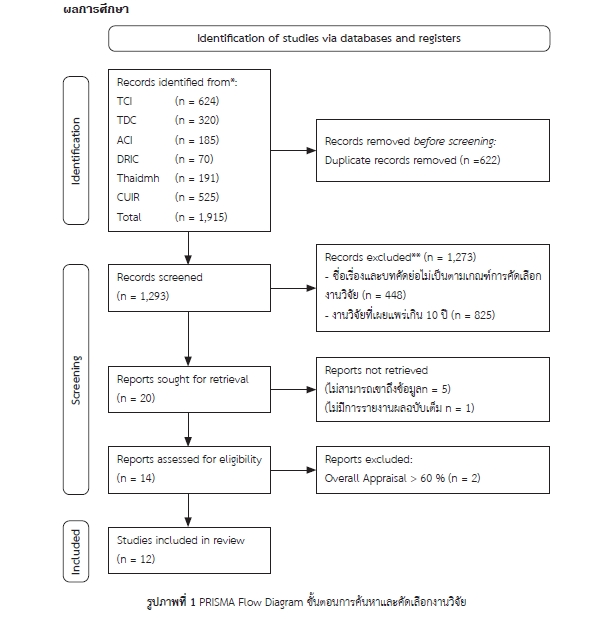
A total of 1,915 records were retrieved from database searches conducted between December 1, 2024, and March 31, 2025. 12 studies met the eligibility and quality assessment criteria, encompassing a total of 548 Thai elderly diagnosed with major depressive disorder. The overall pooled effect size was -1.20 (95% CI: -1.67, -0.73, p <.001). The meta-analysis indicated that variations in effect sizes across different types of psychosocial therapy programs. Acceptance and Commitment Therapy (-2.99), Recovery Programs (-1.85), Behavioral Activation Therapy (-1.44), Resilience Enhancement (-1.38), Psychoeducation (-0.99), Supportive Psychotherapy (-0.82), and Cognitive Behavioral Therapy (-0.72). These therapies demonstrated varying degrees of effectiveness in reducing depressive symptoms.
From the meta-analysis results, psychosocial therapy programs were found to be effective in reducing depressive symptoms in the elderly with major depressive disorder, with effectiveness varying by type of therapy. Future research should focus on developing and evaluating integrated psychosocial therapy programs using mixed-method designs and conducting long-term follow-ups to enhance their reliability and practical applicability.
References
American Psychological Association. (2019). Clinical practice guideline for the treatment of depression across three age cohorts. Retrieved from https://www.apa.org/depression-guideline/guideline.pdf
Aromataris, E., Fernandez, R., Godfrey, C., Holly, C., Khalil, H., & Tungpunkom, P. (2020). Umbrella reviews. In E. Aromataris, C. Lockwood, K. Porritt, B. Pilla, & Z. Jordan (Eds.), JBI manual for evidence synthesis. JBI.
Aungabsee, J., Panyapinijnugoon, C., & Sukjaroen, N. (2023). Types of therapy programs affect to reduce depression for Thai ageing citizen: Meta-analysis. The Journal of Psychiatric Nursing and Mental Health, 37(1), 103–118.
Bai, Z., Luo, S., Zhang, L., Wu, S., & Chi, I. (2019). Acceptance and commitment therapy (ACT) to reduce depression: A systematic review and meta-analysis. Journal of Affective Disorders, 260, 728–737.
Beck, J. S. (2005). Cognitive therapy for challenging problems: What to do when the basics don't work. New York: Guilford Press.
Boonbanchob, U., & Dangdomyouth, P. (2018). The effect of a resilience enhancement program on self-esteem and depression of the elderly with a depressive disorder.
Journal of Nursing Research and Innovation in Health, 30(2), 91–106. [In Thai]
Bunyathikan, T., Soonthornchaiya, R., & Charernboon, T. (2021). The effects of an acceptance and commitment therapy program on the depressive symptoms of elderly patients with major depressive disorder. Journal of Psychiatric and Mental Health Nursing, 46(2), 159–165. [In Thai]
Chuakan, P., Soonthornchaiya, R., & Vuthiarpa, S. (2021). The effects of a group psychoeducation program on depressive symptoms and self-care behaviors of older adults with depressive disorder. Thai Nursing and Midwifery Journal, 37(3), 91–106. [In Thai]
Department of Mental Health, Ministry of Public Health. (2022). Centralized system for psychiatric patient services in Thailand. Retrieved from https://dmh.go.th/report/datacenter/hdc [In Thai]
Department of Provincial Administration, Ministry of Interior. (2024). Number of Thai elderly by province 2024. Retrieved from https://stat.bora.dopa.go.th/stat/statnew/statMONTH/statmonth/#/displayData [In Thai]
Dogar, I. A. (2007). Biopsychosocial model. Annals of Punjab Medical College (APMC), 1(1), 11–13.
Ferreira, M. G., Mariano, L. I., de Rezende, J. V., Caramelli, P., & Kishita, N. (2022). Effects of group acceptance and commitment therapy (ACT) on anxiety and depressive symptoms in adults: A meta-analysis. Journal of Affective Disorders, 309, 297–308.
Glass, G. V., McGaw, B., & Smith, M. L. (1981). Meta-analysis in social research. London: Sage Publications.
Hedges, L. V., & Olkin, I. (1985). Statistical methods for meta-analysis. Orlando, FL: Academic Press.
Kaewkham, P., & Dangdomyouth, P. (2024). The effect of wellness recovery action plan program on depressive symptoms of older persons with major depressive disorder in community. Journal of Nursing Research and Innovation in Health, 36(2), 91–106. [In Thai]
Karrouri, R., Hammani, Z., Benjelloun, R., & Otheman, Y. (2021). Major depressive disorder: Validated treatments and future challenges. World Journal of Clinical Cases, 9(31), 9350–9367.
Kitsumban, V., Thapinta, D., & Picheansathian, W. (2017). The effect of cognitive-behavioural therapy on depression in the elderly: Systematic review. Nursing Journal, 44(1), 161–171. [In Thai]
Kittimasakun, P., Soonthornchaiya, R., & Vuthiarpa, S. (2021). The effects of an applied behavioral activation therapy program on the depressive symptoms of older adults with depressive disorder. Journal of Research in Thai Traditional and Alternative Medicine, 37(3), 91–106. [In Thai]
Kongsonthana, A. (2021). Acceptance and commitment therapy (ACT) for adolescent and application in COVID-19 outbreak: A literature review. Journal of Department of Mental Health Services, 46(2), 159–165. [In Thai]
Kunprasat, A., & Dangdomyouth, P. (2023). The effect of family psychoeducation emphasizing shared care on depressive symptoms of older persons with major depressive disorder in community. Journal of Nursing Research and Innovation in Health, 35(3), 91–106. [In Thai]
Lakklang, A., Jirapornkul, C., Maneenin, N., Saman, J., & Wannasin, J. (2024). Incidence and factors affecting completed suicides in the elderly, Health Region 7. KKU Journal for Public Health Research, 17(4), 89–101. [In Thai]
Larsen, A. J., Teobaldi, G., Espinoza Jeraldo, R. I., Falkai, P., & Cooper, C. (2025). Effectiveness of pharmacological and non-pharmacological interventions for treatment-resistant depression in older patients: A systematic review and meta-analysis. BMJ Mental Health, 28(1), 301–324.
Laukongtam, W., Phimtra, S., Kongsuk, T., & Rungreangkulkij, S. (2021). The effects of group happy reminiscence therapy on depressive symptoms in Thai older people with major depressive disorder. Journal of Psychiatric and Mental Health Nursing, 37(3), 91–106. [In Thai]
Mackin, R. S., & Arean, P. A. (2005). Evidence-based psychotherapeutic interventions for geriatric depression. Psychiatric Clinics of North America, 28(4), 805–820.
Nilsson, A., Surakarn, A., & Peungposop, N. (2025). Integrating mindfulness and yoga: A Buddhist-inspired program to enhance cognitive flexibility and emotion regulation in older Thai adults. Journal of Buddhist Anthropology, 10(2), 226–238. [In Thai]
Page, M. J., McKenzie, J. E., Bossuyt, P. M., Boutron, I., Hoffmann, T. C., Mulrow, C. D., et al. (2021). The PRISMA 2020 statement: An updated guideline for reporting systematic reviews. Systematic Reviews, 89(10), 1–11.
Pantong, K., & Dangdomyouth, P. (2018). The effective of resilience quotient emphasizing mindfulness-based program on depression in older persons with major depressive disorder. Kuakarun Journal of Nursing, 25(2), 105–118. [In Thai]
Persons, J. B., Marker, C. D., & Bailey, E. N. (2023). Changes in affective and cognitive distortion symptoms of depression are reciprocally related during cognitive behavior therapy. Behaviour Research and Therapy, 166, 1-8.
Phuttharod, P., & Sillapagumpised, K. (2021). The effect of a resilience enhancement program on self-esteem and depression of the elderly with a depressive disorder. Journal of Research in Thai Traditional and Alternative Medicine, 37(3), 91–106. [In Thai]
Pinquart, M., Duberstein, P. R., & Lyness, J. M. (2007). Effects of psychotherapy and other behavioral interventions on clinically depressed older adults: A meta-analysis. Aging & Mental Health, 11(6), 645–657.
Remes, O., Mendes, J. F., & Templeton, P. (2021). Biological, psychological, and social determinants of depression: A review of recent literature. Brain Sciences, 11(12), 1-33.
Rodcharoen, S., Kongsuwan, V., & Chanchong, W. (2019). The effects of self-guided cognitive behavioral modification program on self-esteem and depression of elders with major depressive disorder. Nursing Science Journal of Thailand, 37(3), 91–106. [In Thai]
Saengsai, W., & Soonthornchaiya, R. (2014). Effect of cognitive behavior therapy on depression and functioning of elderly patients with depression. Journal of Psychiatric and Mental Health Nursing, 28(3), 91–106. [In Thai]
Samad, Z., Brealey, S., & Gilbody, S. (2011). The effectiveness of behavioural therapy for the treatment of depression in older adults: A meta-analysis. International Journal of Geriatric Psychiatry, 26(12), 1211–1220.
Saokaew, S. (2016). Understanding and interpretation of meta-analysis study. Chiangrai Medical Journal, 8(1), 1–17. [In Thai]
Saokaew, S. (2023). Evidence synthesis in pharmaceutical outcomes research: Meta-analysis in STATA (2nd ed.). Bangkok: Chulalongkorn University Press. [In Thai]
Shang, P., Cao, X., You, S., Feng, X., Li, N., & Jia, Y. (2021). Problem-solving therapy for major depressive disorders in older adults: An updated systematic review and meta-analysis of randomized controlled trials. Aging Clinical and Experimental Research, 33, 1465–1475.
Sousa, S., Paúl, C., & Teixeira, L. (2021). Predictors of Major Depressive Disorder in Older People. International Journal of Environmental Research and Public Health, 18(22), 1-9.
Sripeng, U., & Soonthornchaiya, R. (2021). Supportive psychotherapy with family participation for older patients with major depressive disorder. Nursing Journal of the Ministry of Public Health, 37(3), 91–106. [In Thai]
Tufanaru, C., Munn, Z., Aromataris, E., Campbell, J., & Hopp, L. (2020). Systematic reviews of effectiveness. In E. Aromataris, C. Lockwood, K. Porritt, B. Pilla, & Z. Jordan (Eds.), JBI manual for evidence synthesis. JBI.
Utthapong, W., Srikhruedong, S., & Phuwachanatipong, K. (2023). Mindfulness training for the development of resilience quotient in the elderly. Journal of MCU Humanities Review, 9(2), 377-393.
World Health Organization. (2024, October 1). Ageing and health. Retrieved from https://www.who.int/news-room/fact-sheets/detail/ageing-and-health
Zettle, R. D. (2015). Acceptance and commitment therapy for depression. Current Opinion in Psychology, 2, 65–69.
Zhao, B., Wang, Q., Wang, L., Chen, J., Yin, T., Zhang, J., et al. (2023). Effect of acceptance and commitment therapy for depressive disorders: A meta-analysis. Annals of General Psychiatry, 22, 34.
Downloads
Published
How to Cite
Issue
Section
License

This work is licensed under a Creative Commons Attribution-NonCommercial-NoDerivatives 4.0 International License.