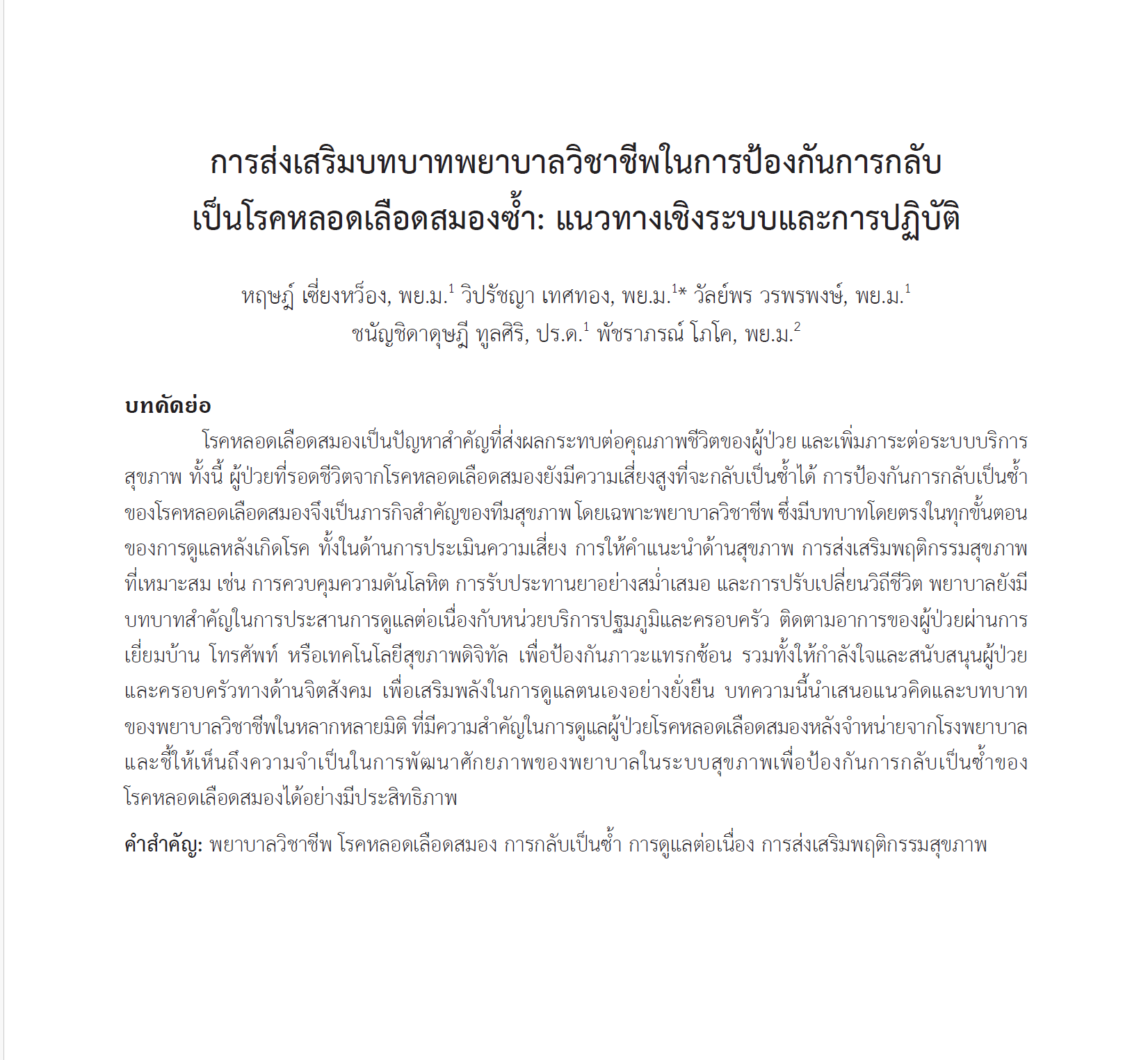
Promoting the Roles of Professional Nurses in Preventing Recurrent Stroke: Systemic and Practical Approaches
Keywords:
professional nurse, stroke, recurrence, continuity of care, health behaviour promotionAbstract
Stroke is a major public health concern that affects patients’ quality of life and increases the burden on healthcare systems. Furthermore, stroke survivors still are at high risk of having recurrent stroke. Preventing stroke recurrence therefore is a key responsibility of the healthcare team, particularly professional nurses who are directly involved in every step of post-stroke care. Nurses play a crucial role in risk assessment, health education, and the promotion of healthy behaviors such as blood pressure control, medication adherence, and lifestyle modifications. They also coordinate continuity of care by collaborating with primary healthcare providers and family caregivers, as well as conducting follow-ups through home visits, phone calls, or digital health tools to monitor patient status and prevent complications. Moreover, nurses provide psychosocial support that empowers stroke survivors and their families to engage in sustained self-care. This article highlights the multidimensional role of professional nurses in post-discharge stroke care and emphasizes the need to strengthen their capacity within the health system to effectively prevent stroke recurrence.
References
Aunthakot, K., Loahasiriwong, W., & Tiamkao, S. (2023). Recurrence stroke of ischemic stroke patients in Thailand: A nationwide study. International Journal of Public Health Science, 12(2), 614–620. http://doi.org/10.11591/ijphs.v12i2.22504
Bamrungthin, N., & Sunongbua, A. (2024). Effectiveness of community-based continuing care for intermediate-phase stroke patients in Mueang Chaiyaphum district. Chaiyaphum Medical Journal, 43(Suppl.), 59–73. [In Thai]
Byrne, S.-J., Williams, D. J., Patton, D., & Horgan, F. (2025). Exploring patients’ experiences of secondary prevention after stroke: A survey study. Discover Public Health, 22, 693. https://doi.org/10.1186/s12982-025-01113-4
Chen, L., Zhou, Y., Li, H., Chen, W., & Wang, Y. (2022). Mobile application-based health education and follow-up management to improve stroke patients' adherence and outcomes: A randomized controlled trial. International Journal of Nursing Studies, 129, 104198. https://doi.org/10.1016/j.ijnurstu.2022.104198
de Havenon, A., Sheth, K. N., Madsen, T. E., Johnston, K. C., Turan, T. N., Toyoda, K., Elm, J. J., Wardlaw, J. M., Johnston, S. C., Williams, O. A., Shoamanesh, A., & Lansberg, M. G. (2021). Cilostazol for secondary stroke prevention: History, evidence, limitations, and possibilities. Stroke, 52(10), e635–e645. https://doi.org/10.1161/STROKEAHA.121.035002
Hafsteinsdóttir, T. B., Vergunst, M., Lindeman, E., & Schuurmans, M. (2011). Educational needs of patients with a stroke and their caregivers: A systematic review of the literature. Patient Education and Counseling, 85(1), 14–25. https://doi.org/10.1016/j.pec.2010.07.046
Kim, J., Lee, K. J., & Park, E. (2021). Factors influencing secondary stroke prevention behaviors among stroke survivors: A systematic review. Journal of Stroke and Cerebrovascular Diseases, 30(4), 105651. https://doi.org/10.1016/j.jstrokecerebrovasdis.2021.105651
Khosravizadeh, O., Sadeghi, T., Rahimi, B., & Karampourian, A. (2021). The effect of family support on treatment adherence and psychological well-being among stroke patients: A systematic review. Journal of Stroke and Cerebrovascular Diseases, 30(5), 105718. https://doi.org/10.1016/j.jstrokecerebrovasdis.2021.105718
Kittipimpanon, K., Thongluang, N., & Wongwanich, S. (2021). Development of an integrated stroke care model between hospital and community: A case study in Sa Kaeo province, Thailand. Journal of Community Health Research, 10(2), 102–113.
Lee, J. Y., Kim, J., & Kang, H. (2019). The effect of a digital education program on self-care and knowledge among stroke survivors: A randomized controlled trial. Patient Education and Counseling, 102(7), 1340–1346. https://doi.org/10.1016/j.pec.2019.01.013
Lutz, B. J., Young, M. E., Cox, K. J., Martz, C., & Creasy, K. R. (2017). The crisis of stroke: Experiences of patients and their family caregivers. Topics in Stroke Rehabilitation, 24(2), 79–88. https://doi.org/10.1080/10749357.2016.1200291
Macleod, M. R., Woodhouse, L. J., & Salman, R. A. (2021). Implementation of evidence-based stroke care: A review of global progress. International Journal of Stroke, 16(1), 20–26. https://doi.org/10.1177/1747493020975610
Mellado, C., van Asch, C. J., Valdés, M., Arias-Rivera, S., & González, M. (2020). Knowledge of stroke warning signs and risk factors among stroke patients: A cross-sectional survey. Journal of Stroke and Cerebrovascular Diseases, 29(9), 105064. https://doi.org/10.1016/j.jstrokecerebrovasdis.2020.105064
Northcott, S., Moss, B., Harrison, K., & Hilari, K. (2016). A systematic review of the impact of stroke on caregivers: Psychosocial outcomes and intervention. Disability and Rehabilitation, 38(10), 929–939. https://doi.org/10.3109/09638288.2015.1068872
Phaophuthon, S. (2023). Development of a continuous home-based intermediate care model for stroke patients in Srisomdet district, Roi Et province. Journal of Environmental Education Medical and Health, 8(2), 500–511. [In Thai]
Rollnick, S., Miller, W. R., Butler, C. C., & Aloia, M. S. (2010). Motivational interviewing in health care: Helping patients change behavior. COPD: Journal of Chronic Obstructive Pulmonary Disease, 5(3), 203–214. https://doi.org/10.1080/15412550802093108
Sarawangkul, R., Chintapanyakun, T., & Lertprapai, K. (2023). The effects of a supportive-educative nursing program via line application for caregivers on caregivers’ capabilities and activities of daily living among patients with stroke at home. Journal of the Police Nurses, 15(1), 87–105. [In Thai]
The American Journal of Managed Care. (2025). Preventing recurrent stroke in 2025: Clinical and managed care perspectives. Retrieved from https://www.ajmc.com/view/the-future-of-stroke-care-addressing-unmet-needs-in-secondary-prevention
Wang, Y., Pan, Y., Zhao, X., Li, H., Wang, D., & Liu, L. (2022). Impact of a nurse-led follow-up program on secondary prevention after ischemic stroke: A randomized controlled trial. Journal of Clinical Nursing, 31(5–6), 684–692. https://doi.org/10.1111/jocn.15930
World Health Organization. (2023). Stroke: Key facts. Retrieved from https://www.who.int/news-room/fact- sheets/detail/stroke
World Stroke Organization [WSO]. (2025). Averting a global health crisis: Pragmatic policy interventions to prevent stroke. Retrieved from https://www.world-stroke.org/assets/downloads/WSO_Prevention_policy_FINAL_signoff_Jan_2025.pdf
Yuen, E. Y., Knight, T., Ricciardelli, L. A., & Burney, S. (2018). Health literacy of older Australians: A systematic review. Health Promotion Journal of Australia, 29(3), 245–257. https://doi.org/10.1002/hpja.24
Downloads
Published
How to Cite
Issue
Section
License

This work is licensed under a Creative Commons Attribution-NonCommercial-NoDerivatives 4.0 International License.