Factors Influencing Maternal Role Attainment Among Working Mothers
Keywords:
Maternal role attainment, Working mothers, Factors InfluencingAbstract
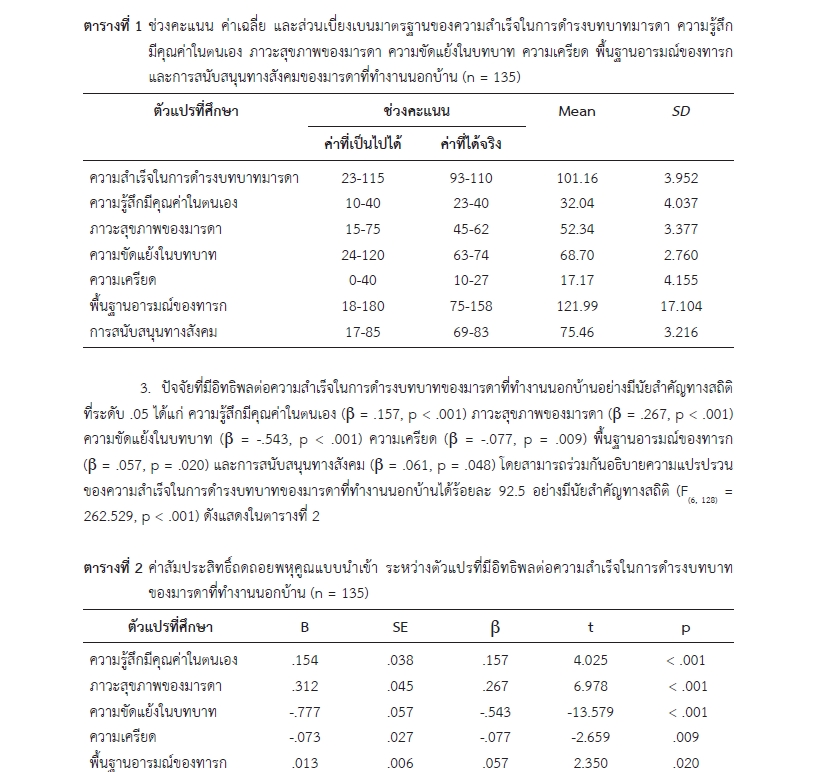
This predictive correlational research aimed to study maternal role attainment and factors influencing maternal role attainment among working mothers. The sample consisted of 135 mothers with children aged 4-6 months who received services at secondary to tertiary hospitals are the group with the highest number of working mothers in Chonburi province, between January and June 2025. Research instruments included a personal data questionnaire, Maternal Role Attainment, Rosenberg Self-Esteem, Maternal health, Role Conflict, Stress, Temperament of Infant, and Social Support, Data were analyzed using descriptive statistics and enter multiple regression analysis.
Results showed that working mothers had a maternal role attainment score of 101.16, with was at a high level. Influencing factors include Role conflict (ß = -.543, p < .001), Maternal health status (ß = .267, p < .001), Self-esteem (ß = .157, p < .001), Stress (ß = -.077, p = .009), Social support (ß = .061, p = .048) and Infant temperament (ß = .057, p = .020). These factors collectively predicted 92.5%, which was statistically significant (R2 = 925, p < .001).
The study recommends that should assess factors influencing maternal role attainment in working mothers and organize activities to promote maternal attainment such as health education and involving families in childcare.
References
Ahmadpour, P., Jahanfar, S., Bieyabanie, M. H., & Mirghafourvand, M. (2022). Predictors of maternal role adaptation in Iranian women: A cross-sectional study. BMC Pregnancy and Childbirth, 22, 367. doi:10.1186/s12884-022-04702-2
Alipour, F., Tabrizi, M., & Nouri, R. (2023). The mediating role of maternal stress in the relationship between marital conflict and maternal competency. Nursing Practice Today, 10(2), 113–122.
Anupapvisedkul, P., Sopajaree, C., Sopon, A., & Eudsaha, S. (2016). Selected factors predicting maternal role attainment among HIV-seropositive mothers. Journal of Nursing Science & Health, 39(2), 44–53.
Kadale, P., Pandey, A., & Raje, S. (2018). Challenges of working mothers: Balancing motherhood and profession. International Journal of Community Medicine and Public Health, 5(7), 2905–2910.
Kaewjiboon, J., Saetang, O., & Chachvarat, T. (2019). Factors related to maternal role of teenagers. Journal of Nursing, Public Health, and Education, 20(3), 95–106. [In Thai]
Kelbore, W., Yasin, H., & Kolle, D. (2020). Maternal role competence and its associated factors among mothers who attended immunization clinics at public health facilities of Arba Minch Town, Southern Ethiopia: A cross-sectional study. International Journal of Sciences: Basic and Applied Research, 53(2), 129–138.
Liang, J., & Chen, Z. (2025). Parents’ work–family conflict and parent-child relationship: The mediating role of parenting burnout and the moderating role of self-compassion. PLoS ONE, 20(3), e0319777. doi:10.1371/journal.pone.0319777
Longo, V., Saadati, N., & Karakus, M. (2024). Exploring the role of extended family in child rearing practices across different cultures. Journal of Psychosociological Research in Family and Culture, 2(4), 4–12.
Maehara, K., Mori, E., Tsuchiya, M., Iwata, H., Sakajo, A., Ozawa, H., Morita, A., Maekawa, T., Makaya, M., & Tamakoshi, K. (2016). Factors affecting maternal confidence among older and younger Japanese primiparae at one month postpartum. Japan Journal of Nursing Science, 13(4), 424–436. doi:10.1111/jjns.12123
Noppakulwonk, T. (2015). The logistics of family work conflicts, organizational climate, and job retention in a Bangkok area delivery business, Thailand (Doctoral dissertation, Thammasat University, Thailand). Retrieved from http://ethesisarchive.library.tu.ac.th/thesis/2015/TU_2015_5206035239_3139_1916.pdf
Phonkusol, C., & Sangin, S. (2020). The factors predicting health behaviors among pregnant migrant women in Chon Buri province. Journal of Thailand Nursing and Midwifery Council, 35(4), 128–144. [In Thai]
Phumonsakul, S. (2000). A structural equation model of maternal role attainment among working primiparous mothers (Doctoral dissertation, Mahidol University, Thailand).
Phumonsakul, S., Somboonsub, A., & Siriwattanachok, U. (2004). Development of maternal role attainment scale (MRAS): Revised short form and psychometric characteristics. Journal of Nursing Science, 22(1), 28–38. [In Thai]
Pimnuwong, S. (2007). Factors influencing self-care behaviors of teenage postpartum mothers (Doctoral dissertation, Christian University, Thailand).
Rafii, F., Alinejad-Naeini, M., & Peyrovi, H. (2020). Maternal role attainment in mothers with term neonate: A hybrid concept analysis. Iranian Journal of Nursing and Midwifery Research, 25(4), 304–313. doi:10.4103/ijnmr.IJNMR_201_19
Ricci, R. B., & Badiee, M. (2022). Predictors of role efficacy in college mothers. College Student Journal, 54(1), 63–76.
Samantarath, P., Phuangprasonka, R., Chumpathat, N., Buala, O., & Siri, O. (2024). Predictors of maternal role attainment among adolescent mothers in eastern Thailand. The Nursing Science Journal of Thailand, 42(1), 69–83. [In Thai]
Wongpakaran, N., & Wongpakaran, T. (2010). The Thai version of the PSS-10: An investigation of its psychometric properties. BioPsychoSocial Medicine, 4(1), 6. doi:10.1186/1751-0759-4-6
Wongpakaran, T., & Wongpakaran, N. (2012). A comparison of reliability and construct validity between the original and revised versions of the Rosenberg Self-Esteem Scale. Psychiatry Investigation, 9(1), 54–58. doi:10.4306/PI.2012.9.1.54
Downloads
Published
How to Cite
Issue
Section
License

This work is licensed under a Creative Commons Attribution-NonCommercial-NoDerivatives 4.0 International License.