Predictors of Parenting Sense of Competence In First-Time Postpartum Parents
Keywords:
Parenting Sense of Competence, First-time parents, Marital relationship, Co-parentingAbstract
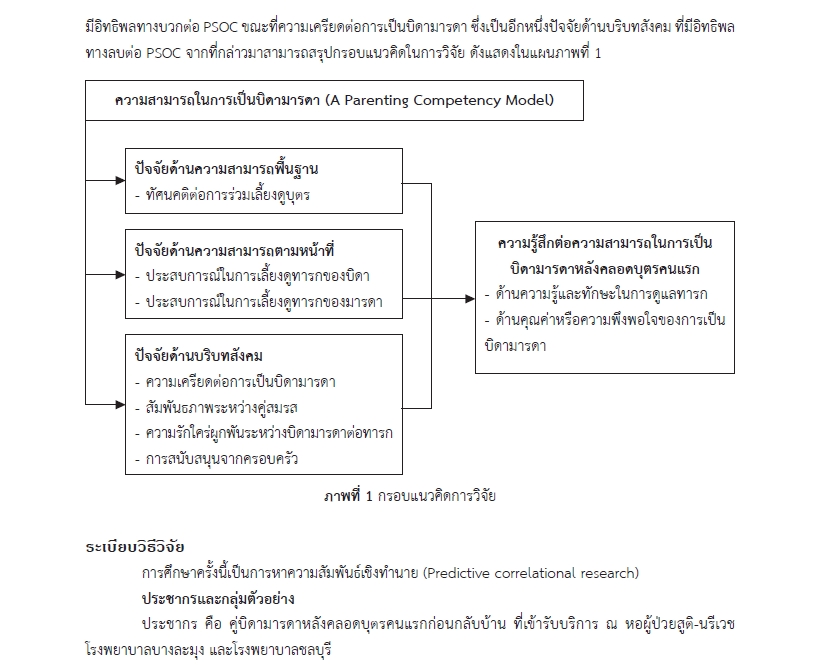
Parenting Sense of Competence (PSOC) is an important factor influencing parents’ confidence in performing their parenting roles. This predictive correlational study examined factors predicting PSOC among first-time parents after childbirth. The sample included 108 pairs of first-time parents receiving services at an obstetric–gynecological ward in a provincial hospital in Chonburi Province. Data were collected using questionnaires completed jointly by both parents, covering demographic characteristics, attitudes toward co-parenting, parenting stress, marital relationship, parental attachment to the infant, family support, and PSOC. All instruments demonstrated acceptable reliability (Cronbach’s alpha = .80–.90). Data were analyzed using descriptive statistics and multiple regression.
The results revealed that the mean Parenting sense of competence (PSOC) score was 90.26 interpreted as relatively high (SD=4.27). The seven predictors jointly explained 21.6% of the variance in PSOC (R²=.216, F7,100=3.942, p<.001). Marital relationship, family support, and parental attachment to the infant were significantly positively correlated with PSOC. Only marital relationship significantly predicted PSOC (ꞵ=.306, t=3.169, p<.01).
The findings indicate that a positive marital relationship is associated with higher levels of Parenting Sense of Competence (PSOC). A supportive spousal relationship may facilitate parents’ adjustment to their new parental roles through emotional support, effective communication, and shared childrearing responsibilities. These factors may enhance parents confidence, satisfaction, and perceptions of competence in caring for their infant. Therefore, interventions aimed at strengthening marital relationships may play an important role in promoting parental competence and supporting the transition to parenthood.
References
Barabach, L., Ludington-Hoe, S. M., Dowling, D., & Lotas, M. (2017). Role of baby-friendly hospital care in maternal role competence. Nursing for Women’s Health, 21(2). 96-107.
Chaiteeka, K., Sriarporn, P., & Deeluea, J. (2021). Effect of social support on stress among first-time fathers. Nursing Journal, 48(4). 202-216. [In Thai]
Chung, F. F., Wan, G. H., Kuo, S. C., Lin, K. C. & Liu, H. E. (2018). Mother–infant interaction quality and sense of parenting competence at six months postpartum for first-time mothers in Taiwan: A multiple time series design. BMC Pregnancy and Childbirth, 18. 365. https://doi.org/10.1186/s12884-018-1979-7.
Dincer, D., & Tunc, E.B. (2023). Parental competence, parenting stress, family harmony, and perceived available support among mothers with children aged 3-6 years. Research on Education and Psychology (REP), 7(Special 2). 215-241. https://doi.org/10.54535/rep.1353500.
Huang, L., Wang, X. j., Liu, G. h., Li, X. t., Zhang, Y. h., Zhao, B. y., & Hu, R. f. (2023). Parenting sense of competence among chinese parents of premature infants: a cross sectional study. BMC Pregnancy and Childbirth, 23(399). 1-10. https://doi.org/10.1186/s12884-023-05703-5.
Johnson, B. D., Berdahl, L. D., Horne, M. M., Richter, E. A., & Walters, M.-g. A. (2014). A parenting competency model. Parenting, 14. 120-192.
Kamu-then, C. (2018). Selected factors related to sleep duration in preterm infant after discharge from hosital (Master’s thesis). Chulalongkorn University, Bangkok, Thailand.
Khampila, W., Supavititpatana, B., & Chaloumsuk, N. (2019). Self-esteem, marital relationship, and parenting stress of first-time adolescent mothers. Journal of Nursing and Health Care, 37(1). 98-107. [In Thai]
Molano, N., León, E., Jiménez-Morago, J. M., & Camacho, C. (2023). Quality ofInter-actions, children’s psychological adjustment and parental stress in -foster families: The mediating role of parental sense of competence. Journal of Child and Family Studies, 32(11). 3601-3611.https://doi.org/10.1007-/s10826-023-02578-0.
Nunchai, J., Sriarporn, P., & Chareonsanti, J. (2016). Factors related to depression among Thai fathers. Nursing Journal, 43(Supplement). 59-70. [In Thai]
Nunes, C., Ayala-Nunes, L., Ferreira, L. I., Pechorro, P., Freitas, D., Martins, C., & dos Santos, R. (2022). Parenting sense of competence: Psychometrics and invariance among a community and an at-risk samples of portuguese parents. Healthcare, 11. 1-13. https://doi.org/10.3390/healthcare1101001
Pornsawat. D. (2010). Spouse support, family support and selected personal factors Influencing maternal role attainment in adolescent mothers (Master’s thesis). Burapha University, Chonburi, Thailand.
Sriarporn, P., Prasitwatanasare, P., Ruksakul, N., & Chaiteeka, K. (2021). Stress in first-time fathers: Role of nurse-midwife. Nursing Journal, 48(2). 283-294. [In Thai]
Suebanun, S., Tachasuksri, T., & Chuahorm, U. (2024). Factors predicting postpartum depression among first – time mothers. Nursing Journal of the Ministry of Public Health, 34(3). 68-81. [In Thai]
Suwansujarid, T. (2013). Development of the father involvement model during pregnancy and neonatal period (Doctor dissertation). Mahidol University, Bangkok, Thailand.
Suwansujarid, T., Vatanasomboon, P., Gaylord, N., & Lapvongwatana, P. (2013). Validation of the parenting sense of competence scale in fathers: Thai version. The Southeast Asian Journal Tropical Medicine Public Health, 44(5), 916-926.
Tohme, P. & Abi Habib, R. (2022). Correlates of work productivity and maternal competence after having a baby: The roles of mother-infant bonding and maternal subjective experiences. BMC Women's Health, 22. https://doi.org-/10.1186/s12905-022-01958-w.
Yan, T. & Hou, Y. (2023). The effect of parenting sense of competence on emotional and behavioral adjustment of children with special education needs: A chain mediating model. ECNU Review of Education. 1-18. https://doi.org/10.1177/20965311231167196.
Downloads
Published
How to Cite
Issue
Section
License

This work is licensed under a Creative Commons Attribution-NonCommercial-NoDerivatives 4.0 International License.