Greater Circulation Simulation Model for Practising Central Venous Catheterization Care Skills of Undergraduate Students
Keywords:
Pediatric nursing mannequin, Central venous catheter care, Experiential learningAbstract
This Design and Development Research (DDR) study, utilizing a quasi-experimental one-group pretest-posttest design, aimed to develop and evaluate the effectiveness of a prototype pediatric central venous catheterization (CVC) circulation model on the practical nursing skills of nursing students. The model integrated design thinking concepts and Kolb’s (2015) experiential learning theory, developed in collaboration with electrical power engineering experts. The sample consisted of 30 fourth-year nursing students selected through purposive sampling. The research instruments included: 1) a prototype pediatric CVC circulation model focusing on anatomical realism and a pressurized tubing system, 2) an E-book practical manual, and 3) a practical nursing skill assessment form. The instruments were validated by experts (IOC = 0.67–1.00) with a reliability coefficient of 0.76. Data were analyzed using descriptive statistics and a paired t-test.
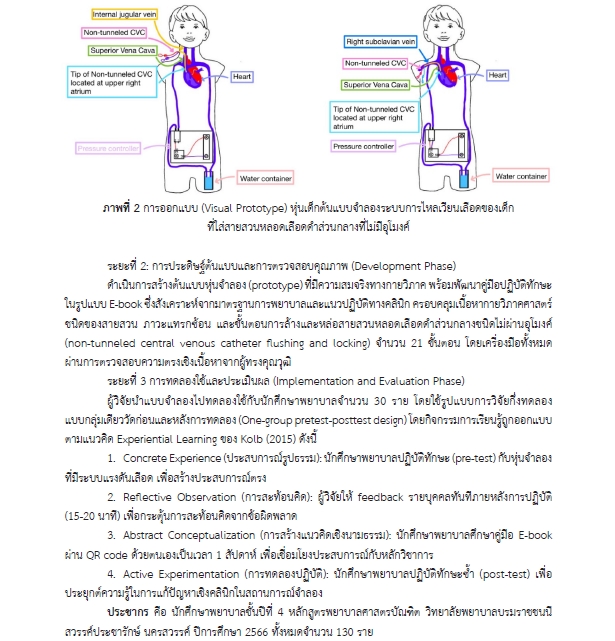
The results revealed that: 1) the developed innovation featured two models based on catheter insertion sites (internal jugular and subclavian veins) connected to a real catheter system for concrete flushing and locking practice; and 2) the post-test mean practical skill score (Mean = 34.73, S.D. = 1.61) was significantly higher than the pre-test score (Mean = 18.63, S.D. = 2.78) (t = 35.133, p < .001, 95% CI = [15.163, 17.037]). The dimension with the highest mean score increase was the aseptic technique. In conclusion, the innovative learning package significantly enhanced students' practical skills.
The findings suggest that nursing institutions integrate this innovative package into practicum courses to prepare and enhance procedural competencies among learners within a safe environment prior to clinical placement.
References
Alconero-Camarero, A. R., Sarabia-Cobo, C. M., Catalán-Piris, M. J., González-Gómez, S., & González-López, J. R. (2021). Nursing students' satisfaction: A comparison between medium- and high-fidelity simulation Training. International Journal Environmental Research and Public Health, 18(2), 804.
Best, J. W. (1977). Research in education (3rd ed.). Englewood Cliffs, New Jersey: Prentice-Hall.
Bloom, B. S. (1971). Handbook on formative and summative evaluation of student learning. New York, NY: McGraw-Hill.
Campbell, D. T., & Stanley, J. C. (1963). Experimental and quasi-experimental designs for research. Chicago, IL: Rand McNally.
Craig, P., Dieppe, P., Macintyre, S., Michie, S., Nazareth, I., & Petticrew, M. (2008). Developing and evaluating complex interventions: the new medical research council guidance. British Medical Journal, 337, a1655.
Dongpho, P., & Chiangdee, K. (2020). Nursing care for prevention of central line-associated bloodstream infection in pediatric intensive care units: The nurse's role. Journal of the Thai Red Cross Nursing College, 13(1), 54-68. [In Thai]
Foucault-Fruchard, L., van der Mee, N., Reinprecht, C, Durand C., Cailhol, J., Zahar, J. R., & Kerneis, S. (2025). Impact of educational interventions provided to patients with a central venous catheter and their informal caregivers: A systematic review. Antimicrobial Resistance and Infection Control, 14(1), 67.
Guerrero, J. G., Rosales, N. S., & Castro, G. M. T. (2023). Impact of high-fidelity simulation exposure of nursing students with their objective structured clinical examination: A quasi-experimental study. Nursing Open, 10(2), 765-772.
Gulnur, K. A. R., & Kazan, E. E. (2021). Evaluation of skills of intensive care nurses regarding central venous catheter care: An observational study. Marmara Medical Journal, 34(3), 298-306.
Handeland, J. A., Prinz, A., Ekra, E. M. R., & Fossum, M. (2021). The role of manikins in nursing students' learning: A systematic review and thematic metasynthesis. Nurse Education Today, 98, 104764.
Hertzog, M. A. (2008). Considerations in determining sample size for pilot studies. Research in Nursing & Health, 31(2), 180–191.
INACSL Standards Committee. (2021). Healthcare simulation standards of best practice TM the simulation design. Clinical Simulation in Nursing, 58, 14-21.
Jeffries, P. R. (Ed.). (2022). Clinical simulation in nursing education: Advanced strategies for great outcomes (3rd ed.). Philadelphia:: Wolters Kluwer.
Kirkpatrick, D. L., & Kirkpatrick, J. D. (2006). Evaluating training programs: The four levels (3rd ed.). San Francisco: Berrett-Koehler Publishers.
Kolb, D. A. (2015). Experiential learning: Experience as the source of learning and development (2nd ed.). Upper Saddle River, NJ: Pearson Education.
Mauro, P., Davide, C., Giovanni, B., Vito, D. A., Maria, G. A., & Giorgio, C. (2021). A GAVeCeLT bundle for central venous catheterization in neonates and children: A prospective clinical study on 729 cases. The Journal of Vascular Access, 22(6), 1023-1043.
McGaghie, W. C., Issenberg, S. B., Barsuk, J. H., & Wayne, D. B. (2010). A critical review of simulation-based medical education research: 2003–2009. Medical Education, 44(1), 50-63.
Nantsupawat, A., Pinitchakkonndet, N., & Sareeso, P. (2022). Developing nursing learning innovation to promote clinical practice competencies of nursing students in the new normal era. Journal of Health Science Research, 16(2), 1-12. [In Thai]
Polit, D. F., & Beck, C. T. (2021). Nursing research: Generating and assessing evidence for nursing practice (11th ed.). Philadelphia: Wolters Kluwer.
Poore, J. A., Cullen, D. L., & Schaar, G. L. (2014). Simulation-based education and experiential learning theory. Clinical Simulation in Nursing, 10(5), e241-e244.
Roddy, L., & Polfuss, M. (2020). Employing design thinking methods in nursing to improve patient outcomes, Nursing Forum, 55(4), 553–558.
Downloads
Published
How to Cite
Issue
Section
License

This work is licensed under a Creative Commons Attribution-NonCommercial-NoDerivatives 4.0 International License.