The Art and Science of Pediatric Oral Medication Administration: The Critical Role of Nurses in Enhancing Safety
Keywords:
Oral medication administration, Pediatric patients, Patient safety, Nursing role, taste-masking strategiesAbstract
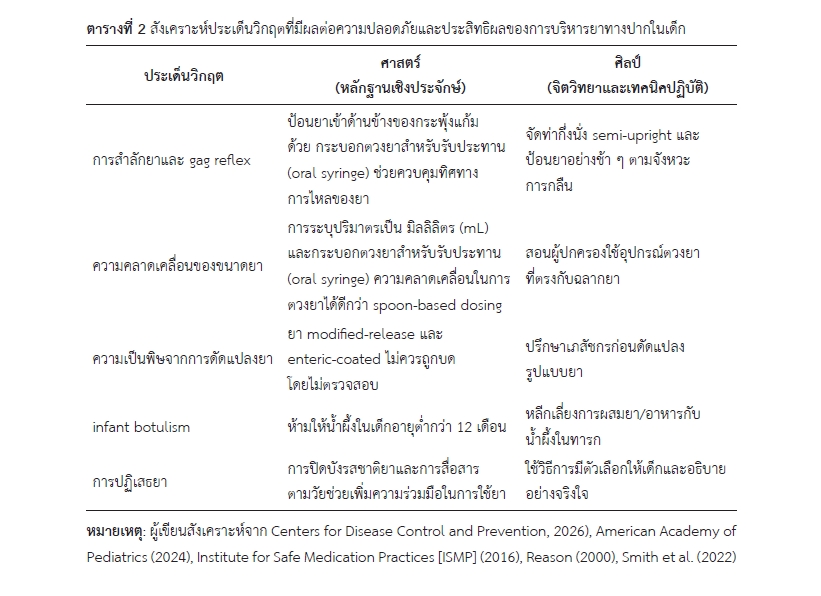
Pediatric oral medication administration requires attention to developmental physiology, swallowing ability, and cooperation, all of which may affect dose accuracy and safety. This narrative review synthesizes evidence and practical guidance for nurses on selecting dosage forms, verifying whether tablets may be split or crushed, measuring liquid medicines in milliliters (mL) with an appropriate oral syringe, positioning and administering medication, and communicating with children at different developmental stages. Experimental evidence on caregivers’ measurement of liquid medicine indicates greater dosing errors with cups and mismatched label and device units. Nurses should therefore verify medication orders and concentrations, select a device suited to the prescribed volume, and ask caregivers to demonstrate measurement and administration before discharge. Safe practice combines accurate medication checks with age-appropriate communication and family participation.
References
American Academy of Pediatrics. (2024, February 21). How to use liquid medicines for children. HealthyChildren.org. https://www.healthychildren.org/English/safety-prevention/at-home/medication-safety/Pages/Using-Liquid-Medicines.aspx
Berthe-Aucejo, A., Girard, D., Lorrot, M., Bellettre, X., Faye, A., Mercier, J. C., Brion, F., Bourdon, O., & Prot-Labarthe, S. (2016). Evaluation of frequency of paediatric oral liquid medication dosing errors by caregivers: Amoxicillin and josamycin. Archives of Disease in Childhood, 101(4), 359–364. https://doi.org/10.1136/archdischild-2015-309426
Bowden, V. R., & Greenberg, C. S. (2015). Pediatric nursing procedures (4th ed.). Lippincott Williams & Wilkins.
Centers for Disease Control and Prevention. (2026a, February 26). Botulism prevention. https://www.cdc.gov/botulism/prevention/
Centers for Disease Control and Prevention. (2026b, April 14). Foods and drinks to avoid or limit. https://www.cdc.gov/infant-toddler-nutrition/foods-and-drinks/foods-and-drinks-to-avoid-or-limit.html
Cram, A., Breitkreutz, J., Desset-Brèthes, S., Nunn, T., & Tuleu, C. (2009). Challenges of developing palatable oral paediatric formulations. International Journal of Pharmaceutics, 365(1–2), 1–3. https://doi.org/10.1016/j.ijpharm.2008.09.015
Hockenberry, M. J., & Wilson, D. (2018). Wong’s nursing care of infants and children (11th ed.). Elsevier.
Institute for Safe Medication Practices. (2016). Oral dosage forms that should not be crushed. https://www.ismp.org/sites/default/files/attachments/2018-02/DoNotCrush.pdf
Institute for Safe Medication Practices. (2020). 2020–2021 ISMP targeted medication safety best practices for hospitals. https://www.ismp.org/sites/default/files/attachments/2020-02/2020-2021%20TMSBP-%20FINAL_1.pdf
Lertthamthewi, W. (2020). Pediatric nursing techniques. Textbook Project, Faculty of Nursing, Mahidol University.
Nursing Division, Office of the Permanent Secretary, Ministry of Public Health. (2020). Guidelines for medication error management for nurses. Nonthaburi: Ministry of Public Health.
Reason, J. (2000). Human error: Models and management. BMJ, 320(7237), 768–770. https://doi.org/10.1136/bmj.320.7237.768
Rungamornrat, S. (2019). Pediatric nursing: The art and science of child care. Faculty of Nursing, Mahidol University.
Saengperm, P. (2018). Management of medication taste in children: Techniques nurses should know. Journal of Nursing Science, 36(1), 12–25.
Smith, L., Leggett, C., & Borg, C. (2022). Administration of medicines to children: A practical guide. Australian Prescriber, 45(6), 188–192. https://doi.org/10.18773/austprescr.2022.067
Subcommittee on Promotion of Rational Drug Use. (2018). Rational drug use manual according to the national list of essential medicines: Pediatric drugs (Rev. ed.). Agricultural Co-operative Federation of Thailand.
Thadakant, S., Hu, S. H., Duangbubpha, S., Changpad, T., & Pibanwong, M. (2022). Medication administration errors of nursing students during practice in clinics and in simulation. Nursing Research and Innovation Journal, 28(2), 282–298. https://he02.tci-thaijo.org/index.php/RNJ/article/view/255826
Thaiyapirom, N. (2018). Pediatric nursing: Theory and practice. Faculty of Nursing, Chiang Mai University.
Yin, H. S., Parker, R. M., Sanders, L. M., Dreyer, B. P., Mendelsohn, A. L., Bailey, S., Patel, D. A., Jimenez, J. J., Kim, K.-Y. A., Jacobson, K., Hedlund, L., Smith, M. C. J., Harris, L. M., McFadden, T., & Wolf, M. S. (2016). Liquid medication errors and dosing tools: A randomized controlled experiment. Pediatrics, 138(4), e20160357. https://doi.org/10.1542/peds.2016-0357
Yin, H. S., Neuspiel, D. R., Paul, I. M., Franklin, W., Tieder, J. S., Adirim, T., Alvarez, F., Brown, J. M., Bundy, D. G., Ferguson, L. E., Gleeson, S. P., Leu, M., Mueller, B. U., Phillips, S. C., Quinonez, R. A., Rea, C., Rinke, M. L., Shaikh, U., Shiffman, R. N., . . . Verhoef, P. A. (2021). Preventing home medication administration errors. Pediatrics, 148(6), e2021054666. https://doi.org/10.1542/peds.2021-054666
Downloads
Published
How to Cite
Issue
Section
License

This work is licensed under a Creative Commons Attribution-NonCommercial-NoDerivatives 4.0 International License.