Model for Preventing Recurrent Falls in Older Adults in Hospitals: An Integrative Review
Keywords:
Model, Recurrent falls, Older Adults, An integrative reviewAbstract
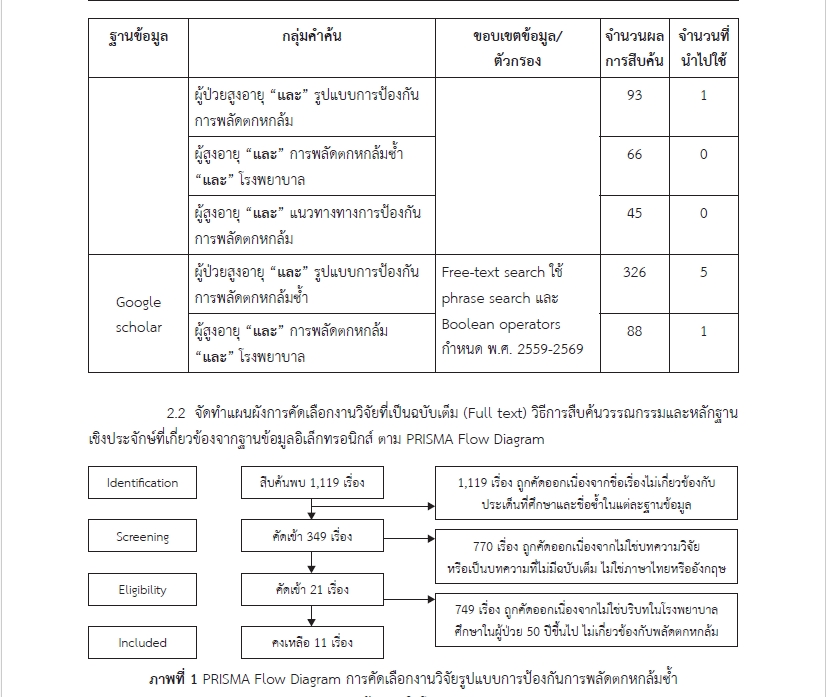
Effective prevention of recurrent falls among older adults in hospitals can reduce recurrent falls and improve their quality of life. This study aimed to analyze, synthesize, and integrate knowledge on models for preventing recurrent falls among older adults in hospitals. An integrative review was conducted using the PICO/PICo framework and included descriptive, exploratory, qualitative, and experimental studies. The review followed the five-step framework of Whittemore and Knafl (2005): problem identification, literature search and selection, quality appraisal, data analysis and synthesis, and presentation of findings. Studies published from 2016 to 2026 were searched in MEDLINE Complete, CINAHL Complete, ThaiJO, and Google Scholar. Of 1,119 identified studies, 11 were included and appraised using the Joanna Briggs Institute (JBI) critical appraisal tools (2022). The researchers verified the data and synthesized them using thematic analysis and narrative synthesis.
The research findings showed that the model for preventing recurrent falls among the elderly in hospital settings is multifactorial. This approach encompasses risk assessment, individualized care, risk factor management, education and engagement, environmental management, multidisciplinary team collaboration, and continuity of care. Implementation strategies are diverse and should be tailored to the elderly individuals' risk levels, functional capabilities, and specific contexts, ensuring a seamless continuum of care from the pre-discharge hospital phase through to the post-discharge period. Outcomes addressed include fall incidence and recurrence, fall risk, balance, physical performance, ability to perform activities of daily living, and fear of falling. Ultimately, the synthesized components should be applied in a context-specific manner rather than relying on a single, standardized model.
Research findings indicate that preventing recurrent falls among the elderly should be addressed through a holistic, multifactorial approach to care. Nurses play a pivotal role in assessment, care planning, coordination, and continuous monitoring from the hospital to the home setting. The synthesized elements should be developed and adapted into individualized care guidelines tailored to the specific service context and accompanied by post-discharge follow-up; furthermore, experimental research should be conducted to systematically evaluate the effectiveness of these guidelines.
References
Aromataris, E., Lockwood, C., Porritt, K., Pilla, B., & Jordan, Z. (Eds.). (2024). JBI manual for evidence synthesis. JBI. https://doi.org/10.46658/JBIMES-24-01
Alsaad, S. M., Alabdulwahed, M., Rabea, N. M., Tharkar, S., & Alodhayani, A. A. (2024). Knowledge, attitudes, and practices of nurses toward risk factors and prevention of falls in older adult patients in a large-sized tertiary care setting. Healthcare, 12(4), 472. https://doi.org/10.3390/healthcare12040472
Buarengthiantong, S., & Yindee, O. (2021). Risk of falls, fear of falling, and fall prevention management among older adults in a geriatric clinic, Klang Hospital. Vajira Nursing Journal, 23(2), 31–43. [In Thai].
Choi, N. G., Marti, C. N., Choi, B. Y., & Kunik, M. M. (2023). Recurrent falls over three years among older adults age 70+: Associations with physical and mental health status, exercise, and hospital stay. Journal of Applied Gerontology, 42(5), 1089–1100. https://doi.org/10.1177/07334648221150884
Department of Health. (2022). Guidelines for fall prevention in the elderly at the community and healthcare facility levels. Ministry of Public Health. Retrieved from https://sgh.go.th/uploads/CPG-book.pdf
Kowasandilok, T., Wannapruck, P., Charoenwai, P., & Kathungkang, P. (2023). Fear of falling in the elderly: Nursing care by using health belief model. Journal of Health Center 9: The Journal of Health Promotion and Environmental Health, 17(3), 1050–1061. [In Thai].
Kullavaniteewat, S., Sorachaimetha, P., Chiarat, S., Kittichaised, R., Radabutr, M., & Boonprasop, S. (2020). A development of personalized care model to prevent falling for patients with impaired mobility receiving rehabilitation in the hospital. Journal of The Royal Thai Army Nurses, 21(2), 422–432. [In Thai].
Meechin, N., Dongruangrach, R., & Daouruang, S. (2023). The development of a model to prevent falls in hospitalized elderly patients. Journal of Khon Kaen Provincial Health Office, 5(1), 138–150. [In Thai].
Meesri, N., Kangchai, W., Jullamate, P., & Chantakeeree, C. (2024). Effects of perceived health belief promotion program on fall prevention behaviors in older adult patients admitted to a hospital. Journal of Health and Nursing Education, 30(3), 72–86. [in Thai].
Mingsumdang, N. (2025). Development of nursing supervision model to prevent falls in elderly patients at Damnoen Saduak Hospital. Journal of Research for Health Improvement and Quality of Life, 5(1), 27–40. [In Thai].
Siri, S. (2020). Effectiveness of clinical practice guidelines implementation for repeated fall prevention among elderly people with hip fracture, Lamphun Hospital. Journal of the Phrae Hospital, 28(1), 135–151. ([In Thai].
Siripanich, B. (2020). Holistic health care for Thai elderly. Journal of Nursing Research, Innovation, and Health, 32(2), 1–14. [In Thai].
The Joanna Briggs Institute. (2022). Title of a qualitative review protocol. Retrieved from https://jbi-globalwiki.refined.site/space/MANUAL/4688211
Thongsumrit, D., Meebunmak, Y., Kaewthong, W., & Khuntorn, S. (2022). Effect of prevention program for the prevention of repeated falls in the elderly in Watphleng District, Ratchaburi Province. Journal of Research for Health Improvement and Quality of Life, 2(1), 62–73. [In Thai].
Ueda, T., Higuchi, Y., Hattori, G., Nomura, H., Yamanaka, G., Hosaka, A., Sakuma, M., Fukuda, T., Fukumoto, T., & Nemoto, T. (2022). Effectiveness of a tailored fall-prevention program for discharged older patients: A multicenter, preliminary, randomized controlled trial. International Journal of Environmental Research and Public Health, 19(3), 1585. https://doi.org/10.3390/ijerph19031585
Unkanawarapan, H. (2025). Effects of the education and behavior change program to increasing self- efficacy in preventing falls in the elderly, That Phanom Crown Prince Hospital. Journal of Environmental Education Medical and Health, 10(3), 557–562. [In Thai].
World Health Organization. (2021). Step safely: Strategies for preventing and managing falls across the life-course. World Health Organization. Retrieved from https://iris.who.int/handle/10665/340962
Downloads
Published
How to Cite
Issue
Section
License

This work is licensed under a Creative Commons Attribution-NonCommercial-NoDerivatives 4.0 International License.