การศึกษาความเป็นไปได้ของแอปพลิเคชันการจัดการอาการ สำหรับผู้ป่วยมะเร็งลำไส้ใหญ่และทวารหนักที่ได้รับเคมีบำบัด
คำสำคัญ:
แอปพลิเคชัน, การจัดอาการในระบบทางเดินอาหาร, มะเร็งลำไส้ใหญ่และทวารหนัก, เคมีบำบัดบทคัดย่อ
การวิจัยนี้มีวัตถุประสงค์เพื่อพัฒนาแอปพลิเคชันการจัดการอาการสำหรับผู้ป่วยมะเร็งลำไส้ใหญ่และทวารหนักที่ได้รับเคมีบำบัด และศึกษาความเป็นไปได้ในการนำไปใช้ มี 2 ระยะคือ 1) ระยะพัฒนาแอปพลิเคชันโดยมีทฤษฎีการจัดการอาการของดอดด์เป็นกรอบแนวคิด และ 2) ระยะทดสอบความเป็นไปได้ของการนำไปใช้ กลุ่มตัวอย่างเลือกแบบเฉพาะเจาะจงเป็นผู้ป่วยมะเร็งลำไส้ใหญ่และทวารหนักที่เข้ารับการรักษาในหอผู้ป่วย14 โรงพยาบาลจุฬาภรณ์ จำนวน 10 ราย เครื่องมือที่ใช้ในการวิจัยนี้ ประกอบด้วยแอปพลิเคชันบนสมาร์ทโฟนในการจัดการอาการในระบบทางเดินอาหารของผู้ป่วยมะเร็งลำไส้ที่ได้รับเคมีบำบัด และแบบประเมินความเป็นไปได้ของแอปพลิเคชัน ใช้ระยะเวลาคนละ 6 สัปดาห์ ติดตามประเมินผลลัพธ์ของการจัดการตนเองและประเมินความเป็นไปได้ของการใช้แอปพลิเคชัน วิเคราะห์ข้อมูลด้วยสถิติเชิงบรรยาย
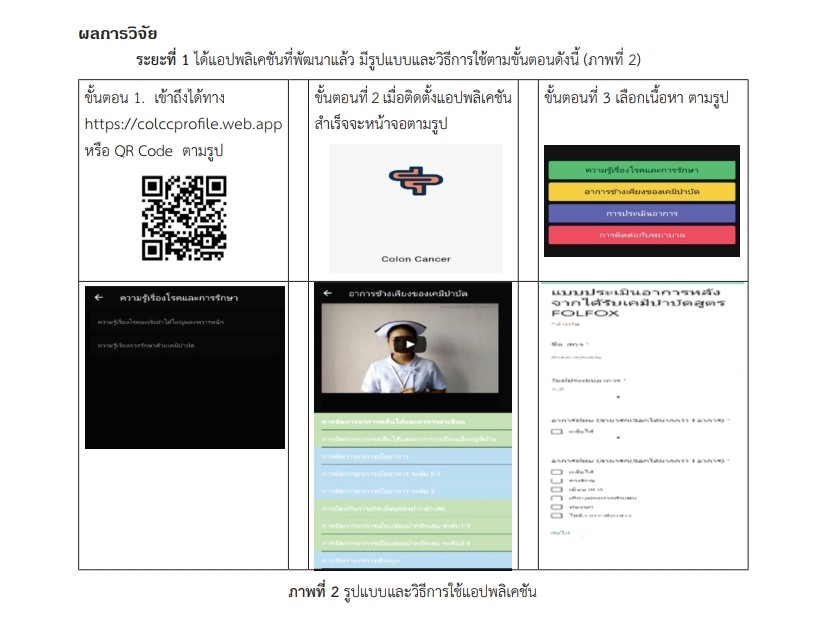
ผลการวิจัย พบว่า ผู้วิจัยดำเนินการพัฒนาแอปพลิเคชัน และได้แอปพลิเคชันที่พัฒนาแล้ว มีรูปแบบและวิธีการใช้ตามขั้นตอน หลังจากนั้นผู้วิจัยนำไปทดลองใช้กับกลุ่มตัวอย่าง และประเมินความเป็นไปได้ของการนำไปใช้ พบว่า อาการที่พบมาก ได้แก่ เบื่ออาหาร เยื่อบุช่องปากอักเสบ ท้องผูก คลื่นไส้ และอาเจียน ตามลำดับ ระดับความรุนแรงของอาการส่วนใหญ่ คือ ระดับ 1 หลังจากจัดการอาการพบว่าอาการส่วนใหญ่ดีขึ้น และค่าเฉลี่ยของการประเมินความเป็นไปได้ของการนำแอปพลิเคชันไปใช้ คือ 17.5 (SD = 0.85) จากผลการวิจัยมีข้อเสนอแนะว่าพยาบาลและผู้ที่เกี่ยวข้องสามารถนำแอปพลิเคชันการจัดการอาการไปประยุกต์ใช้กับผู้ป่วยมะเร็งลำไส้ใหญ่และทวารหนัก เพื่อบรรเทาความรุนแรงของอาการได้
เอกสารอ้างอิง
Andreyev, H., Lalji, A., Mohammed, K., Muls, A., Watkins, D., Rao, S., Starling, N., Chau, I., Cruse, S., Pitkaaho, V., Matthews, J., Caley, L., Pittordou, V., Adams, C., & Wedlake, L. (2021). The FOCCUS study: A prospective evaluation of the frequency, severity and treatable causes of gastrointestinal symptoms during and after chemotherapy. Supportive Care in Cancer: Official Journal of the Multinational Association of Supportive Care in Cancer, 29(3), 1443–1453. doi.org/10.1007/s00520-020-05610-x
Coolbrandt, A., Wildiers, H., Laenen, A., Aertgeerts, B., Dierckx de Casterlé, B., van Achterberg, T., & Milisen, K. (2018). A nursing intervention for reducing symptom burden during chemotherapy. Oncology Nursing Forum, 45(1), 115–128. doi.org/10.1188/18.ONF.115-128
Dodd, M., Janson, S., Facione, N., Faucett, J., Froelicher, E. S., Humphreys, J., Lee, K., Miaskowski, C., Puntillo, K., Rankin, S., & Taylor, D. (2001). Advancing the science of symptom management. Journal of Advanced Nursing, 33(5), 668–676. doi.org/10.1046/j.1365-2648.2001.01697.x
Fishbein, J. N., Nisotel, L. E., MacDonald, J. J., Amoyal Pensak, N., Jacobs, J. M., Flanagan, C., Jethwani, K., & Greer, J. A. (2017). Mobile application to promote adherence to oral chemotherapy and symptom management: A protocol for design and development. JMIR Research Protocols, 6(4), e62. doi.org/10.2196/resprot.6198
Karomprat, A., Chaichan, P., Santawesuk, U., & Sookprasert, A. (2017). Symptoms, symptom management and outcome in cancer patients undergoing chemotherapy. Srinagarind Medical Journal, 32(4), 326–331.
Moradian, S., Krzyzanowska, M., Maguire, R., Kukreti, V., Amir, E., Morita, P. P., Liu, G., & Howell, D. (2020). Feasibility randomized controlled trial of remote symptom chemotherapy toxicity monitoring using the Canadian adapted advanced symptom management system (ASyMS-Can): A study protocol. BMJ Open, 10(6), e035648. doi.org/10.1136/bmjopen-2019-035648
Namvongprom, A., Sinuanchaeng, B., & Pakdevon, P. (2018). Educative-supportive care needs, received and satisfaction among patients with early stage cancer. Journal of Nursing Science & Health, 41(1), 24-33.
National Cancer Institute. (2020). Hospital - based cancer registry 2020. Retrieved from https://www.nci.go.th/e_book/hosbased_2563/index.html
National Comprehensive Cancer Network. (2020). NCCN guidelines for patients colon cancer. Retrieved from https://www.nccn.org/patients/guidelines/content/PDF/colon-patient.pdf
Punthmatharith, B., Thailek, T., & Wiroonpanich, W. (2021). Effects of mobile application for enhancing oral care self-efficacy on preventive behavior and occurrence of oral mucositis in school-aged children with cancer receiving chemotherapy. Songklanagarind Journal of Nursing, 41(1), 37-53.
Rawla, P., Sunkara, T., & Barsouk, A. (2019). Epidemiology of colorectal cancer: Incidence, mortality, survival, and risk factors. Przeglad Gastroenterologiczny, 14(2), 89–103. doi.org/10.5114/pg.2018.81072
Salazar, A., de Sola, H., Failde, I., & Moral-Munoz, J. A. (2018). Measuring the quality of mobile apps for the management of pain: Systematic search and evaluation using the mobile app rating scale. JMIR mHealth and uHealth, 6(10), e10718. doi.org/10.2196/10718
Ward S, C., Leutwyler, H., Dunn, L. B., & Miaskowski, C. (2018). A review of the literature on symptom clusters in studies that included oncology patients receiving primary or adjuvant chemotherapy. Journal of Clinical Nursing, 27(3-4), 516–545. doi.org/10.1111/jocn.14057
Warrington, L., Absolom, K., Conner, M., Kellar, I., Clayton, B., Ayres, M., & Velikova, G. (2019). Electronic systems for patients to report and manage side effects of cancer treatment: Systematic review. Journal of Medical Internet Research, 21(1), e10875.
doi.org/10.2196/10875
World Health Organization [WHO]. (2020). Cancer statistics. Retrieved from https://www.who.int/news-room/fact-sheets/detail/cancer.
ดาวน์โหลด
เผยแพร่แล้ว
รูปแบบการอ้างอิง
ฉบับ
ประเภทบทความ
สัญญาอนุญาต

อนุญาตภายใต้เงื่อนไข Creative Commons Attribution-NonCommercial-NoDerivatives 4.0 International License.