Caring for Pregnant Women with Iron Deficiency Anemia: The Challenging Role of Nurses
Keywords:
Anemia, pregnant women, nursing rolesAbstract
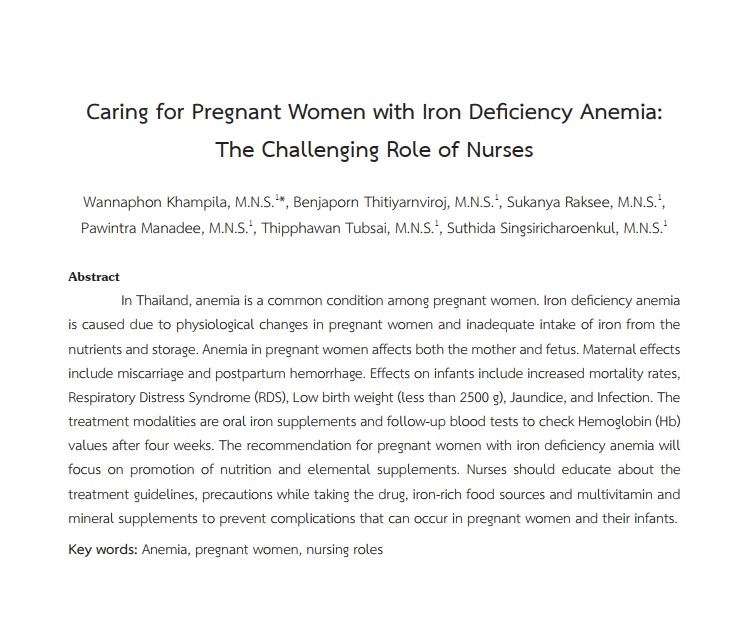
In Thailand, anemia is a common condition among pregnant women. Iron deficiency anemia is caused due to physiological changes in pregnant women and inadequate intake of iron from the nutrients and storage. Anemia in pregnant women affects both the mother and fetus. Maternal effects include miscarriage and postpartum hemorrhage. Effects on infants include increased mortality rates, Respiratory Distress Syndrome (RDS), Low birth weight (less than 2500 g), Jaundice, and Infection. The treatment modalities are oral iron supplements and follow-up blood tests to check Hemoglobin (Hb) values after four weeks. The recommendation for pregnant women with iron deficiency anemia will focus on promotion of nutrition and elemental supplements. Nurses should educate about the treatment guidelines, precautions while taking the drug, iron-rich food sources and multivitamin and mineral supplements to prevent complications that can occur in pregnant women and their infants.
References
Abujilban, S., Hatamleh, R., & Al-Shuqerat, S. (2019). The impact of a planned health educational program on the compliance and knowledge of Jordanian pregnant women with anemia. Women & health, 59(7), 748-759.
American College of Obstetricians and Gynecologists [ACOG]. (2021). Anemia in pregnancy: ACOG practice bulletin, number 233. Obstetrics and Gynecology, 138(2), e55-e64.
Blackburn, S. (2017). Maternal, fetal, & neonatal physiology-e-book: A clinical perspective. St. Louis: Elsevier Health Sciences.
Brannon, P. M., & Taylor, C. L. (2017). Iron supplementation during pregnancy and infancy: Uncertainties and implications for research and policy. Nutrients, 9(12), 1327.
Chantanamongkol, K. (2016). Nursing care for women with congenital diseases. Pathum Thani: Rangsit University. (In Thai)
Charoenwit, T., Uerpairojkit, B., & Manotaya, S. (2008). Obstetrics (4th ed.). Bangkok: Chulalongkorn University. (In Thai)
Cunningham, F. G., Leveno, K. J., Gilstrap, L. C., & Westrom, K. D. (2018). Williams’s obstetrics (25th ed.). New York: McGraw-Hill.
Department Of Health. (2018). A guide to Thai girls with red cheeks. Retrieved from https://dol.thaihealth.or.th/Media/Pdfview/1490d5b1-3322-ea11-80e8-00155d09b41f
Finkelstein, J. L., Kurpad, A. V., Bose, B., Thomas, T., Srinivasan, K., & Duggan, C. (2020). Anaemia and iron deficiency in pregnancy and adverse perinatal outcomes in Southern India. European Journal of Clinical Nutrition, 74(1), 112-125.
Juul, S. E., Derman, R. J., & Auerbach, M. (2019). Perinatal iron deficiency: Implications for mothers and infants. Neonatology, 115(3), 269-274.
Milman, N. (2012). Oral iron prophylaxis in pregnancy: Not too little and not too much!. Journal of Pregnancy, 2012, 1-8.
Namazi, A., & Alizadeh, S. (2016). Health knowledge of pregnant women on anemia and its complication in pregnancy. Journal of Holistic Nursing and Midwifery, 26(2), 98-106.
Pavord, S., Daru, J., Prasannan, N., Robinson, S., Stanworth, S., Girling, J., & BSH Committee. (2020). UK guidelines on the management of iron deficiency in pregnancy. British Journal of Haematology, 188(6), 819-830.
Seaharattanapatum, B., Sinsuksai, N., Phumonsakul, S., & Chansatitporn, N. (2021). Effectiveness of balanced diet-iron supplement program among pregnant women with anemia: A quasi-experimental study. Pacific Rim International Journal of Nursing Research, 25(4), 653-665.
Thanyavinichkul, S., & Phonwattana, T. (2018). Development of preventive and corrective care model for anemic pregnant women at public hospital in Chiang Mai.Lanna Journal of Health Promotion & Environmental Health, 8(1), 9–23. (In Thai)
Tongsong, T., & Wanapirak, C. (2021). Obstetrics (6th ed.). Chiang Mai: Department of Obstetrics and Gynaecology, Faculty of Medicine, Chiang Mai University.
World Health Organization [WHO]. (2021). Worldwide prevalence of anemia 2016 - 2019, WHO Global database on anemia. Retrieved from https://www.who.int/data/gho/data/themes/topics/anaemia_in_women_and_children
Young, M. F., Oaks, B., Tandon, S., Martorell, R., Dewey, K., & Wendt, A. (2019). Maternal hemoglobin concentrations across pregnancy and maternal and child health: A systematic review and meta-analysis (P11-033-19). Annals of the New York Academy of Sciences, 1450(1), 47-68.
Zhang, Q., Lu, X. M., Zhang, M., Yang, C. Y., Lv, S. Y., Li, S. F., Zhong, C. Y., & Geng, S. S. (2021). Adverse effects of iron deficiency anemia on pregnancy outcome and offspring development and intervention of three iron supplements. Scientific Reports, 11(1), 1-11.
Downloads
Published
How to Cite
Issue
Section
License

This work is licensed under a Creative Commons Attribution-NonCommercial-NoDerivatives 4.0 International License.