ปัจจัยทำนายการเกิดภาวะ long covid ในกลุ่มผู้ป่วยหลังติดเชื้อโควิด-19
คำสำคัญ:
การเกิดภาวะ long covid, ผู้ป่วยหลังติดเชื้อโควิด-19บทคัดย่อ
การวิจัยครั้งนี้มีวัตถุประสงค์เพื่อศึกษาปัจจัยทำนายการเกิดภาวะ long covid ในกลุ่มผู้ป่วยหลังติดเชื้อโควิด-19 กลุ่มตัวอย่างคือ ผู้ป่วยหลังติดเชื้อโควิด-19 ซึ่งมารับบริการที่หน่วยบริการสุขภาพพื้นที่จังหวัดสุรินทร์ จำนวน 129 คน ซึ่งได้มาด้วยการสุ่มอย่างง่าย เครื่องมือเก็บรวมรวมข้อมูล ได้แก่ แบบสอบถามข้อมูลทั่วไป และแบบสอบถามภาวะ long covid เก็บรวบรวมข้อมูลระหว่างเดือน มีนาคม ถึงเดือน ธันวาคม พ.ศ 2566 วิเคราะห์ข้อมูลด้วยสถิติเชิงพรรณา และสถิติสมการถดถอยพหุคูณแบบขั้นตอน
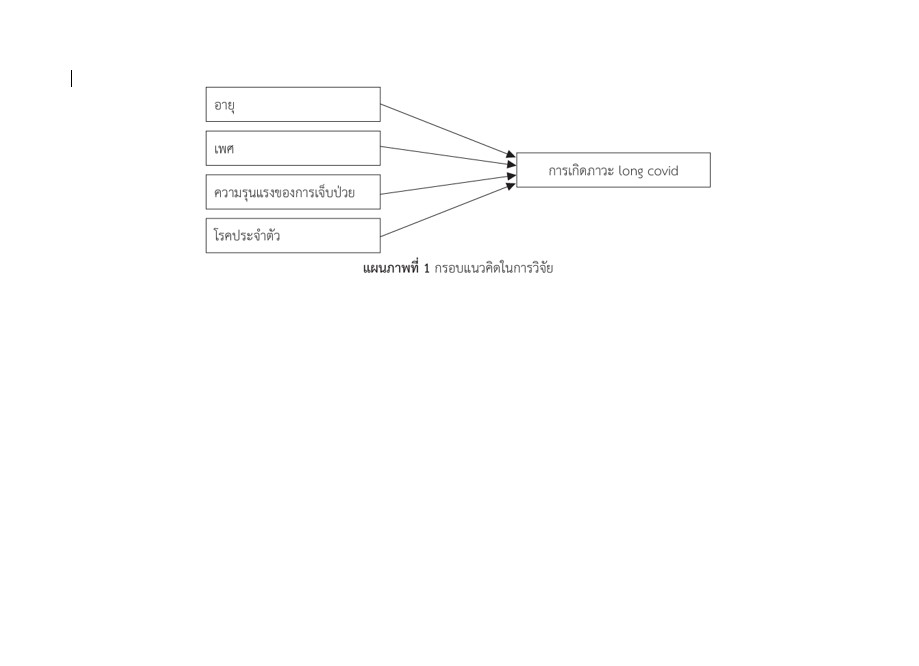
ผลการวิจัยพบว่า อาการ long covid ที่พบมากที่สุด คือ เหนื่อยอ่อนเพลีย จำนวน 70 ราย (ร้อยละ 54.3) รองลงมา คือ อ่อนเพลีย จำนวน 66 ราย (ร้อยละ 51.2) และเหนื่อยง่าย จำนวน 65 ราย (ร้อยละ 50.4) ปัจจัยที่สามารถร่วมทำนายการเกิดภาวะ long covid ได้แก่ โรคประจำตัว (b = .204) และความรุนแรงของการเจ็บป่วย (b = .477) โดยสามารถร่วมทำนายการเกิดภาวะ long covid ได้ร้อยละ 26.3 (R2 = 0.263, p < .001)
จากผลการวิจัยมีข้อเสนอแนะว่า บุคลากรสาธารณสุขที่เกี่ยวข้องควรมีการติดตามดูแลผู้ป่วยโควิด-19 ที่มีโรคประจำตัวและมีความรุนแรงของโรคโควิด-19
เอกสารอ้างอิง
Blomberg, B., Mohn, K. G. I., Brokstad, K. A., Zhou, F., Linchausen, D. W., Hansen, B. A., & Langeland, N. (2021). Long COVID in a prospective cohort of home-isolated patients. Nature Medicine, 27(9), 1607-1613. https://doi.org/10.1038/s41591-021-01433-3
Chanarong, M. (2022). Factors associated with post-discharge delirium in patients. Infected with the coronavirus 2019. Journal of Health and Nursing Education, 28(1), 1-16.
Department of Mental Health. (2565). Long COVID symptoms after recovering from COVID. Retrieved from https://dmh.go.th/news/view.asp?id=2461
Department of Disease Control. (2022). Daily COVID-19 report: Information specific to Thailand. Retrieved from https://data.go.th/dataset/covid-19-daily.
Khamphan, P. (2022). Long COVID and long-term respiratory complications from COVID-19. Journal of Charoenkrung Pracharak Hospital, 18(2), 79-96.
National Institute for Health Research (NIHR). Over a third of covid patients diagnosed with at least one long-covid symptom. Retrieved from https://www.ox.ac.uk/news/2021-09-29-over-third-covid-19-patients-diagnosed-least-one-long-covid-symptom?fbclid=IwAR36_h3vNXg8cdNLHQiMHRWb42Z5D29BNwkMoKH4-hiWvJVwM3utfPziaGA
Srisophit, P. (2022). “Why do I still have anxiety and depression after recovering from COVID?” The impact of long COVID. (Long Covid) Affects the mind. Retrieved from https://www.praram9.com/long-covid-depression/.
Thaksinwaracharn, R. (2022). LONG COVID after infection: What has COVID left behind in our bodies!. Retrieved from: https://www.praram9.com/long-covid/
Teekham, S., & Srisukham, T. (2023). Symptoms remaining after COVID-19 infection and the factors involved. The relationship between self-care behaviors of patients who have previously been infected with COVID-19 in Kring subdistrict, Chiang Khong district, Chiang Rai province. Journal of Disease Prevention and Control, Volume 2, Phitsanulok, 10(2), 49-66.
Surin Provincial Public Health Office. (2022). COVID-19 Information center, Surin province. Retrieved from https://www.facebook.com/SurinCovidCenter/.
Whitaker, M., Elliott, J., Chadeau-Hyam, M., Riley, S., Darzi, A., Cooke, G., & Elliott, P. (2021). Persistent symptoms following SARS-CoV-2 infection in a random community sample of 508,707 people. MedRxiv, 1-40. https://doi.org/10.1101/2021.06.28.21259452
ดาวน์โหลด
เผยแพร่แล้ว
รูปแบบการอ้างอิง
ฉบับ
ประเภทบทความ
สัญญาอนุญาต

อนุญาตภายใต้เงื่อนไข Creative Commons Attribution-NonCommercial-NoDerivatives 4.0 International License.